
The Dashboard Says Everything Is Fine
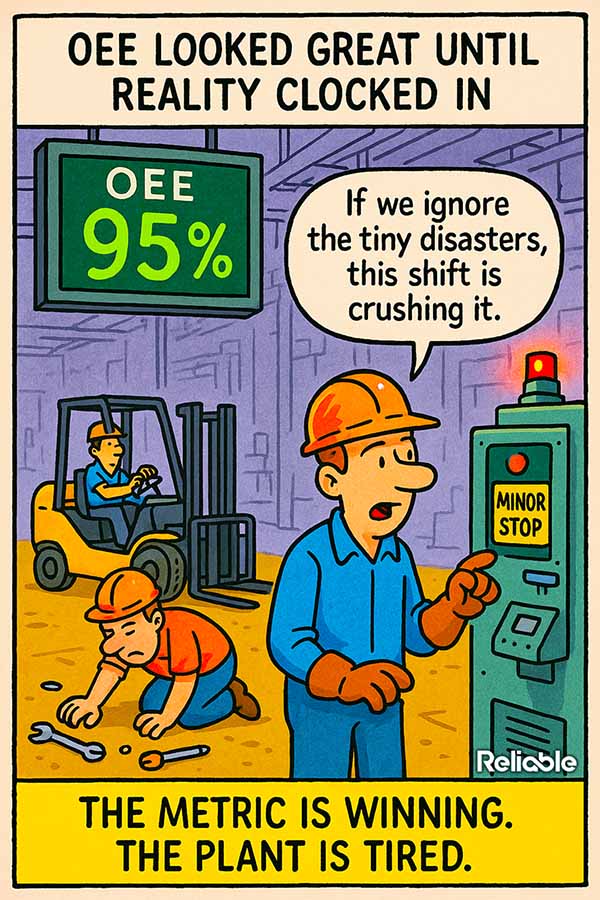
Somewhere right now, a plant manager is staring at a 95% OEE score and feeling pretty good about life. The dashboard is green. The numbers are trending up.
And somewhere on that same plant floor, a bearing is screaming, an operator is nursing a machine through every cycle with a workaround that’s become muscle memory, and the maintenance backlog has quietly doubled since January.
OEE (Overall Equipment Effectiveness) is one of the most widely used metrics in manufacturing. It combines availability, performance, and quality into a single percentage that’s supposed to tell you how well your equipment is running.
In theory, it’s elegant. In practice, it can be one of the most misleading numbers in your entire operation.
A 95% OEE score and a plant falling apart aren’t mutually exclusive. They happen together more often than anyone wants to admit.
The trouble starts when people begin optimizing for the number instead of the outcome the number is supposed to represent. Once the metric becomes the goal, the goal stops being improvement.
How OEE Gets Gamed (Usually Without Anyone Realizing It)
Nobody sits in a conference room and decides to cook the OEE books. It happens gradually, through a series of small, rational decisions that individually make sense but collectively paint a fiction.
Consider how availability gets calculated. Planned downtime is excluded from the equation.
So if a maintenance team reclassifies an unplanned shutdown as “scheduled maintenance” after the fact (because they knew it was coming, sort of), the availability number stays high. The machine was still down. Production still lost hours.
Performance rate is another soft spot. Minor stoppages, micro-stops of a few seconds each, often fly under the data collection threshold.
An operator who clears a jam in eight seconds and gets the line running again has technically experienced a performance loss. But if the system only logs stops over 30 seconds, that jam never happened (statistically speaking).
Then there’s quality. Most OEE calculations measure first-pass yield.
If a defective part gets reworked and eventually ships, it might show up as a quality win. The OEE number stays clean.
The two hours of rework labor to get that part across the finish line? That’s somebody else’s spreadsheet entirely.
- Reclassifying unplanned downtime as planned maintenance to protect availability numbers
- Setting stop-time thresholds too high, which filters out dozens of micro-stops per shift
- Counting reworked parts as quality passes because they eventually meet spec
- Excluding startup and changeover losses by categorizing them outside the OEE window
- Running equipment at reduced speed to avoid triggering fault alarms, which tanks true throughput while the performance metric holds steady
Each of these practices is common. Each one, on its own, seems reasonable. Stack them together and you’ve got an OEE score that’s technically accurate and practically useless.
What the Equipment Actually Knows
Here’s the thing about machines: they don’t care about your KPIs. A motor running hot is running hot whether or not the dashboard says you’re at world-class OEE.
The gap between what OEE reports and what the equipment is actually experiencing tends to show up in predictable places. If you know where to look, the tells are hard to miss.
Machines don’t care about your KPIs. A motor running hot is running hot whether the dashboard says you’re at world-class OEE or not.
Maintenance backlogs are the first tell. When OEE looks great but the backlog keeps growing, something is off.
Either work orders aren’t being created for known issues (because logging them would hurt the numbers), or the team is so focused on keeping uptime high that preventive work keeps getting deferred. Both scenarios end the same way: with a catastrophic failure that nobody saw coming.
Energy consumption is another signal worth watching. Equipment that’s degrading mechanically tends to draw more power.
If your energy costs per unit of production are climbing while OEE stays flat, the machines are working harder to deliver the same output. That’s a leading indicator of trouble that OEE simply doesn’t capture.
Operator workarounds might be the biggest blind spot of all. Experienced operators develop an almost instinctive ability to compensate for equipment problems.
They’ll adjust feed rates, manually clear partial jams before they become full stoppages, or time their interventions to minimize logged downtime. The production keeps flowing. The OEE stays high.
And the underlying condition gets worse with every shift.
One maintenance manager at a food processing plant put it well: the operators had gotten so good at babysitting a failing packaging line that production never missed a beat.
The day the senior operator retired, the line went down three times in a single week. Same equipment, same OEE target. The only thing that changed was the person compensating for the problems nobody had fixed.
Building a Better Picture
OEE still has value. It’s a useful starting point when it’s calculated honestly. The key is to surround it with other data sources that tell you what’s really happening inside the equipment.
Condition monitoring data should sit right next to OEE in every production review. Vibration trends, thermal imaging results, oil analysis reports: these tell you what the equipment is actually doing.
When condition monitoring says a bearing has three months of life left but OEE says everything is fine, guess which one you should listen to.
- Pair OEE with condition monitoring data (vibration, thermography, oil analysis) to cross-reference machine health against production output
- Track maintenance backlog age and volume alongside OEE to spot deferred work hiding behind good numbers
- Monitor energy consumption per unit of production as an independent check on equipment efficiency
- Capture operator workaround frequency as a leading indicator of unaddressed equipment degradation
Some plants have started using a “reliability adjusted OEE” that factors in the health of critical assets. If a machine is producing at 95% OEE but condition monitoring shows it’s operating in a degraded state, the adjusted score reflects that risk.
Maintenance cost per unit is another metric that deserves a seat at the table. A line with 95% OEE and escalating maintenance costs is telling you it’s being held together with overtime and spare parts.
That trajectory has an endpoint, and OEE alone won’t warn you before you reach it.
Making the Data Honest
The cultural piece matters as much as the technical one. If operators and supervisors feel pressure to protect OEE numbers, they’ll find creative ways to do it.
That’s human nature responding to incentive structures, and you can’t fix it with better software.
If your team feels pressure to protect the OEE number, they’ll find creative ways to do it. You can’t fix that with better software. You fix it by changing what gets rewarded.
The fix starts with how you talk about the numbers. When a team reports an OEE drop because they logged downtime more accurately, that should be celebrated.
When an operator flags a micro-stop pattern that wasn’t being captured, that’s valuable intelligence worth recognizing publicly.
Standardizing your data collection rules helps too. Define exactly what counts as planned versus unplanned downtime.
Set your stop-time thresholds based on what’s technically significant, not what makes the report look good. Audit the classifications periodically to make sure the definitions haven’t drifted.
- Standardize downtime classification rules and audit them quarterly
- Set micro-stop thresholds based on engineering significance, not reporting convenience
- Reward accurate reporting over favorable reporting in team performance reviews
The most reliable plants tend to be the ones where OEE is treated as a diagnostic tool rather than a scorecard. They use it to find problems, to ask questions, to dig deeper.
The Number Behind the Number
A 95% OEE score can mean your plant is running beautifully. It can also mean your team has gotten very good at making the math work while the equipment slowly deteriorates.
What can tell you the difference is context. Condition monitoring data, maintenance trends, energy patterns, operator feedback: these are the things that give OEE meaning.
Without them, you’re flying on a single instrument in heavy fog.
The plants that get this right don’t ignore OEE. They triangulate it.
They ask what’s behind the number, and they build systems that make honest answers easier to find than comfortable ones. That’s the difference between a metric that drives improvement and one that just drives complacency.
So the next time someone presents a 95% OEE score with a satisfied grin, ask what the condition monitoring data says. Ask what the maintenance backlog looks like. Ask the operators how many workarounds they ran last week.
The number on the dashboard might be accurate. The story it tells might not be.