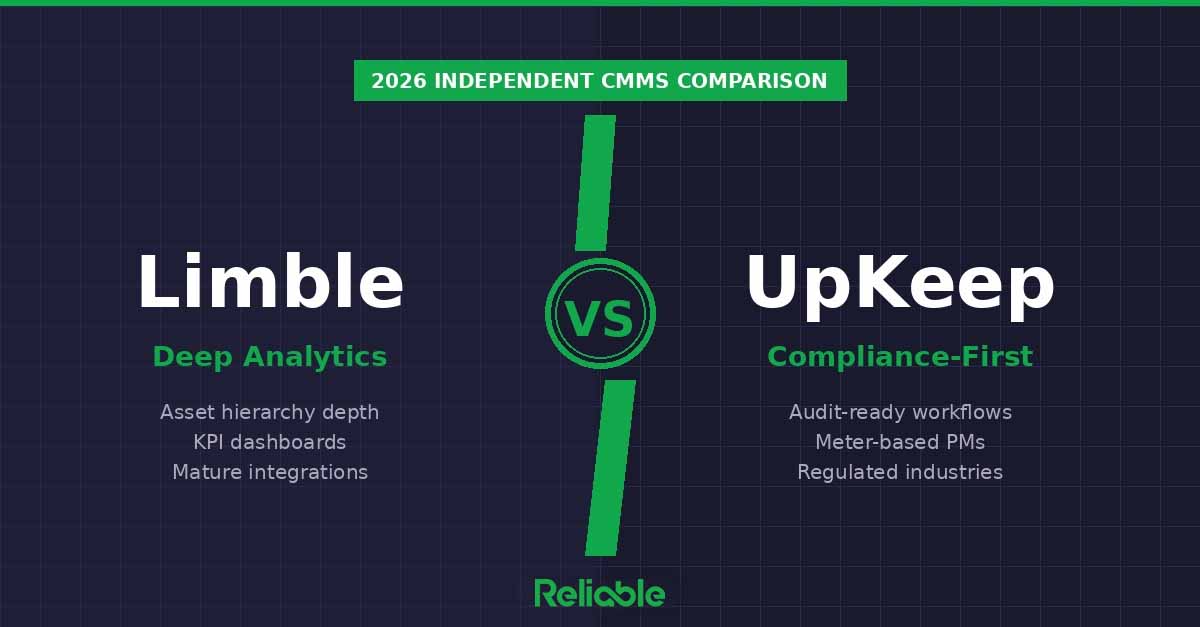

TL;DR: Limble and UpKeep are both strong CMMS platforms for mid-market industrial operations, and they serve different buyers. Limble wins for reliability-engineering-driven teams that need deep asset hierarchies, rich analytics, and mature integrations with ERP and IoT systems. UpKeep wins for manufacturing and regulated industries that need audit-ready compliance, meter-based PMs, and documentation discipline. UpKeep publishes transparent pricing starting at $20 per user per month. Limble uses custom quoting. Choose Limble if reliability analytics drive your decisions. Choose UpKeep if compliance does.
How We Compared Limble and UpKeep
This comparison is independent editorial analysis based on publicly available product documentation, verified customer reviews across G2 and Capterra, and hands-on product demos. Reliable Magazine does not accept payment from either vendor for ranking consideration, and neither Limble nor UpKeep sponsored this article. Our goal is to help maintenance and reliability professionals choose the right platform – not to push the one that pays us the most.
We evaluated both platforms across six criteria that matter most for industrial maintenance teams:
- Asset management depth – how detailed the asset hierarchy and history tracking can get
- Compliance and audit-readiness – checklists, safety procedures, and documentation for regulated environments
- Reporting and analytics – the quality and flexibility of dashboards and KPI tracking
- Integrations – native connectivity to ERP, IoT sensors, and accounting systems
- Pricing and transparency – published rates, free tiers, and total cost of ownership
- Implementation and time-to-value – onboarding speed, configuration depth, and ongoing support
Reliable does not accept payment for rankings. Vendors may sponsor enhanced listings with additional detail, but editorial rankings are independent. Read our editorial policy.
Limble at a Glance
Limble has been building CMMS software since 2015 with a desktop-first philosophy and deep functionality as its differentiator. The asset hierarchy is among the most detailed in the industry – you can map equipment down to individual components and maintain full maintenance histories across decades. Custom dashboards give reliability engineers and maintenance managers genuine visibility into MTBF, MTTR, PM compliance, and other reliability KPIs.
Limble’s integration library is mature, covering major ERP systems, IoT sensor networks, and accounting platforms. The mobile app is strong and has been improving, but the platform shows its desktop roots in the richness of its configuration options. That same depth that delights reliability engineers can overwhelm teams looking for fast adoption.
Pricing: Free (Basic), premium tiers use custom quoting – Limble calculates pricing based on team size, site count, and feature requirements. Request a quote at limble.com.
Best for: Reliability-engineering-driven teams, multi-site operations, mid-market and enterprise plants with complex asset portfolios, teams that prioritize analytics and reporting.
UpKeep at a Glance
UpKeep was founded in 2014 and has built its reputation in manufacturing and regulated industries where audit readiness, safety compliance, and documentation discipline matter. The work order system is built around detailed checklists, safety procedures, and document attachments. Meter-based PM triggers are native, which is essential for production equipment tracked by run-hours rather than calendar dates. Reporting is strong for compliance-driven KPIs like PM compliance rates, certification tracking, and audit-trail documentation.
UpKeep’s mobile app is functional and solid. The desktop interface is the platform’s strongest surface, which fits a buyer profile where planners, compliance managers, and reliability engineers drive the system alongside technicians.
Pricing: $20/user/month (Essential), $55/user/month (Premium), scales to Professional and Enterprise tiers.
Best for: Manufacturing plants with audit requirements, regulated industries (pharma, food and beverage, medical device), teams that need meter-based PMs on production equipment, compliance-driven maintenance operations.
Head-to-Head: Limble vs UpKeep
Asset Management Depth
Winner: Limble. Limble’s asset hierarchy and component-level tracking is among the deepest available in the CMMS category. Teams running complex equipment with nested sub-assemblies, rotating spares, and multi-decade maintenance histories will find Limble more accommodating. UpKeep handles asset management well for production equipment, especially with meter-based PM triggers, but Limble is the stronger choice when asset data is central to your reliability strategy.
Compliance and Audit Readiness
Winner: UpKeep. UpKeep’s feature set is oriented toward compliance from the ground up. Detailed safety checklists, document attachments on work orders, certification tracking, and audit-ready reporting are native rather than add-ons. For plants subject to FDA, FSMA, OSHA, or ISO audits, UpKeep’s documentation discipline is a genuine advantage. Limble supports compliance workflows but requires more configuration to reach the same level of out-of-the-box audit readiness.
Reporting and Analytics
Winner: Limble. Custom dashboards, drill-down reports, and KPI tracking for MTBF, MTTR, and PM compliance are stronger out of the box. UpKeep has strong reporting for compliance-driven KPIs and audit documentation, but Limble wins for reliability engineers who need deep operational analytics. The gap is meaningful for teams that live in reports and dashboards.
Integrations
Winner: Limble. Limble’s integration track record with ERP systems, IoT sensors, and accounting platforms is longer and more mature. UpKeep has a solid and growing integration library, but Limble wins for teams with complex multi-system environments. If connectivity to SAP, Oracle, Dynamics, or a diverse sensor stack is a top three selection criterion, Limble has the edge.
Pricing and Transparency
Winner: UpKeep. Published pricing at $20 per user per month (Essential) and $55 per user per month (Premium) lets buyers evaluate fit without a sales call. Limble’s custom quoting means you cannot compare total cost without contacting sales, which adds friction and slows evaluation. For teams that want to make fast, informed decisions, UpKeep wins on transparency alone.
Implementation and Time-to-Value
Draw. Both platforms take longer to implement than the fastest CMMS options. UpKeep deployments typically run four to eight weeks. Limble deployments run four to twelve weeks depending on asset hierarchy depth and integration complexity. Neither is a two-week rollout, and both reward the time investment with deeper functionality. Teams needing faster adoption should evaluate MaintainX instead.
Feature Comparison Table
| Capability | Limble | UpKeep |
|---|---|---|
| Starting price | Free (Basic) / custom quote | $20/user/mo (Essential) |
| Premium pricing | Custom – contact sales | $55/user/month |
| Asset hierarchy | Deepest in the market | Solid, production-focused |
| Compliance and audit features | Good, requires configuration | Strong, native, audit-ready |
| Reporting and analytics | Deep, customizable, KPI-rich | Strong for compliance KPIs |
| ERP and IoT integrations | Mature, broad | Solid, growing |
| Meter-based PMs | Supported | Native, mature |
| Time-to-value | 4–12 weeks typical | 4–8 weeks typical |
| Best for | Reliability engineering, analytics | Regulated manufacturing, compliance |
Which One Should You Choose?
Choose Limble if:
- You have a reliability engineering function that needs deep analytics and KPI tracking
- Your asset portfolio is complex – multi-site, multi-decade, component-level tracking
- You need to integrate tightly with SAP, Oracle, Dynamics, or an existing IoT sensor network
- Custom reporting and dashboards are central to how your team makes decisions
- You can invest the time in a thorough implementation to unlock the platform’s depth
- Your operation is mid-market or enterprise with budget for custom-quoted software
Choose UpKeep if:
- You operate in a regulated industry – pharma, food and beverage, medical device, aerospace
- Audit readiness and documentation discipline are core to your maintenance function
- You need meter-based PM triggers on production equipment tracked by run-hours
- Compliance reporting is a top three selection criterion
- Transparent published pricing matters to your procurement process
- Your planners and compliance managers drive the system, not just technicians
The Honest Middle Ground
Here is what most vendor-published comparison guides will not tell you: both Limble and UpKeep are genuinely good CMMS platforms, and they solve different problems rather than competing head-on. If you are a food processing plant facing an FDA audit next quarter, UpKeep’s compliance depth will serve you better. If you are a reliability-engineering-driven operation with complex assets and an analytics-heavy culture, Limble will probably serve you longer.
The worst mistake teams make in CMMS selection is choosing based on a polished demo rather than on how the software feels to the people who will use it every day. Have your compliance manager pull an audit report in UpKeep. Have your reliability engineer build a custom dashboard in Limble. Let the software make the case with your team, not with a sales rep.
Frequently Asked Questions
Is Limble or UpKeep better for asset management?
Limble has deeper asset management capabilities. Its asset hierarchy is among the most detailed in the CMMS market, allowing teams to map equipment down to individual components with full maintenance histories spanning years or decades. UpKeep has solid asset management focused on production equipment with meter-based triggers and compliance documentation, but Limble’s depth wins for reliability-engineering-driven teams that treat asset data as a strategic resource.
Which CMMS is better for manufacturing compliance, Limble or UpKeep?
UpKeep is generally stronger for manufacturing compliance. Its work order system is built around detailed safety checklists, document attachments, and audit-trail documentation that aligns naturally with FDA, FSMA, OSHA, and ISO audit requirements. Limble supports compliance workflows well but requires more configuration to hit the same level of out-of-the-box audit readiness. For regulated industries, UpKeep is the faster path to audit-ready documentation.
Which is more affordable, Limble or UpKeep?
UpKeep is more transparent on pricing, with published rates at $20 per user per month (Essential) and $55 per user per month (Premium). Limble uses custom pricing based on team size, site count, and feature requirements, which means you cannot compare total cost without requesting a quote. In practice, Limble often comes in competitive with UpKeep Premium for mid-sized teams but can price higher at enterprise scale depending on configuration.
Does Limble or UpKeep have better reporting and analytics?
Limble has deeper reporting and analytics capabilities. Custom dashboards, drill-down reports, and native tracking of reliability KPIs like MTBF, MTTR, and PM compliance are stronger out of the box. UpKeep has strong reporting for compliance-driven KPIs and audit-ready documentation, but Limble wins for reliability engineers and maintenance managers who need deep operational analytics to drive decisions.
Which CMMS is easier to implement, Limble or UpKeep?
Both platforms take longer to implement than the fastest CMMS options. UpKeep deployments typically run four to eight weeks, driven by compliance configuration and documentation setup. Limble deployments run four to twelve weeks depending on asset hierarchy depth and integration complexity. Neither is a two-week rollout. Teams wanting fast adoption should evaluate MaintainX instead, which typically deploys in two to four weeks but has less depth in compliance and asset management.
Can I migrate from Limble to UpKeep or vice versa?
Yes, but migration always involves friction. Both platforms offer data import tools and implementation support, but custom fields, work order history, asset hierarchies, and PM schedules rarely transfer cleanly. Expect two to four months of parallel operation during transition. The better move is to invest time upfront in a proper evaluation and demo with your actual use cases before committing to either.
Related Guides
- Best CMMS Software 2026: Independent Comparison of 7 Platforms
- MaintainX vs Limble: Which CMMS Wins in 2026?
- UpKeep vs MaintainX: Which CMMS Wins in 2026?
Sources
- Limble CMMS product documentation – limble.com
- UpKeep product documentation and published pricing — upkeep.com
- G2 and Capterra verified customer reviews (April 2026)
- Reliable Magazine independent product demos and hands-on evaluation
Last updated: April 21, 2026. This comparison is editorial analysis by Reliable Magazine. Neither Limble nor UpKeep paid for ranking consideration or editorial input.