
The Expensive Illusion of “We Know Our Equipment”
Most plants have at least one person who can tell you what a machine sounds like when it’s happy. They’ll cock their head near a gearbox, listen for a second, and say something like, “That bearing’s got about three months left.” Sometimes they’re right. Sometimes they’re spectacularly wrong.
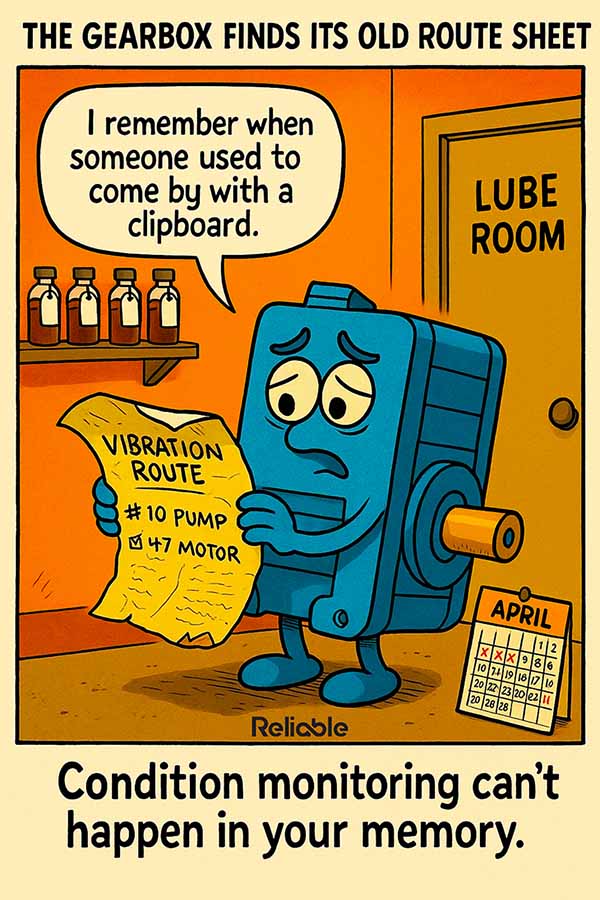
The problem with relying on human intuition for condition monitoring isn’t that the intuition is bad. It’s that it doesn’t scale, it doesn’t transfer, and it walks out the door every time someone retires, changes shifts, or takes a new job. A condition monitoring program built on tribal knowledge is a program built on sand.
Structured routes solve this. They turn individual expertise into institutional capability. And the difference between a plant that uses them and a plant that doesn’t shows up in every reliability metric that matters.
What a Condition Monitoring Route Actually Is
A condition monitoring route is a documented, repeatable path through a facility that specifies exactly which assets to measure, what to measure on each one, where to take the measurement, and how often. It’s the difference between “go check the pumps” and “collect vibration data at points 1 through 4 on pumps P-101 through P-108 every 28 days, using the following sensor configuration.”
That level of specificity matters. Without it, two technicians collecting data on the same machine might measure at different locations, use different sensor settings, or skip assets entirely based on what they think is important that day.
A condition monitoring route turns individual expertise into institutional capability that survives turnover, shift changes, and budget cuts.
The result is data that can’t be trended reliably. And condition monitoring without reliable trend data is just expensive noise.
The Real Cost of Informal Programs
Plenty of facilities own vibration analyzers, infrared cameras, and ultrasound equipment. Far fewer use them systematically. A 2022 survey by the Society for Maintenance and Reliability Professionals (SMRP) found that 61% of respondents owned predictive maintenance tools, but only 38% had formal routes and schedules for using them.
That gap is where money disappears. A $30,000 vibration analyzer sitting in a technician’s toolbox isn’t a condition monitoring program. It’s a paperweight with a warranty.
Plants without formal routes tend to fall into one of two patterns. Some collect data sporadically, usually right after a failure scares everyone into action. The data burst lasts a few weeks, then fades as other priorities take over. Others collect data consistently but without standardization, so the measurements can’t be compared across time or across technicians.
Both patterns produce the same outcome: missed failures that could have been caught, and a growing pile of data that nobody trusts enough to act on.
Building Routes That Work
Good condition monitoring routes share a few characteristics that separate them from clipboard exercises. The route has to be designed around the failure modes you’re trying to detect, the measurement points have to be consistent and clearly marked, and the collection interval has to match the equipment’s failure progression timeline.
Start with Criticality
You can’t monitor everything equally, and you shouldn’t try. Start by ranking your assets by criticality: what’s the production impact, safety risk, and repair cost if this machine fails unexpectedly? The assets that score highest get the most frequent routes and the most measurement points.
A common framework for this is the criticality matrix that scores assets on consequence of failure (safety, environmental, production, cost) and likelihood of failure (age, duty cycle, operating environment). The top tier gets monthly or biweekly routes. The middle tier gets quarterly. The bottom tier might get annual surveys or run-to-failure treatment.
You can’t monitor everything equally, and you shouldn’t try. Criticality analysis tells you where your routes will deliver the highest return.
This sounds obvious, but it’s where many programs stumble. Without a formal ranking, routes tend to be built around convenience (what’s easy to get to) or anxiety (what failed last) rather than risk.
Define Measurement Points Precisely
Every measurement point on a route needs three things:
- A unique identifier that maps to a specific physical location on the machine (e.g., “P-101 DE Horizontal” for the drive end horizontal position on pump P-101)
- A documented sensor orientation and mounting method so that every technician collects data the same way every time
- Alarm thresholds based on baseline data, manufacturer specs, or industry standards like ISO 10816 for vibration severity
Marking physical measurement points on the equipment itself (paint dots, engraved tags, magnetic mounts) eliminates ambiguity. When a new technician picks up the route, they don’t have to guess where the last person put the sensor.
Set Collection Intervals Based on Failure Progression
How often you collect data should be driven by how quickly the failure modes you’re monitoring tend to progress. A slow-developing fault like bearing wear on a large, slow-speed gearbox might only need monthly monitoring. A high-speed compressor with a history of blade fouling might need weekly or even continuous monitoring.
The P-F interval (the time between a detectable fault and functional failure) is the key number. Your collection interval should be significantly shorter than the P-F interval so you have time to detect the fault, plan the repair, and execute it before the machine fails. A common rule of thumb: collect at one-third to one-half the P-F interval.
Technology Helps, but Discipline Matters More
Modern condition monitoring software can automate route creation, enforce collection sequences, flag missed readings, and trend data across years of history. Wireless sensors and online monitoring systems can eliminate manual routes entirely for critical assets.
These tools are valuable. They’re also not a substitute for the foundational work of defining what to monitor, where, and why. A wireless sensor installed at the wrong location on a gearbox will faithfully transmit useless data for years. Software that auto-generates routes without input from reliability engineers will create busywork, not insight.
The technology stack should support the program, and the program should be designed by people who understand the equipment’s failure modes. Getting that order backwards is one of the most common (and most expensive) mistakes in predictive maintenance.
A wireless sensor installed at the wrong location will faithfully transmit useless data for years. Technology supports the program; it doesn’t replace it.
The plants that get the best results tend to start simple. Paper routes or basic software, a small number of critical assets, and a committed technician who collects data on schedule. They build from there, adding assets, refining alarm thresholds, and integrating technology as the program matures.
Route Compliance: The Metric Nobody Wants to Track
A route that exists on paper but doesn’t get executed on schedule is worth exactly nothing. Route compliance (the percentage of scheduled data collections that actually happen on time) is the single best leading indicator of a condition monitoring program’s health.
World-class programs maintain route compliance above 95%. The average hovers around 70% to 80%. Below 60%, you’re essentially running a reactive maintenance program with extra steps.
Common reasons for poor compliance include:
- Technicians pulled away from routes to handle emergency repairs or production support
- Routes that are too long or too complex to complete in the allotted time
- Lack of management support or visibility into compliance metrics
- Equipment access issues (locked out, running at wrong speed, too hot to approach)
Fixing compliance problems usually requires both management commitment (protecting route time from competing demands) and route optimization (making sure the routes are physically achievable in the time available). If a route takes eight hours but the technician only has four, compliance will never hit target no matter how much leadership talks about it.
The Payoff
Facilities with mature, route-based condition monitoring programs consistently outperform their peers. Industry benchmarks from the Electric Power Research Institute (EPRI) and others show that structured predictive maintenance programs deliver a 10:1 to 40:1 return on investment. Unplanned downtime drops by 30% to 50%. Maintenance costs decrease by 15% to 25% as planned repairs replace emergency breakdowns.
Those numbers come from programs that do the boring work: documenting routes, training technicians, enforcing compliance, and refining thresholds based on actual data. There’s no shortcut and no substitute for consistency.
The expertise that lives in one person’s head is valuable. But it’s also fragile. A documented route captures that expertise, makes it repeatable, and ensures it survives the inevitable moment when that person isn’t available. That’s the difference between a condition monitoring program and a condition monitoring hobby.
Getting Started
If your facility has condition monitoring tools but no formal routes, the fix doesn’t require a six-figure software purchase or a year-long consulting engagement. Start with your ten most critical rotating assets. Define measurement points, set collection intervals, and assign an owner. Use whatever data collection tool you already have.
Track compliance weekly. Trend the data monthly. Review alarm exceedances with operations and maintenance together. Within six months, you’ll have enough data to demonstrate value and enough momentum to expand.
The hardest part of building a condition monitoring program isn’t buying the equipment or learning the analysis techniques. It’s committing to the routine of collecting good data, on time, every time. Routes make that commitment concrete. Everything else follows from there.
- Start with a criticality ranking of your top assets to focus effort where it matters most
- Mark physical measurement points on each machine so every technician collects data identically
- Track route compliance weekly and treat it as a leading indicator of program health