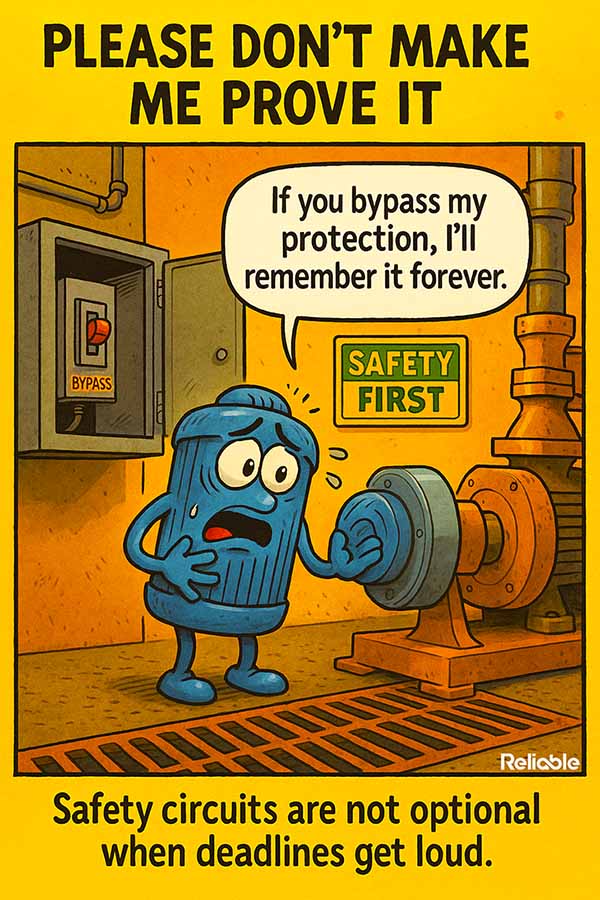

The Shortcut That Never Saves Time
Every maintenance professional has felt the pressure. A machine trips, production stops, and someone with authority says the magic words: “Can we just bypass it for now?”
The answer, technically, is almost always yes. Safety interlocks, temperature cutoffs, vibration shutdowns, pressure relief switches: they can all be defeated with a jumper wire, a zip tie, or a few keystrokes in a PLC. The harder question is whether anyone has counted the real cost of doing so.
What the Numbers Actually Show
OSHA estimates that bypassed or defeated safety devices contribute to roughly 12% of industrial fatalities each year. The Machinery Failure Prevention Technology (MFPT) Society has tracked cases where a single bypassed interlock led to catastrophic equipment failure within hours of the override.
The financial picture is just as ugly. According to the National Safety Council, the average cost of a workplace fatality in 2023 exceeded $1.3 million when you factor in lost productivity, legal fees, regulatory fines, and insurance premium increases. A medically consulted injury averaged $44,000.
Compare that to the cost of a few hours of unplanned downtime. For most facilities, that number ranges from $5,000 to $50,000 depending on the operation. The math doesn’t favor the bypass.
A bypassed safety circuit doesn’t eliminate the hazard. It eliminates the warning.
And those are just the direct costs. When OSHA issues a willful violation citation for a defeated safety device, fines can exceed $160,000 per instance. If a pattern emerges, the facility faces repeat violation multipliers that push penalties into seven figures.
There’s also the ripple effect on production itself. A catastrophic failure caused by a bypassed interlock doesn’t just damage the equipment that lost its protection. It can take out adjacent systems, contaminate product, and shut down an entire line for weeks. The very downtime the bypass was supposed to prevent ends up multiplied tenfold.
How Bypass Culture Takes Root
Nobody walks into a plant on day one planning to defeat safety systems. It starts small. A nuisance trip on a sensor that’s been acting up. A hot day that pushes a temperature switch past its setpoint. A vibration alarm that triggers during startup but settles out after 30 seconds.
Each of these scenarios feels like a false alarm. And each bypass feels reasonable in isolation.
The problem is accumulation. One bypass becomes two. Two become five. Within a year, the maintenance team is running equipment with multiple layers of protection stripped away, and nobody can remember which ones are still active. Here’s what typically drives bypass culture:
- Production pressure that treats downtime as a personal failure rather than a system event
- Chronic underfunding of maintenance that leaves sensors uncalibrated and spare parts unavailable
- Lack of a formal management of change (MOC) process for temporary overrides
When these conditions overlap, bypassing becomes normalized. The person who raises a concern gets labeled as the one “slowing things down.”
Every bypass has a half-life. The longer it stays in place, the more invisible it becomes.
That invisibility is the real threat. A bypass that everyone knows about can at least be managed. A bypass that’s been forgotten is a time bomb.
The Forgotten Bypass Problem
Temporary bypasses have a way of becoming permanent. A 2019 study published in the Journal of Loss Prevention in the Process Industries found that 34% of safety system bypasses in surveyed facilities had been in place for more than six months. Nearly 15% had no documented return-to-service date at all.
This is where the real danger lives. The original person who installed the bypass may have left the company. The reason for the bypass may no longer exist. But the jumper wire is still there, quietly removing a layer of protection that everyone assumes is active.
Shift handoffs make the problem worse. The day shift installs a bypass during troubleshooting and forgets to mention it. The night shift inherits a machine that looks fully protected but isn’t. Communication gaps like this have contributed to some of the most serious industrial incidents on record.
Plants that manage this well use bypass logs with mandatory review cycles. Every override gets a tracking number, an expiration date, and an owner. When the expiration hits, the bypass either gets formally extended (with justification) or removed. No exceptions.
Building a System That Resists Shortcuts
The goal isn’t to eliminate every bypass forever. Some temporary overrides are legitimate and necessary during troubleshooting or commissioning. The goal is to make sure every one of them is visible, documented, and time-limited.
Facilities with strong bypass management programs typically share a few traits:
- A written procedure that requires two signatures for any safety system override
- A physical tag or indicator on every bypassed device, visible to operators on the floor
- Weekly audits of all active bypasses, with automatic escalation for anything past its expiration date
These aren’t expensive programs to run. A bypass log, a tagging system, and a weekly review meeting can cost less than a single nuisance trip investigation. The return on investment shows up in reduced incidents, lower insurance premiums, and fewer uncomfortable conversations with regulators.
Every bypass has an expiration date. The question is whether you wrote it down.
When operators know that safety systems are reliable and properly maintained, they stop viewing them as obstacles. They start treating them as tools that keep production running safely and consistently.
What Happens When You Get It Right
Insurance carriers often offer premium reductions of 5% to 15% for facilities with documented safety integrity programs. OSHA inspection outcomes improve measurably. And the maintenance team gains something harder to quantify but equally valuable: trust from operations.
That trust changes behavior. Operators report trips instead of hiding them. Technicians document overrides instead of improvising them. The whole culture shifts toward transparency, and transparency is what keeps people safe.
The next time someone asks if you can “just bypass it,” the answer is still yes. You can. The better question is how much you’re willing to bet that nothing goes wrong while the protection is gone. Because the equipment will remember, even if the people don’t.