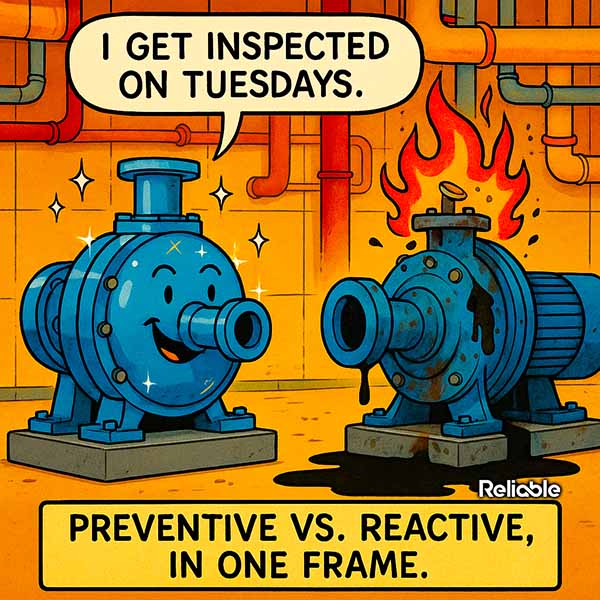

In a reactive maintenance culture, the alarm is the trigger. Something fails, someone responds, and production waits. It feels like normal operations because it’s familiar. Familiar and efficient, though, aren’t the same thing.
Organizations that default to reactive maintenance typically aren’t choosing it deliberately. It’s where most facilities land when maintenance is underfunded, understaffed, or never built into the operating culture. You run until something breaks, then you fix it.
The costs of this approach are well documented in reliability literature, but they rarely show up cleanly on a single report. They’re scattered across overtime budgets, emergency purchase orders, production records, and quality logs. That’s part of why the habit persists.
What Reactive Maintenance Actually Costs
The labor premium alone is significant. Emergency repair work happens at inconvenient times, by definition. That means overtime rates, weekend callouts, and contractor premiums when in-house staff can’t respond fast enough. Benchmarking data from plant maintenance organizations consistently shows emergency repair labor costing two to three times more per hour than planned work.
Parts are the other major cost driver. When a bearing fails unexpectedly, you’re not pulling from stock. You’re on the phone with a distributor, paying overnight freight, and hoping the right part is actually available. Critical components for older equipment sometimes aren’t. Then you’re dealing with manufacturer lead times, and the line sits idle while the clock runs.
Secondary damage is the cost that gets underestimated most consistently. A bearing that fails under load doesn’t just damage itself. It can score a shaft, damage a housing, destroy a seal, and in some cases trigger a cascade that takes out connected equipment. What started as a $200 bearing becomes a $15,000 repair.
The real costs that reactive maintenance generates:
- Emergency labor premiums, typically two to three times the cost of planned labor
- Expedited parts and overnight freight charges on components not held in stock
- Secondary damage to shafts, housings, seals, and adjacent equipment
- Production downtime at full line rate while repairs are completed
- Quality losses from product made during degraded operation before the failure
The total cost of a single unplanned failure on a critical asset often exceeds the annual cost of maintaining that asset on a proper PM schedule. That ratio varies by equipment type and application, but for anything in a critical production path, the math is hard to argue with.
Emergency maintenance labor costs two to three times more per hour than planned work. That premium adds up fast when failures happen at 2 AM on a Saturday.
The problem is that these costs are diffuse. Overtime hits one budget. Expedited parts hit another. Production losses may not be attributed to maintenance at all. When costs are fragmented, the true price of reactivity stays hidden, and the cycle continues.
That fragmentation is also why facilities running reactive maintenance programs often feel perpetually stretched. New failures keep generating new emergencies, and there’s no time for prevention because prevention requires planning, and planning requires time that’s always consumed by the next crisis.
Why Reactive Cultures Persist
The inertia behind reactive maintenance is real. If the facility has been running this way for 20 years, the systems, staffing, and culture are all built around response. Shifting to prevention requires upfront investment: more labor hours, more parts in stock, more time spent on routes and inspections. The payoff comes later.
Leadership timelines don’t always accommodate that. A plant manager under pressure on quarterly numbers isn’t naturally inclined to fund a maintenance program with an 18-month payback horizon. The immediate cost is visible. The avoided cost is theoretical.
There’s also a more basic problem: in a reactive shop, maintenance gets measured on response time. Speed to repair is the metric that matters. Technicians become skilled at fast diagnosis and quick fixes. Prevention requires different skills and a different mindset, and developing either takes time that a reactive schedule never provides.
Reasons reactive maintenance cultures persist:
- Costs are fragmented across departments, hiding the true total from any single report
- Upfront investment in PM programs conflicts with short-term budget pressure
- Measurement systems reward response speed rather than failure avoidance
- Experienced staff have built their expertise around reactive response, not prevention
The Parts Problem
One underappreciated driver of reactive maintenance is parts availability. If the storeroom is well-stocked with the right critical spares, a failure can be addressed quickly and cheaply. Most reactive shops aren’t stocked that way. If you’re not planning maintenance, you’re not planning parts either.
The result is a compounding problem. Equipment fails, parts aren’t on hand, lead times stretch, and downtime extends. Every additional hour the line sits idle costs far more than the parts themselves ever would have.
A storeroom stocked for reactive maintenance is always behind the curve. You’re building inventory based on what just failed instead of what’s about to.
Shifting to a planned maintenance model changes the parts equation entirely. When you know an inspection is coming, you can stage likely replacement components beforehand. When your condition monitoring data tells you a bearing is degrading, you order the replacement before the failure, not after.
Over time, that approach also reduces total storeroom investment. You’re buying what you know you’ll use rather than hoarding everything that might possibly fail. Planned maintenance and intelligent parts management reinforce each other.
When Running to Failure Makes Sense
Reactive maintenance isn’t always the wrong call. For non-critical equipment with low failure consequences, easy replaceability, and no safety implications, running to failure can be entirely rational. A basic utility pump with a spare on the shelf that takes 20 minutes to swap has a very different economic profile than a single-train compressor in a continuous process.
The formal term is run-to-failure, or RTF. Reliability engineers apply it deliberately on equipment that’s been analyzed and determined to have failure modes that are safe, inexpensive to address, and low in production impact. The key word is ‘deliberately.’
Most reactive programs aren’t running RTF deliberately. They’re reactive because nobody sat down and decided what strategy to apply to which equipment. Deliberate RTF on a $500 cooling fan is sensible engineering. Unplanned reactivity on a $200,000 gearbox is just hoping for the best.
Criteria for applying a deliberate run-to-failure strategy:
- Failure has no safety or environmental consequences
- Failure has minimal impact on production throughput or quality
- Replacement parts are readily available, inexpensive, and held in stock
- Repair or replacement can be completed in under one hour
Applying those criteria systematically across your asset register is one of the most valuable exercises a reliability team can do. It produces a defensible maintenance strategy for every piece of equipment, and it ensures that prevention resources are concentrated where they actually matter.
Deliberate run-to-failure on a $500 fan is good engineering. Unplanned reactivity on a $200,000 gearbox is just hoping for the best.
The facilities that get this right aren’t trying to prevent every failure on every asset. They’re focused on preventing failures where failure is genuinely expensive, dangerous, or disruptive. That clarity makes their programs more effective and considerably easier to fund.
Reactive maintenance feels efficient because it’s responsive. The facilities running the lowest total maintenance costs, though, aren’t the ones fixing things fastest. They’re the ones failing least.
The path out of a reactive culture starts with visibility: into costs, into failure history, into what each asset actually requires. Get that picture clearly enough, and the argument for prevention makes itself.