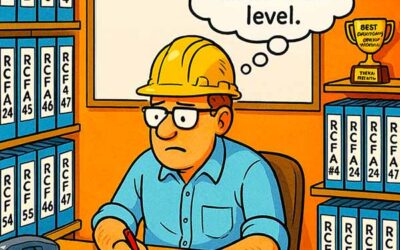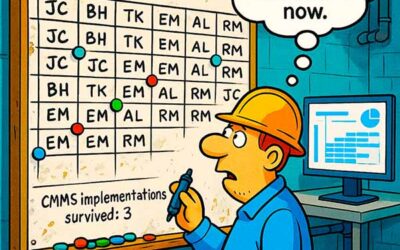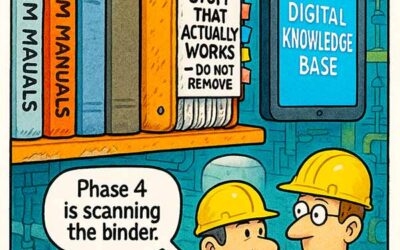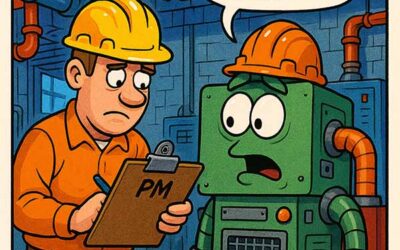


Operator basic care – cleaning, inspection, lubrication, tightening, and early abnormality detection – has been practiced for decades but was formalized and structured in TPM Autonomous Maintenance (Jishu Hozen). These principles apply broadly across plants, whether or not they run a full TPM program.
Misalignment typically stems from unclear standards, uncertain ownership, missing point-of-use tools, weak reporting systems, poor access, or tasks that haven’t been validated for necessity and frequency through structured methods such as asset criticality ranking or RCM functional analysis. Some of the questions below support analytical validation; others surface workflow, capability, ergonomic, cultural, or design limitations. Collectively, they help teams progress through the Jishu Hozen maturity stages (commonly defined in 5–7 steps), from initial cleaning to autonomous inspection.
25 Conversation Starters
- “Which basic care tasks are functionally critical—and what structured method (criticality ranking, RCM functional analysis, risk matrix) supports that classification?”
- “What does ‘good’ look like for cleaning, inspection, and lubrication, and where are those visual standards posted?”
- “Which tasks are interpreted differently across shifts, and what in the standard allows that variation?”
- “Where do operators feel unsure about performing a task correctly, and what capability or standard is missing?”
- “Which expectations are formally documented versus carried as tribal knowledge, and how do we eliminate undocumented variation?”
- “How do we verify a task is completed to the defined standard rather than simply marked as done?”
- “What abnormalities do operators notice but don’t report—and what improvement is needed in the defect-tag or digital reporting workflow?”
- “When tasks slip under production pressure, what does that signal about task validity, frequency, workload, or resource allocation according to RCM logic?”
- “Which tasks feel like guesswork because inspection criteria are unclear – and which require well-defined qualitative standards because quantitative limits aren’t feasible or meaningful?”
- “Where do we disagree on task frequency, and what evidence (failure modes, degradation rate, OEM guidance) should drive the decision?”
- “Which tasks fail due to missing tools or materials, and how can 5S point-of-use design remove these barriers?”
- “Where do communication or responsibility handoffs between operations and maintenance break down most often, and why?”
- “Which tasks consistently take longer than planned, and what ergonomic, access, workflow constraints, or underestimated time standards are driving that?”
- “Where do operators feel responsible, and where do they feel restricted due to risk level, skill requirements, or AM maturity?”
- “What visual controls, labels, inspection windows, or point marks would reduce interpretation differences across shifts?”
- “Which tasks depend too heavily on experience instead of clearly defined standard work?”
- “Where do repeat issues occur, and how do we distinguish between inconsistent basic care and inherent design, lubrication, thermal/electrical stress, or duty-cycle problems? (Hint: Does the issue persist even when care is performed to standard?)”
- “Which tasks are documented as complete but show no effect – or show effects with no documentation – and what does that reveal about workflow discipline or feedback-loop integrity?”
- “Which tasks do operators believe maintenance should own, and how does that align with AM maturity, skill requirements, risk classification (hazardous energy, exposure level), and lockout/tagout (LOTO) rules?”
- “Which steps create friction between shifts, and how can we stabilize them through clarified standards or redesigned workflows?”
- “What information, limits, or condition cues would help operators detect abnormalities earlier?”
- “Where does task execution vary between new and experienced operators, and what training or standard gaps cause that?”
- “Which tasks are done from habit rather than condition-based purpose, and how do we realign them with the intended failure mode protection?”
- “Which tasks do operators avoid because they fear performing them incorrectly, and what micro-training or guided practice would remove that barrier?”
- “If we rebuilt the basic care routine from scratch, what would we simplify, relocate, automate, or redesign to reduce variation and workload?”
Skipped Tasks = System Signals
Skipped tasks indicate mismatches in necessity, frequency, workload, or workflow – not operator behavior. Validate through RCM logic (SAE JA1011/1012).
Qualitative vs. Quantitative Inspections
When quantitative limits aren’t feasible or meaningful, define clear qualitative cues (normal vs abnormal) to minimize subjectivity.
Ownership & Safety Boundaries
Ownership depends on AM maturity, operator capability, required skill level, risk classification (hazardous energy, exposure level), and LOTO – not just what a RACI matrix prescribes on paper.
TPM / AM Maturity Stages
Consistency improves as teams move through Jishu Hozen stages (5–7 steps depending on model):
- Initial cleaning
- Source/root cause elimination
- Tentative standards
- Inspection standards
- Autonomous inspection
- (Optional stages: proficiency improvement, full stabilization)
Diagnosing Repeat Failures
Repeat failures aren’t always care-execution issues. They may arise from:
- design defects
- lubrication selection limitations
- thermal/electrical stresses
- duty-cycle changes
- environmental or process conditions
Confirm whether the issue persists even when care is executed perfectly.
Misalignment in operator basic care is rarely about motivation. It comes from unclear standards, inaccessible equipment, missing point-of-use tools, weak reporting systems, uncertain ownership boundaries, or tasks that haven’t been validated for necessity or frequency.
These conversation starters reveal those barriers, clarify roles, and help distinguish care-execution issues from underlying design or operating-context problems. When aligned with TPM/AM and RCM principles, basic care slows condition deterioration, strengthens early detection, and prevents failures from escalating into unplanned downtime or equipment functional failures.