

Shaft Alignment Best Practices Start with Precision
In maintenance, the line between “working” and “working right” is drawn by precision. That distinction becomes critical in shaft alignment. Misalignment may seem minor – a few thousandths of an inch off – but it compounds through every rotation, magnifying stress and vibration until components fail.
Close enough isn’t a strategy. It’s a slow path to inefficiency and unplanned downtime. Equipment aligned by feel or sight might seem to run fine for weeks, but the unseen cost is mounting in the form of bearing wear, seal leakage, and wasted energy.
Precision isn’t about perfection; it’s about proof. If you can’t measure it, you can’t trust it.
Adopting shaft alignment best practices means rejecting guesswork. It’s about measurable accuracy, controlled adjustments, and verification through data. Every correction tightens the connection between machine reliability and maintenance discipline.
Why Shaft Alignment Best Practices Prevent Hidden Damage
Alignment isn’t just geometry; it’s machine health. Even a slight offset or angular error can trigger destructive forces. Misaligned shafts cause cyclic loading on bearings and couplings, turning steady rotation into repetitive mechanical punishment. Heat increases, lubricant films shear, and vibration accelerates component fatigue.
Research by SKF and other reliability organizations shows misalignment contributes to roughly half of rotating equipment failures. That’s not a coincidence; it’s physics. Every micron of misalignment forces components out of their designed load path.
Implementing shaft alignment best practices eliminates that chaos. Techniques like laser alignment, soft-foot correction, and thermal growth compensation ensure that equipment operates within engineered tolerances. When shafts share a common centerline, efficiency improves, vibration stabilizes, and maintenance intervals extend naturally.
Precision alignment doesn’t just prevent damage, it stops the feedback loop that amplifies it. Vibration leads to misalignment, which leads to more vibration, and the cycle continues until something breaks. Breaking that loop begins with precision.
The Precision Attitude: From “That Looks Right” to “That Is Right”
The hardest part of alignment improvement isn’t technical; it’s cultural. Too often, maintenance teams have the skills but not the discipline. “That looks about right” becomes the standard when time pressure and production demands dominate decision-making.
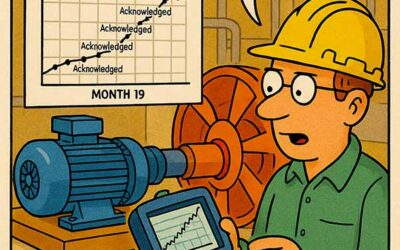
The cartoon captures it perfectly: the personification of Precision, arms crossed, unimpressed by approximation. It’s a reminder that attitude defines alignment results long before the wrenches move.
Precision doesn’t tolerate opinions – it demands proof, measurement, and accountability.
Adopting shaft alignment best practices requires a shift from intuition to evidence. Every adjustment must be measured, documented, and verified. Laser alignment tools, dial indicators, and feeler gauges remove the guesswork. When data replaces opinion, confidence in the result rises, and so does reliability.
Plants that value precision create fewer emergencies. They don’t rely on luck; they rely on process. Over time, this mindset spreads across maintenance disciplines – balancing, torque tightening, and lubrication – and the plant evolves from reactive to predictive behavior.
How to Build a Sustainable Shaft Alignment Program
Precision alignment must become a habit, not a project. Sustainable programs are built on four cornerstones:
- Documented procedures and tolerances: Define exact limits for offset, angularity, and soft foot. Use manufacturer data, but refine it based on field experience.
- Calibrated tools: Laser systems and dial indicators require periodic calibration. Precision is worthless if tools drift out of spec.
- Technician training: Even the best tools are ineffective without skilled hands. Train personnel on setup, measurement interpretation, and correction techniques.
- Continuous verification: Always check alignment after startup and thermal stabilization. Machines move under load; cold alignment doesn’t always equal hot alignment.
Data management is the next frontier. Digital alignment logs, mobile apps, and cloud-based maintenance platforms can trend results over time. Anomalies stand out instantly, enabling proactive intervention.
A mature alignment program includes periodic audits, peer reviews, and refresher training. Each iteration closes gaps, reduces variability, and keeps alignment precision alive even as new personnel rotate in.
The Technical Edge: Tools and Techniques That Define Precision
Modern shaft alignment best practices rely on technology that makes precision repeatable. Laser alignment tools dominate because of their accuracy and speed. They eliminate subjective interpretation, providing instant feedback and automatic compensation for thermal growth or coupling backlash.
For smaller operations, dial indicators remain reliable if used properly, ensuring bracket rigidity, precise rotation, and consistent measurement. The key is not the tool but the technique. A laser alignment system used carelessly will deliver worse results than dial indicators handled by a disciplined technician.
Other supporting practices include:
- Soft foot correction: Ensures machinery sits flat on its base without frame distortion.
- Thermal growth calculation: Adjusts alignment targets based on temperature changes during operation.
- Base re-leveling: Prevents structural shifts from reintroducing misalignment.
- Coupling inspection: Worn or damaged couplings mask underlying misalignment problems.
Precision in alignment means integrating all these checks into a single workflow, rather than treating them as separate tasks. Each influences the other.
Why Precision Alignment Is a Business Strategy
The financial impact of shaft alignment best practices extends beyond maintenance. Properly aligned equipment consumes less energy, runs cooler, and lasts longer. One study by the U.S. Department of Energy found that even minor misalignment can increase power consumption by 3–5%. Over hundreds of motors, that loss compounds into a significant cost.
Reliable machines also reduce production interruptions, improving on-time delivery and safety. Well-aligned rotating assets operate with lower vibration levels, which protects nearby structures and instrumentation. The ripple effect is organization-wide: quality improves, maintenance hours drop, and operators gain confidence in their systems.
Precision isn’t a luxury. It’s a profit multiplier.
Close Enough Is Never Enough
Precision is not perfectionism. It’s discipline applied to mechanics. When plants adopt best practices for shaft alignment, they stop fighting the same failures repeatedly and start building systems that sustain reliability over time.
“Yeah, sure, that looks about right” belongs to the past. Modern maintenance professionals measure, adjust, and verify. They recognize that every degree, every thousandth, every shim matters. Because once a machine is precisely aligned, everything connected to it – production, safety, and profitability – comes into alignment too.