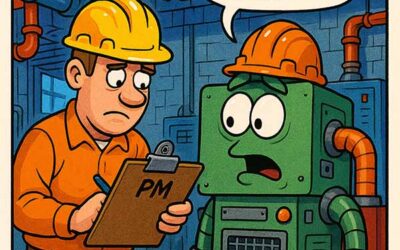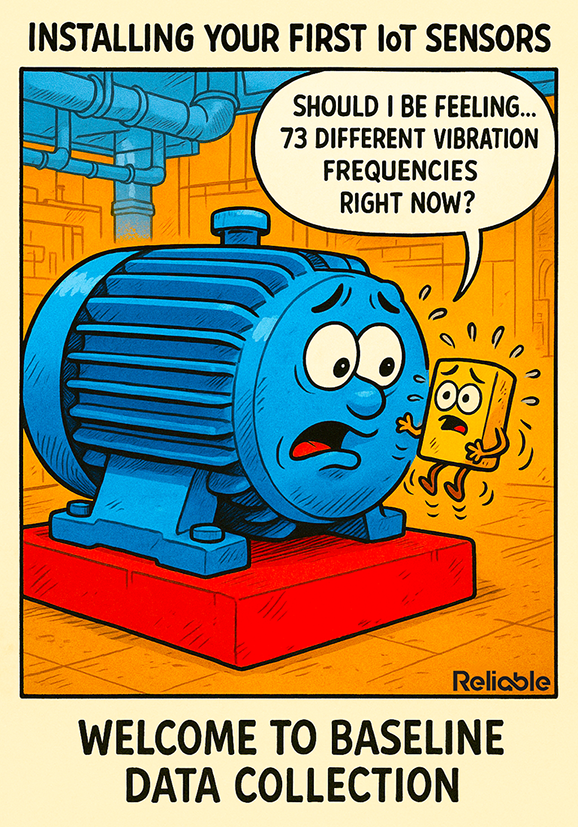

When plants first install IoT sensors in predictive maintenance, reality often feels like chaos. Machines that once seemed steady suddenly reveal dozens of vibration peaks, temperature fluctuations, and unexpected noise patterns. The cartoon captures this perfectly: a motor, bewildered by the flood of sensor feedback, asking if it’s normal to feel 73 different vibration frequencies.
That confusion is the first step toward insight. The truth is, these sensors don’t create problems; they uncover them. For the first time, maintenance teams can “see” asset health at a granular level. The challenge is learning how to interpret it.
Sensors don’t lie. They simply reveal the story your machines were already telling.
Baseline data collection is where reliability begins. It transforms the overwhelming torrent of data into organized, meaningful benchmarks that define what “healthy” looks like. Without a solid baseline, predictive analytics are just educated guesses. With it, every deviation becomes a valuable clue.
Why Baseline Data Matters
A predictive maintenance program without a baseline is like diagnosing illness without ever knowing the patient’s typical vital signs. Establishing a baseline defines what “normal” looks like for each machine under real operating conditions.
When IoT sensors for predictive maintenance are first installed, they collect data that becomes a digital fingerprint —a combination of vibration patterns, thermal behavior, current draw, and process load. This fingerprint anchors your reliability program.
Key goals of baseline data collection
- Document steady-state behavior. Capture data during stable operation, not during startup or shutdown.
- Understand machine individuality. Even identical assets behave differently due to installation, alignment, and environment.
- Prevent false alarms. Proper baselines keep software from overreacting to normal variability.
- Enable long-term trending. You can’t spot deviation without a reference point.
With a well-built baseline, every alert or anomaly is compared to a verified standard. Your team can trust the data rather than question its accuracy.
Steps to Build an Effective IoT Baseline
Collecting baseline data isn’t just about turning sensors on; it’s a structured process that combines engineering discipline with data science.
1. Choose your parameters wisely
Start with the failure modes you want to detect. For rotating assets, prioritize vibration, temperature, and current signature. For fluid systems, focus on pressure, flow rate, and particle count. Avoid collecting everything just because you can—more data doesn’t mean better insight.
2. Capture data under stable conditions
Data taken during unstable loads or process variation will distort your baseline. Record multiple samples under steady operation, ideally over several production cycles, to average out minor fluctuations.
3. Annotate every variable
Document ambient conditions, operator actions, and process states. That metadata will be vital when interpreting anomalies months later. If your system allows tagging or note fields, use them religiously.
4. Cross-check with field expertise
Experienced technicians validate the most effective IoT sensors in predictive maintenance. Vibration analysts and lubrication specialists help confirm whether the “normal” data truly represents healthy operation.
5. Store data with integrity and accessibility
Use structured naming conventions, timestamps, and consistent units. Baseline data should be stored in a way that allows easy retrieval and analysis, whether you’re using a CMMS, APM, or historian.
Tip: Treat baseline sessions like a physical inspection – systematic, recorded, and verified by more than one expert.
Common Pitfalls When Installing IoT Sensors
New users of IoT sensors in predictive maintenance often run into predictable mistakes that compromise early results. These pitfalls create distrust in the technology and erode credibility before the system can prove its value.
Frequent mistakes and how to avoid them
- Ignoring sensor calibration. Drift and mounting errors create false data. Always verify sensors before each session.
- Misaligned sensor placement. Incorrect orientation can amplify or hide critical frequency bands.
- Collecting during variable operations. Startup and load transitions distort baseline stability.
- Failing to document context. Without notes, future teams won’t know whether data came from normal or abnormal states.
- Lack of training. Teams must understand what the data means—otherwise, the project becomes an IT experiment, not a reliability tool.
Even the best sensors can’t compensate for poor data hygiene. Precision begins with disciplined processes.
From Baseline to Predictive Power
Once your baseline is built, the fundamental transformation begins. IoT sensors in predictive maintenance enable continuous monitoring, pattern recognition, and AI-assisted diagnostics. But none of it works if the baseline isn’t sound.
Analytics platforms compare live readings to those baseline values. Deviations in vibration amplitude, harmonic frequencies, or bearing signatures can signal imbalance or wear long before failure occurs.
Turning data into action
- Automate filtering and alarms. Remove normal fluctuations so your alerts mean something.
- Integrate with maintenance workflows. Link sensor alerts to your CMMS or ERP so actions follow insights.
- Refine baselines continuously. When machines are upgraded, repaired, or relocated, refresh your baseline.
- Use trending analysis. Evaluate rate-of-change to predict failure timing, not just detect it.
When properly maintained, a baseline becomes a living reference. A map of machine health that evolves as your operation matures.
Building a Data-Driven Reliability Culture
Installing IoT sensors in predictive maintenance is as much about people as it is about technology. Data without interpretation is just noise; people turn it into knowledge.
Maintenance teams must adopt a mindset of curiosity and treat every anomaly as a clue, every pattern as a story. Encourage technicians to explore why signals change, not just when they do.
Leading organizations embed this thinking into their reliability culture:
- Train technicians in data literacy. Teach them to read vibration spectra, temperature trends, and power signatures.
- Reward insight, not reactivity. Recognize those who identify and prevent failures before they happen.
- Integrate IT and maintenance teams. Analytics only deliver value when operational and digital expertise collaborate.
The long-term benefit is strategic foresight – turning maintenance from a cost center into a performance driver.
The First Step Toward Truly Intelligent Maintenance
The first time you install IoT sensors, the noise can feel overwhelming: 73 vibration frequencies, temperature spikes, endless data streams. But with patience and structure, that noise becomes your greatest ally.
Baseline data transforms chaos into clarity. It marks the beginning of a reliability journey in which machines speak and maintenance listens intelligently.
If your sensors are buzzing with signals, don’t panic, celebrate. You’re witnessing your equipment’s first honest conversation with the digital age.