

Smarter Teams Start with Smarter Tools
Predictive maintenance tools are transforming how maintenance teams work, think, and measure success. Technologies like vibration analysis, oil condition monitoring, infrared thermography, and ultrasonic inspection are no longer optional. They are essential components of modern reliability programs.
These tools detect issues long before failure, allowing teams to act on insights rather than react to breakdowns. But the most profound change isn’t mechanical—it’s cultural. Predictive maintenance tools shift maintenance from reactive firefighting to strategic foresight.
Predictive maintenance doesn’t just change how machines are maintained; it changes how people define their value in a world that rarely breaks.
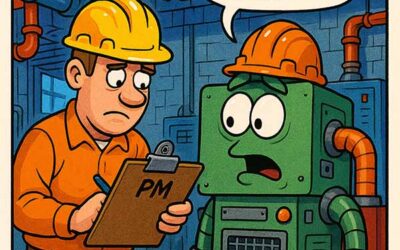
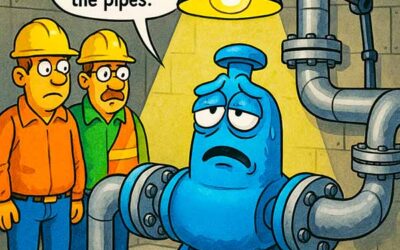
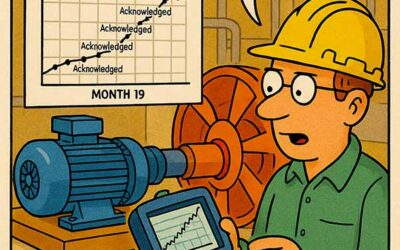
The cartoon that inspired this piece —a vibration analyzer worrying about its own relevance —captures the human side of this transformation. It’s a tongue-in-cheek reflection on a more profound anxiety: when technology gets too good at predicting failure, what happens to the people who used to fix it?
The answer is simple. Predictive maintenance tools don’t make humans obsolete—they make them indispensable in new ways. They elevate maintenance professionals from repair technicians to reliability strategists, transforming data into decisions that drive uptime, efficiency, and profit.
 How Predictive Maintenance Tools Transform Maintenance Teams
For decades, maintenance work relied on intuition, experience, and sensory observation. Skilled technicians could often diagnose problems by sound, temperature, or vibration long before an instrument confirmed it. Those skills remain invaluable, but predictive maintenance tools now extend and amplify that expertise.
Key technologies include:
- Vibration analysis – Detects bearing faults and imbalance at the earliest microscopic wear stage.
- Oil analysis – Identifies chemical markers of oxidation, contamination, and additive depletion before visible symptoms appear.
- Infrared thermography – Exposes hidden electrical resistance, heat buildup, and mechanical friction.
- Ultrasonic testing – Reveals steam trap failures, vacuum leaks, and compressed air losses that drain energy and productivity.
When data from these predictive maintenance tools converge, they tell the story behind every failure, turning isolated signals into actionable insights. Feeding this information into an integrated reliability system allows teams to recognize patterns across assets, shifts, and operating conditions. They begin to understand the why, not just the what, behind recurring failures.
Key Features and Technologies in Predictive Maintenance
Modern predictive maintenance relies on a tightly integrated ecosystem of sensors, analytics, and intelligence. What separates successful programs from experimental ones isn’t just access to tools, it’s the technology stack that powers them.
IoT and condition monitoring sensors are the foundation. These devices continuously capture vibration, temperature, pressure, and lubricant condition data in real time. IoT sensors allow for remote visibility and continuous asset monitoring across an entire facility, replacing manual inspection routes with constant surveillance.
Layered on top are AI-based anomaly detection and machine learning algorithms. These technologies analyze massive data streams to identify deviations from normal behavior before human operators can see them. As models learn from each event, they improve precision, detecting emerging faults earlier with fewer false alarms.
Artificial intelligence doesn’t replace intuition, it amplifies it, turning patterns into foresight long before failure takes form.
Data becomes actionable through custom dashboards and performance analytics platforms. These tools transform raw sensor feeds into trend lines, heat maps, and predictive alerts. Operators can monitor remaining useful life (RUL) estimates, energy efficiency, and equipment health scores on a single screen.
The heart of predictive maintenance lies in data collection and management. Centralized systems organize input from diverse sources—condition monitoring sensors, laboratory results, and operational data—into unified databases that enable cross-asset insights. When paired with real-time data monitoring and robust data analytics, plants gain a living digital fingerprint of every machine’s behavior.
Together, these capabilities shift maintenance from static interval-based schedules to dynamic, evidence-driven reliability management. Teams no longer rely on what they think might fail—they act on what the data proves is failing.
This deeper visibility fuels smarter planning and scheduling:
- Identify and address root causes such as misalignment, lubrication breakdown, or contamination.
- Prioritize high-risk assets based on trend data rather than arbitrary intervals.
- Optimize resource allocation so maintenance work directly supports uptime and efficiency goals.
Over time, maintenance evolves from a reactive expense to a predictive investment. The most effective teams treat predictive maintenance tools as a collaborative ecosystem—technicians gather data, reliability engineers interpret trends, and planners act on insights. Everyone contributes to a unified reliability strategy grounded in data, not guesswork.
 Integrating Predictive Maintenance Tools Into Daily Workflows
Technology alone doesn’t create reliability. Execution does. Many plants own predictive maintenance tools but never integrate them into daily decision-making. Data gets trapped in reports, dashboards, or disconnected systems. The key to realizing value is workflow integration.
Leading organizations link predictive maintenance tools directly to their CMMS or asset management software. Sensor data triggers automated alerts that generate work orders. Inspection results sync with asset histories, allowing engineers to view degradation trends over time.
When predictive tools and CMMS systems speak the same language, data becomes decisions instantly.
This integration closes the gap between information and action. Maintenance teams no longer scramble to interpret isolated readings; they receive contextual, prioritized recommendations.
For example, a vibration alert might automatically cross-reference oil analysis data and thermal readings, revealing a combined fault signature that points to misalignment. The CMMS can then auto-schedule an alignment correction during planned downtime, preventing a future catastrophic failure.
But successful integration also depends on culture. Smart teams hold daily or weekly “data huddles” to review predictive findings and verify corrective actions. They assign accountability to close each loop; no alert left unresolved, no trend ignored. Over time, predictive data becomes part of how work is planned, discussed, and celebrated.
 How Smart Maintenance Teams Use Predictive Maintenance Tools for Continuous Improvement
Predictive maintenance tools deliver far more than early warnings—they drive continuous improvement cycles. Each data point is an opportunity to refine processes, improve designs, and prevent future waste.
1. Correlate and contextualize data.
The best results come from combining data from multiple predictive maintenance tools. Vibration trends can be compared with lubricant particle counts or thermography hotspots. This layered approach eliminates false positives and increases diagnostic accuracy.
2. Create actionable feedback loops.
Every time a predictive alert is verified, the team should record the outcome: the action taken, the condition observed, and the failure avoided. Over time, this builds an internal “knowledge graph” of cause-and-effect relationships unique to that plant’s equipment.
3. Quantify results and communicate value.
Smart maintenance teams translate reliability wins into measurable business outcomes, such as hours of downtime avoided, maintenance cost savings, and energy efficiency gains. A $10,000 investment in predictive maintenance tools can often prevent $100,000 in lost production or asset replacement costs.
These feedback loops turn predictive programs into performance engines. The process is iterative: each inspection, analysis, and corrective action feeds the next improvement cycle. This is how reliability maturity evolves: through disciplined use of data and consistent follow-through.
 The Human Element: Data Alone Doesn’t Create Reliability
Even in a world of machine learning and AI diagnostics, people remain the most critical asset in maintenance. Predictive maintenance tools can detect anomalies, but they can’t understand context. Humans interpret what matters, when, and why.
For example, a rise in vibration might not indicate failure; it could signal a process change or temporary load variation. Only trained professionals can distinguish noise from signal. That’s why predictive programs succeed when teams blend human expertise with digital intelligence.
Even the smartest sensor needs a skilled mind to turn data into understanding.
The best maintenance leaders invest in upskilling. They train technicians in data literacy, vibration fundamentals, thermography interpretation, and lubrication analysis. They cultivate curiosity and cross-functional communication: skills machines can’t replicate.
When technicians understand why a signal matters, they transition from data collectors to reliability analysts. When engineers see trends in context, they guide operational strategy—the organization’s collective intelligence compounds.
Predictive maintenance tools, when fully adopted, don’t reduce headcount; they expand capability. They free people from repetitive inspection routes and enable them to work on higher-value initiatives, such as redesigning failure-prone components, optimizing maintenance intervals, or mentoring new staff in reliability principles.
Building the Future of Reliability with Predictive Maintenance Tools
The next evolution of predictive maintenance tools lies in automation and AI. Self-learning algorithms are already correlating vibration spectra with bearing failure patterns. Soon, digital twins will simulate entire systems to predict how minor parameter changes affect long-term reliability.
Smart maintenance teams are preparing for this now by developing hybrid strategies that combine machine intelligence and human expertise to co-pilot the reliability process. Predictive maintenance tools provide insight; people provide judgment.
The future of reliability belongs to teams where humans and machines think together.
As these tools advance, the role of maintenance professionals will continue to evolve. Instead of reacting to failures, they’ll orchestrate reliability ecosystems that include sensors, analytics, and automated diagnostics. The ultimate goal isn’t eliminating maintenance, it’s making maintenance invisible through perfect predictability.
Organizations that embrace this vision will not only achieve world-class uptime but also build workplaces where technology and people advance together. The true competitive advantage won’t come from owning predictive maintenance tools; it will come from mastering how to use them.
Technology Evolves, Reliability Endures
Predictive maintenance tools empower smarter maintenance teams by combining data precision with human insight. They turn maintenance from reactive cost control into strategic value creation. The more these tools are embraced, the more empowered the teams become.
The anxiety that automation replaces humans misses the point. The real story is collaboration between sensors and senses, algorithms and experience, prediction and prevention. Predictive maintenance tools don’t eliminate maintenance; they make it intelligent, intentional, and impactful.
As plants modernize and AI expands, one truth remains: reliability is still a human mission. The most innovative organizations will use predictive maintenance tools not just to monitor machines, but to magnify the intelligence, creativity, and purpose of the people who keep them running.