
When “Approved” Still Means Broke
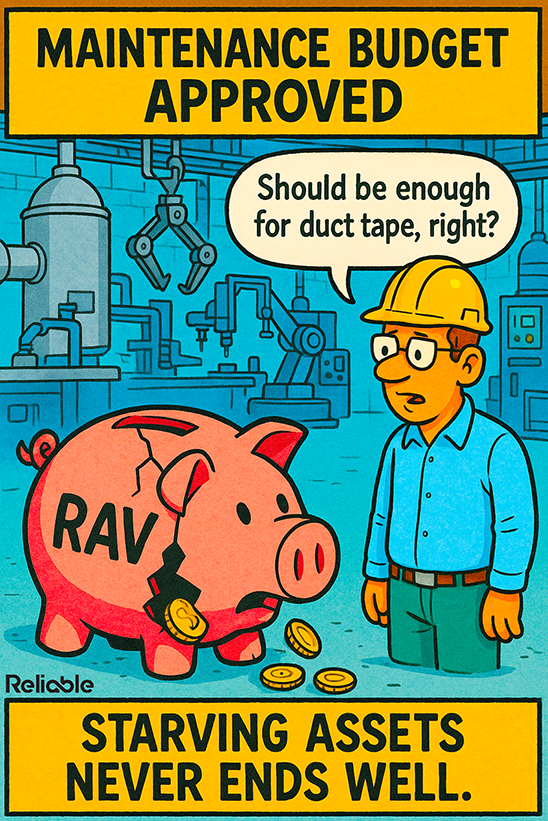
The cartoon tells a painfully familiar story: a cracked piggy bank labeled “RAV” and a weary engineer wondering if the new budget covers duct tape. This is the reality for countless maintenance departments celebrating “budget approval” even when the numbers are insufficient to sustain asset health.
Approving a maintenance budget without linking it to asset needs isn’t cost control, it’s controlled decline.
This is not about money alone; it’s about budget planning for maintenance. Many organizations treat maintenance as a discretionary cost rather than an operational investment. Budgets are often based on last year’s numbers plus or minus a token adjustment. The result? Deferred maintenance, emergency fixes, and a false sense of savings that inevitably explodes into downtime and unplanned costs.
When leaders cut funding without understanding the impact on reliability, they create a starvation cycle. Underfed assets run longer with less lubrication, fewer inspections, and delayed repairs. Eventually, something breaks, and the emergency costs that follow dwarf the “savings” achieved by trimming the budget.
The True Cost of Starving Assets
Underfunding maintenance doesn’t just delay repairs; it multiplies risk, cost, and chaos across the operation. For every $1 deferred in preventive maintenance, plants often spend $4–$5 later in corrective repairs. That tradeoff quietly drains profitability, reliability, and morale.
To see the impact clearly, it helps to break it down:
1. Financial Losses Add Up Fast
- Emergency repairs cost far more than planned work.
- Expedited parts and overtime destroy budgets that were already tight.
- Unplanned downtime leads to production losses that dwarf the “savings” from budget cuts.
- Each deferred lubrication, inspection, or alignment task increases long-term lifecycle costs.
2. Reliability Performance Collapses
- Predictive programs like oil analysis, vibration monitoring, and thermography are the first to be cut—ironically, the ones that prevent failure.
- Missed inspections allow minor defects to evolve into major breakdowns.
- KPI trends (MTBF, OEE, asset availability) decline sharply once funding dries up.
- The “firefighting” mindset replaces structured reliability improvement.
3. People Burn Out
- Skilled technicians tire of constant reactive work and leave for better-managed operations.
- Morale drops as maintenance becomes synonymous with failure instead of prevention.
- Burnout spreads when teams can’t get ahead of the backlog.
- Institutional knowledge disappears as frustrated veterans retire early or move on.
4. Culture and Trust Erode
- Operations teams lose confidence in maintenance reliability.
- Maintenance blames operations for poor care, and operations blames maintenance for downtime.
- The plant drifts toward a blame culture, where no one owns reliability.
- Leadership starts micromanaging instead of empowering improvement.
5. The Long Game Loses
- Deferred investment in training, digital tools, and predictive technology keeps the organization stuck in reactive mode.
- What appears to be short-term cost control becomes long-term value destruction.
- Equipment replacement cycles shorten, total cost of ownership skyrockets, and competitiveness erodes.
Starving assets is a slow bleed. The hidden costs may not appear on a balance sheet this quarter, but they always show up in failures, fatigue, and lost opportunity.
Aligning Maintenance Budget Planning with Asset Value
To fix the problem, plants must connect maintenance budget planning directly to asset value and business objectives. One widely accepted benchmark is maintenance cost as a percentage of Replacement Asset Value (RAV). For most industries, world-class performers spend roughly 2%–4% of RAV annually. Below 2%, the risk of chronic underfunding rises sharply.
Spending less than 2% of RAV on maintenance isn’t efficiency – it’s a warning sign of reliability debt.
However, that percentage is not a fixed rule. Mature organizations with predictive and proactive reliability strategies might trend lower without increasing risk, because they’ve built strong reliability foundations. Newer programs, or plants recovering from decades of reactive maintenance, will need more than 4% temporarily to stabilize performance.
The most critical principle: budgets must scale with asset criticality. A high-value compressor that serves as a production bottleneck warrants a proportionally higher maintenance investment than a low-impact conveyor. Budget allocation should follow risk, not habit.
An RAV-based approach helps leadership visualize maintenance funding in financial terms. It translates reliability needs into investment logic. Executives may not grasp vibration velocity or lubricant particle counts, but they understand asset value preservation and return on investment.
Building a Predictive Maintenance Budget Model
Traditional maintenance budgets often start with a spreadsheet of last year’s spend. A few line items get adjusted, and that becomes the “plan.” It’s a backward-looking approach that guarantees repeated failures. Predictive plants use maintenance budget planning built around data, risk, and performance objectives.
Here’s a more effective process:
- Establish Performance Targets: Define measurable reliability goals like OEE, uptime, MTBF, or cost per unit produced.
- Identify Failure Drivers: Use FMEA and Pareto analysis to pinpoint chronic failure modes and their costs.
- Forecast Preventive Needs: Calculate labor, materials, and downtime prevention costs for each failure mode.
- Integrate Condition Monitoring: Use predictive tools like oil analysis, vibration, ultrasound, and thermography to shift work from reactive to proactive.
- Include Training and Tools: Budget for technician certification, data systems, and CMMS optimization – these are multipliers, not overhead.
- Reassess Quarterly: Align funding to real reliability performance metrics, not static budgets.
Predictive maintenance models align spending with value creation. They connect failure prevention directly to financial performance, turning the maintenance department into a profit protector rather than a cost sink.
From Cost Center to Value Creator
Executives rarely oppose reliability. They just don’t always understand it. The key to winning budget approval is to express maintenance budget planning in financial language. Link every dollar of maintenance spend to risk avoided, downtime reduced, or production throughput gained.
Example metrics that bridge communication gaps:
- Cost of Unreliability (CoUR): Quantify total losses from unplanned events.
- Maintenance Cost per Unit Produced: Show how reliability investments reduce operational cost.
- Return on Asset (ROA): Correlate asset uptime and lifespan with profitability.
Visual dashboards help tremendously. When leaders can see that a $20,000 vibration program prevented $200,000 in bearing failures and lost production, the funding debate ends. Maintenance becomes an enabler of corporate goals, not a recurring expense to trim.
Integrating Digital Tools into Budget Strategy
Modern maintenance budget planning should integrate analytics and automation. CMMS and APM platforms allow maintenance leaders to model costs, visualize trends, and tie financial performance directly to asset health metrics.
Predictive AI tools can now identify underperforming assets and estimate the ROI of intervention strategies. For instance, predictive algorithms may suggest that increasing lubrication inspection frequency by 25% reduces the risk of bearing failure by 60%. Budgeting then becomes a science of probabilities rather than guesswork.
Additionally, integrating IoT data streams like temperature, vibration, flow, and energy metrics provides continuous justification for budget decisions. Instead of arguing over “gut feel,” maintenance leaders can present data-backed financial correlations: increased maintenance investment leads to measurable operational gains.
When Leadership Buys Reliability
Once leadership sees maintenance as an asset reliability strategy rather than an expense, budgets evolve from restrictive to strategic. The conversation shifts from “What can we afford to fix?” to “What investments deliver the highest uptime and lowest total cost of ownership?”
When leaders view maintenance as an investment, every dollar becomes a lever for uptime, not just an entry on a balance sheet.
Communicating the financial consequences of deferred maintenance is vital. Show scenarios where a $100,000 proactive repair avoids $1 million in production loss. Demonstrate how reliability initiatives, such as lubrication programs, training, and predictive monitoring, extend mean time between failures (MTBF) and increase equipment lifecycles.
A well-built maintenance budget is a business continuity plan. It protects not only machines but also brand reputation, employee safety, and customer trust.
Feed the Assets, Fuel the Future
The cracked piggy bank in the cartoon represents more than humor. It’s a financial metaphor. Starving assets erode reliability, profitability, and morale. Plants that repeatedly underfund maintenance are not saving money; they’re accumulating deferred costs disguised as temporary wins.
Accurate maintenance budget planning turns cost control into cost mastery. It aligns reliability, asset performance, and business goals into one cohesive strategy. Every dollar spent on maintenance should have a measurable purpose, such as preventing failures, extending lifespan, and driving sustainable growth.
Feed your assets, and they’ll return the favor with uptime, efficiency, and long-term profitability.