
There’s a common misconception in maintenance circles: if a bit of grease is good, more must be better.
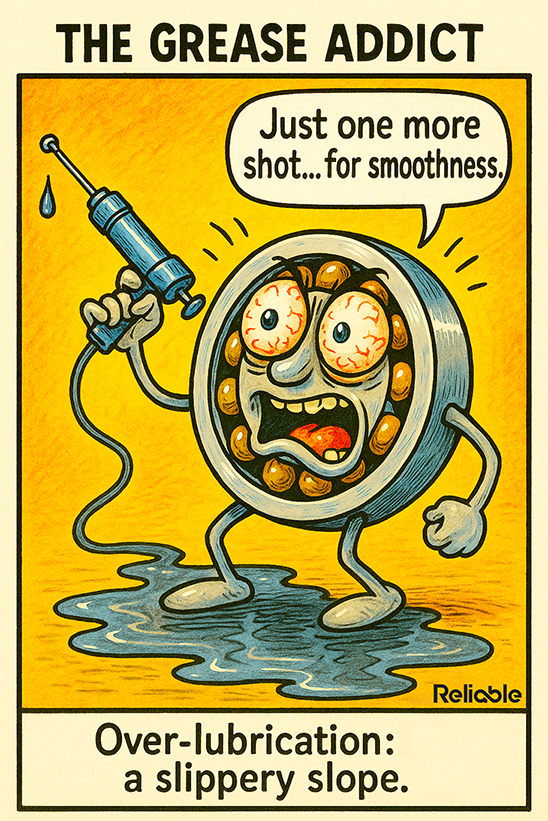
Unfortunately, this thinking has destroyed more bearings than neglect ever did. The cartoon “The Grease Addict” captures this perfectly—a bearing with wild eyes, clutching a grease gun, saying, “Just one more shot … for smoothness.”
Too much grease isn’t preventive maintenance; it’s precision gone wrong, and it quietly kills reliability from the inside out.
It’s a humorous exaggeration, but it represents a severe and pervasive problem. Many plants are losing thousands of dollars in bearing life and energy costs due to over-lubrication and bearing failure, an entirely preventable issue caused by misunderstanding, habit, or misplaced good intentions.
Why Over Lubrication Bearing Failure Happens
Bearings are precision-engineered components, designed to operate with microscopic oil films separating the rolling elements. Grease, contrary to popular belief, isn’t meant to fill the entire cavity; it’s a lubricant-delivery system. The thickener holds base oil and additives, releasing them slowly as the bearing rotates and pressure changes.
When a technician injects too much grease, that balance collapses. Excess grease increases internal pressure, causing the bearing to churn instead of glide. The rolling elements plow through the grease, generating heat through shear. The result: the lubricant oxidizes faster, the oil separates from the thickener, and boundary lubrication fails.
Over-lubricated bearings also force grease past seals, contaminating housings and electrical components. In electric motors, purged grease can enter windings and cause insulation breakdown. What began as a “preventive” act turns into an expensive teardown waiting to happen.
Early signs of over-lubrication bearing failure include:
- Consistently high bearing temperatures
- Frequent grease purging or residue near seals
- Elevated amperage draw in motor-driven assets
- A sticky, sluggish sound or vibration in rotation
Once these symptoms appear, the bearing’s life expectancy may already be reduced by half.
The Science Behind Grease Volume and Frequency
To prevent bearing failure due to over-lubrication, you must precisely quantify lubrication. Every bearing has a calculated grease requirement based on its geometry and operating conditions.
However, volume alone doesn’t solve the problem. Frequency is equally critical. Greasing too often can be as harmful as greasing too much. Each cycle restarts the churning process, keeping grease from reaching its stabilized oil-release state.
The correct interval depends on bearing speed, temperature, contamination level, and position (vertical or horizontal). Reliability engineers use calculators or CMMS-integrated tools to set optimal schedules. Some plants install ultrasound sensors that “listen” for changes in friction—grease is added only until the ultrasonic signal stabilizes. This condition-based approach replaces guesswork with precision.
Modern digital lubrication programs can automatically track these events, standardize technician behavior, and build data-driven insights to improve reliability outcomes.
The Cascading Consequences of Over-lubrication Bearing Failure
The cost of over-lubrication-induced bearing failure goes far beyond a single failed bearing. It ripples through production, reliability, and energy efficiency.
When grease overheats, its base oil evaporates or oxidizes, forming hard deposits and varnish on bearing races. This increases surface roughness and accelerates fatigue spalling. Meanwhile, the trapped thickener hardens into an abrasive residue, further damaging the surface finish.
But the most insidious effect is energy loss. A bearing overloaded with grease consumes more torque, increasing power draw and operational temperature. That heat drives a feedback loop of accelerated oxidation, viscosity loss, and chemical degradation.
Typical impacts include:
- 20–30% shorter grease life per 10°C temperature rise
- 10–15% increase in motor energy consumption
- Unplanned bearing replacements within 25–40% of expected service life
- Seal blowouts and lubricant leakage contaminating other components
In multi-bearing assemblies (such as conveyor rollers or motor-driven pumps), an overgreased bearing can alter system alignment and load distribution, leading to vibration problems and coupling fatigue.
The financial toll adds up fast; what seems like a $10 maintenance mistake can lead to tens of thousands in repairs, energy waste, and lost production hours.
Preventing Over-Lubrication Bearing Failure: A Culture of Precision
Preventing over-lubrication bearing failure requires more than new tools; it requires a mindset change. Lubrication must be seen as a precision process, not a routine habit.
Practical strategies include:
- Label Every Grease Point: Each fitting should display the grease type, calculated volume, and re-lube interval. Visual labeling eliminates ambiguity during shift changes.
- Train Technicians on Lubrication Science: Many over-greasing incidents stem from well-meaning but uninformed habits—training on grease behavior, flow dynamics, and thermodynamics changes that.
- Use Ultrasound-Assisted Greasing: Portable acoustic sensors detect frictional noise and stop greasing at the optimal point, avoiding both under- and over-lubrication.
- Integrate Lubrication Routes: Digital management ensures accountability and data capture for every lubrication event.
- Monitor Temperature and Vibration Trends: An uptick in temperature post-lubrication is a red flag for over-greasing. Correlating this with vibration trends provides early warnings.
When these steps are followed, maintenance transforms from reactive firefighting to proactive precision. Bearings run cooler, seals last longer, and energy efficiency improves measurably.
Changing the Narrative Around “More is Better”
The “Grease Addict” cartoon speaks to human psychology as much as maintenance error. People often equate visible grease with assurance; if they can see it, they assume the job was done right. But reliability isn’t about optics; it’s about physics.
Changing this mindset takes leadership. Supervisors and reliability leaders must reinforce that less can indeed be more when it comes to lubrication. Over-greasing doesn’t show care; it shows a lack of control.
Shifting to precision lubrication means celebrating technicians who grease accurately, not abundantly. It means replacing the phrase “top it off” with “verify condition.” Plants that do this see measurable gains: 30–50% reduction in bearing failures and significant energy savings within months.
Escaping the Slippery Slope
The phrase “Over-lubrication: a slippery slope” captures both the humor and danger of the problem. The temptation for “one more shot” is strong, but each unnecessary pump of the grease gun erodes reliability.
Avoiding over-lubrication bearing failure is about discipline. It’s about understanding that bearings don’t fail from lack of attention; they fail from the wrong kind of attention. When technicians trust data, use ultrasound tools, and follow precise intervals, lubrication becomes science rather than superstition.
Grease wisely, not generously, and your machines will thank you with years of quiet, efficient service.