
When Safety Feels Like a Slowdown
Every maintenance technician has faced that moment of frustration when guarding blocks access to a coupling, belt, or valve that needs quick attention. The guard feels like an obstacle. The thought creeps in: “I’ll just take it off for a minute.”
That “minute” is how too many life-changing injuries begin. Guarding slows you down until it saves you. Machine guarding safety requirements were written in blood, not bureaucracy. They’re reminders of every incident where “just a second” was too late.
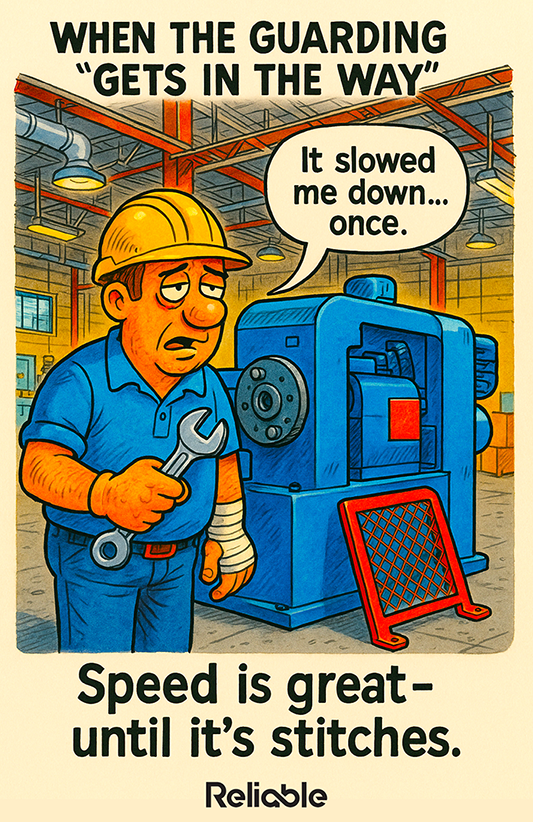
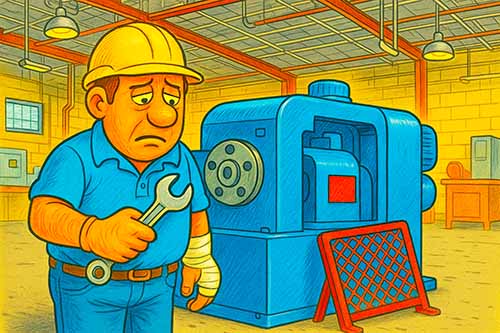
The cartoon captures this perfectly. The character’s bandaged hand says more than a thousand safety posters. Once he learned the hard way, speed no longer seemed like an advantage.
Machine guarding isn’t just about compliance; it’s about control. It’s the quiet line between the operator’s precision and the machine’s power. It protects the hands that build, the eyes that inspect, and the lives that depend on getting home in one piece.
Understanding Machine Guarding Safety Requirements
Machine guarding safety requirements, outlined in OSHA 1910 Subpart O, exist to prevent workers from contacting moving machine parts. These parts rotate, shear, crush, or strike faster than human reflexes can react. Guards, interlocks, and shields aren’t overprotection; they’re engineering empathy.
There are four main categories of machine guards:
- Fixed guards: Permanent barriers that provide consistent protection for predictable hazards.
- Interlocked guards: Connected to the control system, stopping the machine when removed.
- Adjustable guards: Designed for flexibility where process variation requires manual setup.
- Self-adjusting guards: Automatically reposition based on machine or material movement.
The right choice depends on the hazard’s nature: motion, power transmission, or point of operation. Yet the most significant risk isn’t mechanical design; it’s human normalization. When technicians see guarding as a nuisance rather than a necessity, the system fails.
Every maintenance program should audit compliance with machine guarding safety requirements as carefully as lubrication schedules or torque settings. A guard left off is as dangerous as an uncalibrated sensor or a skipped oil sample; both are failures waiting to happen.
The Real Cost of Ignoring Guarding
Bypassing guards may save seconds, but those seconds can cost everything. A 2023 Bureau of Labor Statistics report showed over 7,000 machine-related amputations in U.S. manufacturing, most during maintenance or setup, not active production.
The direct cost of one serious injury can exceed $100,000 once medical treatment, investigations, retraining, and downtime are added. Indirectly, morale collapses. Maintenance teams lose confidence, operators lose trust, and leadership loses credibility.
Every guard left off the machine leaves the entire plant exposed, not just one worker.
Unplanned downtime from an injury can also cripple production. Investigations halt workflows, insurance rates climb, and OSHA citations can exceed $15,000 per violation. A single missing guard can trigger cascading financial losses across an entire plant.
Plants that consistently enforce machine guarding safety requirements outperform those that cut corners. Not only do they avoid incidents, they improve uptime, maintain equipment integrity, and retain skilled workers who know they’re protected.
Neglecting guarding isn’t an act of rebellion; it’s an act of risk miscalculation. Speed feels efficient until it’s interrupted by a trip to the emergency room.
Integrating Guarding Into Maintenance Culture
Proper safety integration starts when guarding becomes part of how reliability is defined, not an afterthought, not a “compliance item.” Plants that lead in reliability culture make guarding a visible, measurable KPI.
1. Include guarding in PM inspections.
Make it standard to verify that guards are present, secure, and intact. Missing fasteners, warped shields, or bent mesh are early warning signs of future negligence.
2. Redesign guards that impede access.
If a guard “gets in the way,” that’s a design flaw, not an excuse. Work with engineering to create quick-access guards, hinges, or tool-free clips. Modern guarding systems can balance accessibility with protection through modular design.
3. Tie guarding to Lockout/Tagout (LOTO).
No LOTO procedure is complete unless the integrity of the guarding is verified before re-energization. The guard isn’t just a barrier; it’s a safety confirmation that work is truly complete.
4. Use data and storytelling.
Share real injury cases from your plant or industry peers. Nothing embeds the lesson deeper than an authentic story about a shortcut that went wrong.
5. Involve operators in solutions.
Operators often know which guards cause daily frustrations; when they’re involved in redesigns, compliance skyrockets.
Embedding machine guarding safety requirements in maintenance routines transforms safety from “checklist culture” to “ownership culture.”
Turning Compliance Into Competitive Advantage
It’s easy to think safety slows production. But reliability-minded organizations know the opposite is true: safety and efficiency are two sides of the same coin.
Plants that proactively address guarding design reduce downtime caused by incidents, inspections, and rework. Insurance premiums drop, turnover decreases, and engagement rises. Even audits become smoother because compliance is built into operations rather than bolted on.
More importantly, strong machine guarding safety requirements communicate professionalism to customers, auditors, and regulators. It signals that your plant isn’t just chasing uptime, it’s managing risk intelligently.
In world-class facilities, you’ll hear phrases like:
- “If it’s guarded, it’s good.”
- “If it’s missing, we’re stopping.”
That mindset turns compliance into a competitive advantage, because every second not lost to injury, investigation, or repair is a second gained in productivity.
Speed Is Great Until It’s Stitches
Guarding is the maintenance world’s most underappreciated performance enhancer. It doesn’t make machines run faster, but it ensures people can keep working tomorrow.
Reliability professionals must remember: a guard isn’t a hindrance, it’s a promise. It promises that today’s quick fix won’t become tomorrow’s lost time injury. It’s the thin line between efficiency and regret.
The next time a guard feels “in the way,” think of the worker in the cartoon — the one who learned the hard way that speed is great, until it’s stitches.