
When Bearings Whisper: What Vibration Analysis Reveals
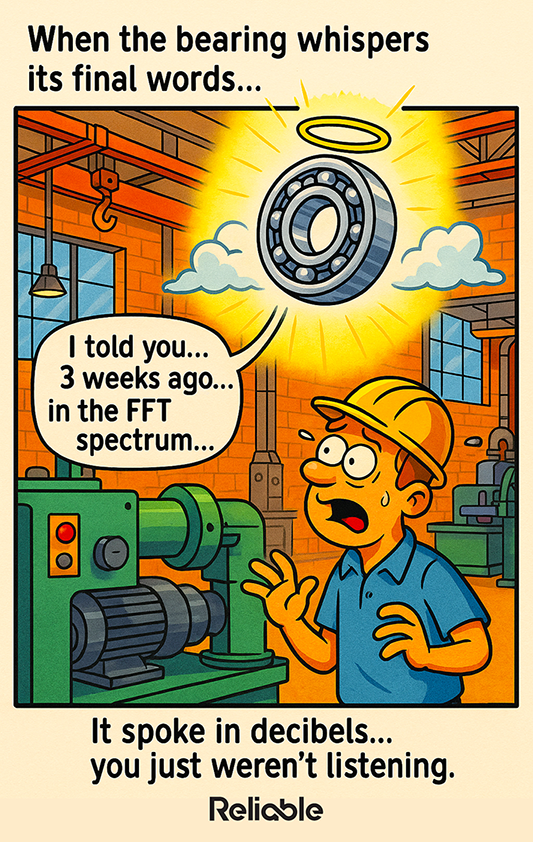
Every bearing tells a story, not in words, but in decibels. Long before catastrophic failure, subtle peaks emerge in the vibration spectrum, small enough to be dismissed as background noise. The cartoon captures this hauntingly well: a bearing’s “final words” reminding us that its signals were there all along.
In reliability engineering, vibration analysis for bearing failure detection isn’t just about data collection; it’s about interpretation. Every increase in amplitude, every harmonic at a characteristic frequency, is a message from inside the machine. The real challenge is not whether the bearing spoke, but whether the maintenance team was truly listening.
Why Bearings Speak Before They Fail
Most bearings don’t fail suddenly. The process is gradual, beginning with microscopic surface defects invisible to the naked eye. These imperfections propagate under load, generating impact forces that excite the natural frequencies of the bearing elements. Each type of defect —inner race, outer race, rolling element, or cage —produces a distinct vibration pattern.
Early-stage damage produces high-frequency, low-amplitude energy, often drowned out by environmental noise or overlooked due to insensitive alarm thresholds. As the fault evolves, impacts become stronger and more frequent, producing harmonics at multiples of the bearing fault frequency.
The progression follows a clear timeline:
- Initiation Phase: Minor fatigue or contamination triggers microscopic cracks.
- Propagation Phase: Cracks deepen, modulating vibration frequencies.
- Terminal Phase: Amplitude spikes appear, often accompanied by rising temperature or noise.
By applying vibration analysis to detect bearing failure, maintenance teams can identify a bearing’s condition and take action before it enters the destructive phase.
The FFT Spectrum: The Bearing’s Native Language
The Fast Fourier Transform (FFT) is the cornerstone of modern vibration diagnostics. It translates complex time-domain signals into the frequency domain, revealing hidden periodicities linked to specific machine components.
In vibration analysis for bearing failure detection, FFT plots expose the unique frequencies of mechanical defects. Each bearing geometry, the number of rolling elements, pitch diameter, and contact angle, determines its defect frequencies:
- BPFO (Ball Pass Frequency Outer race)
- BPFI (Ball Pass Frequency Inner race)
- BSF (Ball Spin Frequency)
- FTF (Fundamental Train Frequency)
When tracked over time, these spectral peaks serve as an early-warning radar. Analysts can visualize small changes in defect energy long before audible noise appears. The FFT doesn’t just show that something is wrong; it shows where it’s bad.
However, FFT data is only as valuable as the context applied to it. Raw spectra mean little without trending, baselining, and correlation to load conditions. A bearing at light load, for instance, may mask a defect signature that becomes obvious under full torque. True diagnostic insight comes from watching the FFT evolve, a voice that starts as a whisper, grows into a hum, and finally becomes a cry for help.
Why the Warnings Go Unheard
In theory, vibration data gives us predictive power. In practice, that power is often muted by organizational habits and blind spots. Common reasons include:
- Data collection without interpretation: Too many facilities treat vibration monitoring as a box-ticking exercise. Data is collected, stored, and forgotten.
- Over-reliance on alarm thresholds: Default alarm bands ignore machine-specific variability, leading to either false positives or missed faults.
- Skill gaps: Analysts who can recognize defect frequencies and sidebands are rare. Without trained personnel, FFT plots become noise.
- Reactive culture: Maintenance teams still prioritize urgent failures over subtle anomalies.
Ignoring these small shifts in spectral patterns leads to what the cartoon dramatizes: the bearing “spoke” weeks ago, but no one was paying attention. Plants that mature beyond this reactive mindset turn vibration data into an intelligent narrative of machine health.
Integrating Vibration Analysis into a Reliability Strategy
To make vibration analysis for bearing failure detection truly effective, it must be integrated into a structured reliability program rather than treated as a stand-alone practice. Successful programs share these traits:
- Baseline Every Asset – Establish reference spectra when machines are healthy. This defines what “normal” really looks like.
- Automate Trending – Use software to detect gradual amplitude growth or frequency modulation before thresholds are breached.
- Cross-Validate with Other Data Sources – Combine vibration insights with oil analysis, thermography, and ultrasonic inspection for root cause validation.
- Apply Condition-Based Maintenance (CBM) – Shift from calendar-based PMs to data-driven interventions, aligning maintenance actions with actual asset health.
- Document the Story – Every failure teaches—record spectra before, during, and after replacement to refine future detection thresholds.
The payoff is measurable: fewer unplanned outages, longer bearing life, and better credibility between maintenance and production teams. Plants that master vibration analytics reduce failure-related costs by up to 50% and improve OEE (Overall Equipment Effectiveness) through data-driven precision.
The Human Side of Machine Listening
Even with automation, algorithms, and AI, vibration analysis remains a human art. Machines generate data, but humans interpret meaning. The best analysts combine technical skill with intuition, understanding when a small 1.5x harmonic sideband at 30 Hz means trouble.
This is where emotional intelligence meets mechanical intelligence. Analysts must also communicate effectively, translating technical anomalies into language that operators and managers understand. Saying “BPFO sidebands indicate outer-race fatigue” means little unless it’s connected to risk, cost, and production context.
A plant that “listens” well doesn’t just detect faults; it builds a culture where every signal —from FFT peaks to lubrication reports —becomes part of a unified reliability story.
Listening Beyond the Noise
The bearing in the cartoon may be gone, but its data remains. Every spike in amplitude, every rise in the noise floor, every subtle harmonic, those were its final words. Vibration analysis for bearing failure detection turns those words into warnings, giving maintenance teams a voice in the future rather than the aftermath.
Machines rarely fail without warning. The question is whether your plant’s systems, culture, and people are tuned to hear them.
When the bearing whispers, it’s not superstition, it’s science. Listen closely, and you’ll never be surprised by silence again.