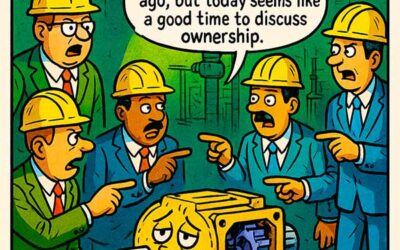
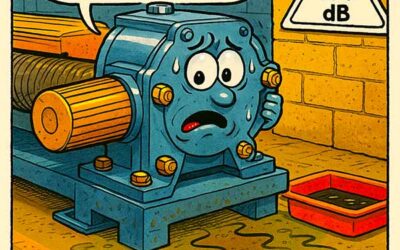
In maintenance, silence can be expensive. Every ignored vibration spike or rising temperature trend is a story that ends with downtime. The cartoon says it perfectly: a frustrated sensor crossing its arms as a motor burns beside it, “But sure, ignore my data again.”
That’s not just humor, it’s reality in too many plants. Despite widespread investment in IoT sensors for predictive maintenance, many organizations still fail to act on the insights these devices produce. The result? Data-rich but decision-poor maintenance departments.
The power of IoT sensors lies not in the data they collect, but in the action they inspire. Used correctly, they enable a new kind of reliability, one that replaces guesswork with foresight and converts early warnings into cost savings.
How IoT Sensors for Predictive Maintenance Actually Work
IoT sensors for predictive maintenance continuously collect condition data: vibration, temperature, pressure, oil quality, current draw, and more. Each device transmits readings wirelessly to a centralized system, where analytics software identifies deviations from standard operating patterns.
For instance:
- A vibration sensor might detect increasing amplitude at a specific frequency that signals bearing wear.
- A thermal sensor might identify a slow heat rise in a gearbox, indicating inadequate lubrication.
- A current sensor could detect a slight imbalance that precedes winding failure in a motor.
Once data is captured, cloud-based algorithms interpret trends across thousands of readings. These models are trained on historical data, allowing them to forecast when a component will likely fail—not just that it’s failing.
The outcome: maintenance teams receive warnings, allowing intervention before damage escalates. Each alert effectively buys time, time to plan, order parts, and schedule repairs without stopping production.
The sophistication of IoT sensors for predictive maintenance is growing rapidly. Newer systems use edge computing, performing analytics directly on the device itself. This reduces latency, ensures faster response, and minimizes bandwidth use, critical for remote or hazardous environments where reliability is everything.
The Business Value of IoT Sensors for Predictive Maintenance
Beyond the technical details lies the economic argument. Plants adopting IoT sensors for predictive maintenance consistently report measurable ROI. Downtime costs often exceed $250,000 per hour in some industries, making early detection an enormous competitive advantage.
Key benefits include:
- Reduced unplanned downtime: Failures detected weeks in advance can be scheduled for off-shift repairs.
- Maintenance optimization: Intervals are based on condition, not arbitrary time cycles.
- Inventory efficiency: Spare parts stocking aligns with actual degradation patterns.
- Extended asset life: Detecting imbalance and misalignment early prevents secondary damage.
- Safety improvement: Predicting failure before it becomes catastrophic protects personnel and equipment.
When predictive systems integrate with CMMS platforms, they automatically trigger work orders when specific thresholds are exceeded. This closes the reliability loop, turning sensor data into maintenance execution without manual handoffs.
IoT sensors don’t just measure machine health; they measure the maturity of your reliability culture.
Over time, organizations that consistently act on IoT insights see cultural transformation. Maintenance becomes a strategic discipline, not a firefighting function. Reliability teams move from reacting to predicting, and from predicting to optimizing.
Challenges in Implementing IoT Sensors for Predictive Maintenance
The path to predictive excellence isn’t simple. Many organizations deploy IoT sensors enthusiastically, only to discover that technology alone doesn’t deliver reliability. The most common pitfalls include:
- Alert fatigue: Too many alarms with no clear prioritization.
- Disconnected systems: Data from sensors, CMMS, and SCADA rarely talk to each other.
- Lack of analytical expertise: Teams struggle to interpret signal patterns or trend reports.
- Cultural resistance: Operators and technicians still trust “feel” over data.
To overcome these issues, successful plants implement a data hierarchy. Not every asset needs IoT monitoring—only those critical to production continuity. Define alert thresholds carefully, ensuring every notification demands meaningful action.
A second success factor is training. Reliability engineers must understand how to translate patterns into root causes—for example, increasing vibration amplitude combined with high bearing temperature points to lubrication starvation, not imbalance.
Finally, organizations must foster cross-functional ownership. Predictive maintenance only works when production, maintenance, and engineering share accountability for interpreting and responding to IoT data.
When the cultural and process barriers fall, IoT sensors become the backbone of reliability, not another ignored alert system.
How IoT Sensors for Predictive Maintenance Enable Smart Factories
IoT sensors don’t just predict failure, they help orchestrate entire production ecosystems. In Industry 4.0 environments, predictive maintenance is one pillar of the smart factory strategy, integrating real-time data across mechanical, electrical, and digital systems.
Here’s how:
- Digital twins replicate asset performance virtually, simulating degradation and predicting outcomes before physical inspection.
- AI-driven analytics correlate sensor inputs from multiple sources – vibration, temperature, energy consumption – to identify combined failure modes.
- Prescriptive maintenance goes beyond prediction by recommending optimal responses, such as lubrication adjustments or speed corrections.
The next frontier is autonomous maintenance ecosystems. Imagine a future where IoT sensors detect a trend, AI confirms the diagnosis, a robotic system applies corrective lubrication, and a CMMS automatically logs the intervention.
That’s not science fiction, it’s an emerging reality in leading facilities today. As costs drop and data infrastructure matures, these systems will become the norm rather than the exception.
Predictive maintenance evolves into intelligent reliability orchestration, where every device, from sensors to controllers, contributes to uptime intelligence.
Building a Future-Ready Reliability Strategy
IoT sensors for predictive maintenance are tools—but strategy gives them purpose. Reliability leaders should develop frameworks that blend technology adoption with human discipline:
- Asset Criticality Assessment: Prioritize which machines justify IoT investment.
- Baseline Data Collection: Record normal operating ranges for all parameters.
- Integration with CMMS: Ensure sensor alerts translate to actionable work orders.
- Analytics Feedback Loops: Continuously refine predictive models with post-repair insights.
- Cultural Reinforcement: Reward teams who prevent failures before they happen.
This approach converts predictive maintenance from a project into a continuous improvement system. Each intervention improves both the data model and the organization’s reliability maturity.
Conclusion
The cartoon’s burned motor and exasperated sensor capture a universal truth—technology alone can’t create reliability. Listening, interpreting, and acting on data completes the circle.
IoT sensors for predictive maintenance represent the sensory system of modern industry: alert, connected, and precise. But their warnings must reach the ears of decision-makers who value prevention over repair.
The plants that thrive in the next decade will be those that listen early, act fast, and learn continuously. Because in reliability, ignoring data isn’t just neglect, it’s permission for failure.