
All Six Losses in One Day: When TPM Fails, Losses Win
Total Productive Maintenance (TPM) was conceived to unite production and maintenance under one shared mission: maximize equipment effectiveness through proactive, operator-led care. But in too many plants, TPM has become a hollow ritual, clipboards filled, boxes checked, dashboards colored green, while machines groan, parts fail, and production limps along.
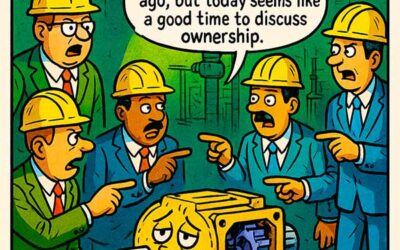
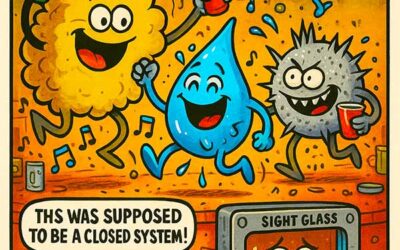
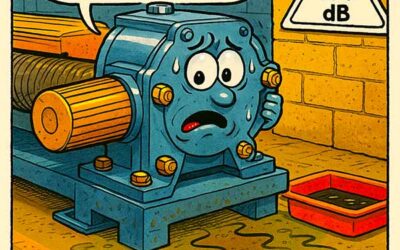
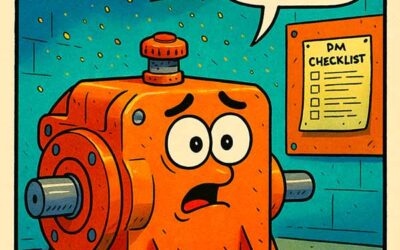
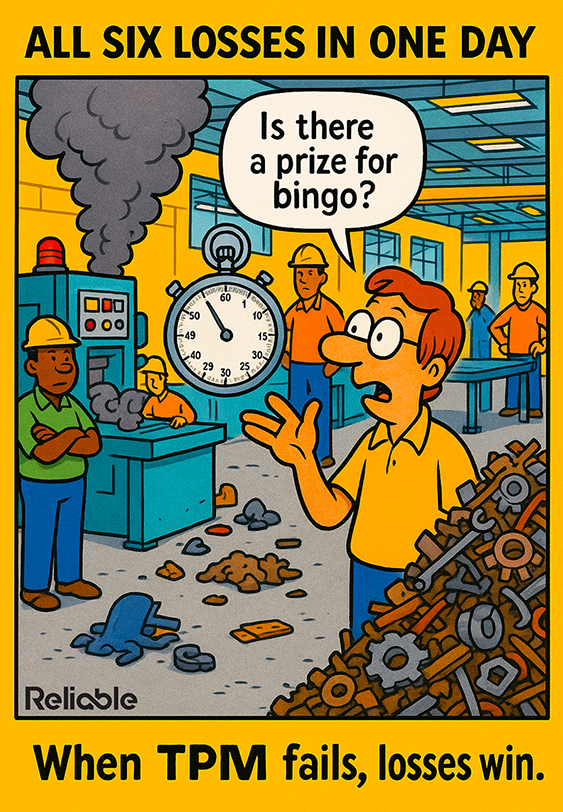
The cartoon captures this dysfunction perfectly: a maintenance engineer surrounded by chaos, stopwatch in hand, asking, “Is there a prize for bingo?” after experiencing all six significant losses in a single day. It’s humorous because it’s painfully honest. TPM, when misapplied, becomes the very opposite of what it intends, a performance-management parody rather than a performance system.
To understand why TPM succeeds in some plants but fails in others, we must revisit its original intent and the foundational principle behind it: ownership.
Understanding the Six Big Losses in TPM
The Six Big Losses in TPM are the enemy of manufacturing efficiency. They are universal, measurable, and unforgiving. Each represents a drain on productivity that collectively erodes Overall Equipment Effectiveness (OEE).
- Breakdowns – unplanned downtime due to equipment failure.
- Setup and Adjustment Losses – time lost to changeovers and calibration.
- Idling and Minor Stoppages – frequent small interruptions caused by jams, sensor faults, or misfeeds.
- Reduced Speed – operating below the designed rate due to wear, inefficiency, or poor settings.
- Defects and Rework – quality losses from process instability.
- Yield Losses – startup rejects and early production waste.
Each of these losses fits neatly into OEE’s three dimensions: Availability, Performance, and Quality. The problem? Many organizations treat TPM as a measurement exercise rather than a behavioral transformation. They tally downtime minutes, calculate percentages, and create impressive reports, but the underlying causes remain unchallenged.
When TPM devolves into “tracking the losses” rather than eliminating them, you get a plant that looks busy but achieves little. True TPM is about structural elimination—designing, training, and motivating people so that each category of loss shrinks through insight, not through luck.
Why TPM Fails: Culture Before Checklists
In every failed TPM initiative, the fingerprints of culture are everywhere. Teams understand the Six Big Losses in TPM, but they don’t own them. Operators are asked to perform daily inspections, clean and lubricate, or fill out condition logs, but without context or authority, those tasks become chores. The human system doesn’t change; the paperwork increases.
The heart of TPM lies in autonomous maintenance, empowering operators to detect early warning signs, correct minor problems, and communicate effectively with maintenance. But empowerment requires trust and training. Many organizations skip those steps. Instead, they impose TPM as a top-down directive, stripping it of the very autonomy that makes it work.
TPM doesn’t fail because people resist change – it fails because leadership resists patience.
Another failure point is short-term thinking. TPM is a marathon, not a sprint. The first months often reveal more problems than they solve, because visibility improves before performance does. Leaders who expect instant gains frequently misinterpret this transparency as failure and pull back support just when it’s most needed.
Lastly, TPM fails when it’s disconnected from business value. Without linking the Six Big Losses in TPM to financial performance, lost throughput, overtime costs, wasted materials, management sees it as an “operations project,” not a strategic initiative.
When the culture is wrong, even the best TPM playbook becomes theater.
Turning the Six Big Losses in TPM into Wins
Reviving TPM requires less reinvention and more rediscovery. It’s about returning to the fundamentals and ensuring that behaviors, not bureaucracy, drive results.
1. Start small, finish strong.
Select one asset or one area suffering from multiple losses. Measure its OEE baseline, identify its top two loss categories, and attack them methodically. Document every root cause and countermeasure. Publicize the results. Small wins earn credibility.
2. Build ownership from the ground up.
Let operators lead condition checks, cleaning routines, and minor adjustments. Train them to recognize signs of deterioration – temperature, noise, vibration – and to report trends before they escalate. Maintenance’s role should shift from firefighting to coaching.
3. Make the Six Big Losses in TPM financially visible.
Translate each loss category into dollars per shift or per week. For example, a 3% speed loss on a critical filler line might equate to $75,000 in annual lost revenue when you make waste tangible, engagement increases.
4. Create visual feedback loops.
Use performance boards and digital dashboards that show daily trends in OEE, downtime, and yield. Celebrate recoveries. Investigate regressions. A data-driven environment keeps TPM relevant and transparent.
5. Sustain through cross-functional ownership.
Maintenance, production, engineering, and quality must share one scorecard. If one department’s “win” creates another’s “loss,” the system collapses. TPM thrives only when everyone owns the exact definition of success.
This systematic approach transforms TPM from a compliance ritual into a living reliability culture.
The Future of TPM: Data, AI, and Predictive Precision
As manufacturing enters the digital era, the principles behind TPM are merging with Industry 4.0. The Six Big Losses in TPM are no longer tracked manually; they are continuously monitored by sensors, analyzed by algorithms, and visualized in real time.
Predictive maintenance platforms now detect micro-patterns of degradation invisible to the human ear or eye. Machine learning models correlate production speed, vibration, and temperature data to anticipate failures days or even weeks ahead. Yet technology alone doesn’t deliver reliability; it augments human discipline.
Predictive maintenance isn’t replacing human intuition – it’s revealing what intuition can’t see.
The ideal model blends human vigilance with digital intelligence. Operators still inspect, clean, and care for their machines—but now they do so guided by data, not guesswork. AI doesn’t replace TPM; it fulfills its original promise by making losses measurable, predictable, and preventable.
This integration marks a turning point. Plants that master digital TPM will redefine what “zero losses” means, not a slogan, but a measurable operating reality.
Final Thoughts: The Real Prize Isn’t Bingo
The cartoon’s humor resonates because it reflects a universal truth: many TPM programs collect all six losses like trophies of good intentions. But when TPM fails, losses win.
True success isn’t about prizes, posters, or acronyms; it’s about the relentless pursuit of elimination. Each small victory against one of the Six Big Losses in TPM compounds into a culture of reliability, pride, and performance.
And that’s the real prize worth winning.