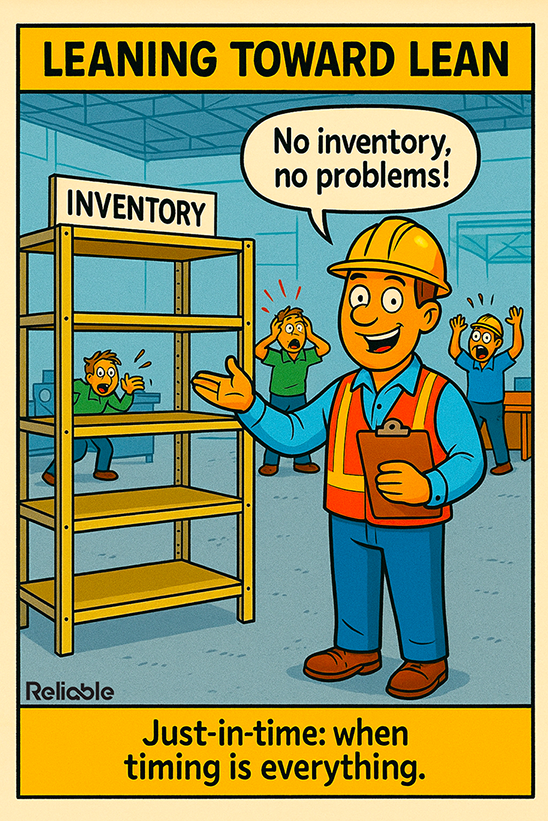

The cartoon illustrates a classic lean misstep, celebrating empty shelves as proof of efficiency. The cheerful supervisor proclaiming, “No inventory, no problems!” captures the irony of just-in-time inventory management gone wrong. While lean thinking rightly aims to minimize waste, many organizations misinterpret the principle and confuse less with better.
In reality, the purpose of just-in-time (JIT) is not to starve production lines of materials but to synchronize them so precisely that each component arrives at the perfect moment. Actual JIT requires a balance of precision, visibility, and contingency – not an obsessive race to the lowest inventory count.
1. Understanding Just-in-Time Inventory Management
Just-in-time inventory management emerged from Toyota’s production system, built on the idea that waste (muda) can be systematically eliminated through continuous improvement and flow optimization. It reduces the cost of holding inventory, minimizes obsolescence, and improves responsiveness to customer demand.
However, JIT only succeeds when a manufacturer’s entire value stream, suppliers, logistics partners, production planners, and maintenance teams operate as a synchronized system. The closer each process is timed to actual demand, the less capital is tied up in storage. But that same precision leaves the system vulnerable to even minor disruptions if not supported by robust processes and communication.
The most effective JIT operations understand that “lean” does not mean “thin.” They design stability into every handoff, ensuring that the flow of materials is steady, predictable, and capable of handling the inevitable variations of real-world manufacturing.
2. The Hidden Costs of Going Too Lean
The phrase “No inventory, no problems!” is a dangerous oversimplification. In just-in-time inventory management, too little buffer inventory can create catastrophic ripple effects. When one component doesn’t arrive on time, downstream production stops. What looks efficient on paper can become chaos on the floor.
Common hidden costs of going too lean include:
- Production downtime: Machines sit idle while waiting for parts.
- Emergency shipping costs: Overnight freight or supplier expediting destroys cost savings.
- Lost customer trust: Late deliveries damage reputation and credibility.
- Overburdened staff: Pressure mounts on planners and maintenance teams to “catch up.”
When organizations implement JIT without a mature process culture, they often replace inventory waste with chaos waste – unplanned downtime, constant firefighting, and inconsistent output. The point of lean is to improve reliability and flow, not to push operations to the brink.
Effective lean practitioners use data-driven decision-making to find the minimum viable inventory, small enough to reduce waste but large enough to protect continuity. This balance defines sustainable lean performance.
3. Synchronizing Supply Chains with Just-in-Time Inventory Management
In the modern era, just-in-time inventory management depends as much on data visibility as on discipline. Digital transformation has made it possible to monitor and control supply chains in real time, ensuring that lean systems don’t collapse under variability.
Technologies enabling synchronization include:
- Industrial IoT (IIoT): Sensors and systems that provide real-time production and logistics visibility.
- AI-powered forecasting: Predictive analytics that anticipate changes in demand or supplier performance.
- Digital twins: Virtual models that simulate production and logistics flows to identify weak points.
- Supplier performance dashboards: Continuous monitoring to ensure adherence to delivery and quality standards.
By connecting suppliers, warehouses, and production facilities through shared data, manufacturers achieve a responsive, self-correcting system. JIT then becomes a dynamic process—adjusting to external variables without losing flow integrity.
This synchronization is especially critical in global supply chains, where disruptions (weather events, port delays, geopolitical shifts) can ripple across continents. A well-designed JIT program includes not only synchronization but redundancy, backup suppliers, contingency stock for critical items, and transparent communication protocols that keep everyone informed when timing slips.
4. Building Resilience into Lean Systems
The final evolution of just-in-time inventory management is resilience. Lean without resilience is fragility disguised as efficiency. When organizations focus solely on minimizing cost, they expose themselves to system-wide collapse under stress.
Key strategies for building resilience into JIT include:
- Strategic buffer zones: Holding micro-inventories for high-risk or long-lead parts.
- Multi-sourcing: Avoiding single-supplier dependency to reduce vulnerability.
- Scenario modeling: Simulating disruptions to test how the system responds.
- Collaborative planning: Aligning schedules, forecasts, and risk assessments across partners.
- Predictive maintenance: Ensuring that machine reliability supports JIT flow continuity.
Toyota’s approach remains the benchmark: its JIT systems are supported by decades of supplier integration, standardized communication protocols, and a deeply ingrained problem-solving culture. When a disruption occurs, their teams respond instantly, not with panic, but with structure and discipline.
The essence of resilience is readiness. A resilient lean system does not rely on luck or perfection but on processes that anticipate variability and recover quickly.
5. The Human Side of Just-in-Time Inventory Management
Beyond technology and systems, just-in-time inventory management relies heavily on people. Operators, planners, and supervisors must understand the intent behind the method. Without buy-in and training, JIT devolves into box-checking, empty shelves mistaken for progress.
Empowered employees can recognize when the system is strained and act before a failure cascades. They must have the authority to halt production when flow integrity is at risk and mechanisms to communicate across functions instantly. A culture of shared accountability transforms lean from a management slogan into a lived discipline.
In short, lean succeeds when people think systemically. They understand that timing, not inventory, is the heartbeat of production.
Conclusion: Lean Without Losing Balance
The humor of the cartoon underscores a truth many manufacturers learn the hard way: being “lean” isn’t about having nothing, it’s about having precisely what you need, exactly when you need it.
Just-in-time inventory management demands precision, communication, and adaptability. It thrives when supply chains are visible, processes are standardized, and decision-making is informed by data rather than dogma.
The ultimate measure of lean success is not how empty the shelves are, but how consistently and predictably value flows to the customer. Timing is everything, and when done right, just-in-time becomes not a constraint, but a competitive advantage.