
Bearings are the silent enablers of modern industry. They enable rotating equipment to operate with efficiency, consistency, and precision. Yet, many bearings are doomed before they even begin turning. False brinelling damage in bearings before installation is one of the most insidious forms of premature wear.
Unlike catastrophic overloads or poor lubrication practices, this failure mode often occurs while a bearing is still wrapped in packaging or waiting on a shelf. The irony is painful: before the first shaft rotation, reliability may already be compromised.
This article examines the nature of false brinelling, its significance, and what reliability professionals can do to prevent this silent saboteur from undermining asset performance.
Understanding False Brinelling Damage in Bearings Before Installation
To understand the problem, we must first distinguish between “true” brinelling and “false” brinelling. True brinelling occurs when static overload forces permanently indent the raceways. False brinelling, by contrast, is the result of small-amplitude oscillations and vibrations acting on a stationary bearing.
Here’s how it happens:
- A bearing is placed on a truck, train, or ship for transport.
- External vibration from the journey transmits into the bearing.
- The rolling elements, though not rotating, microscopically rock back and forth in place.
- These micro-movements displace lubricant films and create direct contact between rolling elements and raceways.
- Over time, fretting wear patterns form, which resemble brinell marks but stem from vibration instead of overload.
By the time the bearing reaches the plant, surface scars are already etched into the raceways. Even if the bearing appears new and unused, those microscopic imperfections act like cracks in glass—tiny flaws that grow under stress until the bearing fails well before its expected service life.
False brinelling damage in bearings before installation is a relatively common occurrence. Plants that stockpile spares or receive long-distance shipments are especially vulnerable. In fact, studies suggest that improper storage and handling account for a surprisingly high percentage of early bearing failures, which are often misdiagnosed as operational issues when, in reality, the real culprit was mishandling before the bearing even entered service.
Why False Brinelling Damage in Bearings Before Installation Matters
The consequences of ignoring this problem are both technical and economic in nature. Superficial as the marks may look, they create ripple effects that degrade reliability in several ways:
- Accelerated Fatigue – Once a surface is scarred, stress risers form. These micro-defects concentrate fatigue loads, accelerating crack propagation.
- Increased Noise and Vibration – Damaged raceways create mechanical chatter, which leads to audible noise and elevated vibration signatures. This not only reduces comfort in operator environments but also triggers false alarms in condition monitoring systems.
- Premature Replacement – Bearings with false brinelling rarely achieve their rated lifespan. A component designed for 100,000 hours might fail in a fraction of that time.
- Hidden System Costs – Early bearing failure doesn’t just take out the bearing. It increases wear on shafts, housings, couplings, and seals. Often, secondary equipment must also be rebuilt.
- Misdiagnosed Failures – Technicians often misattribute failures to lubrication errors, misalignment, or contamination, when the damage was “baked in” before installation.
Consider a scenario: a critical pump motor is rebuilt with a bearing that should be brand-new. Within weeks, vibration alarms trip, and failure occurs. Engineers scramble to find the cause, possibly lubricant viscosity or electrical fluting. They spend thousands on troubleshooting, only to eventually realize the bearing was compromised before it ever came into contact with the shaft. The root cause wasn’t in the plant at all, it was in the supply chain.
Prevention Strategies for False Brinelling Damage in Bearings Before Installation
The good news is that preventing false brinelling is entirely achievable. It requires an awareness of the problem, structured handling protocols, and discipline across the supply chain.
1. Transport Safeguards
- Use cushioned or foam-lined crates for transport.
- Employ isolation mounts to minimize vibration during long-haul shipping.
- Avoid stacking heavy items directly against bearing containers.
2. Smart Storage Practices
- Store bearings away from vibrating equipment or high-traffic zones.
- Place critical spares in controlled environments with low ambient vibration.
- For large bearings, store them horizontally to distribute loads evenly.
3. Rotational Maintenance
- Periodically rotate shafts or manually turn bearings in storage to redistribute lubricant films and prevent localized wear.
- Implement a rotation schedule for spares stored longer than six months.
4. Protective Lubricants and Packaging
- Apply preservatives or vibration-resistant greases during extended storage.
- Seal crates tightly to protect from contaminants, which worsen fretting.
5. Training and Culture
- Teach storeroom personnel that bearings can “wear out” before they ever run.
- Incorporate inspection steps before installation, checking for false brinelling scars under magnification.
- Make it a cultural expectation that handling is as critical as lubrication or alignment.
By embedding these practices into procurement and storeroom operations, plants can eliminate a costly and unnecessary source of premature failures.
From Awareness to Reliability Culture
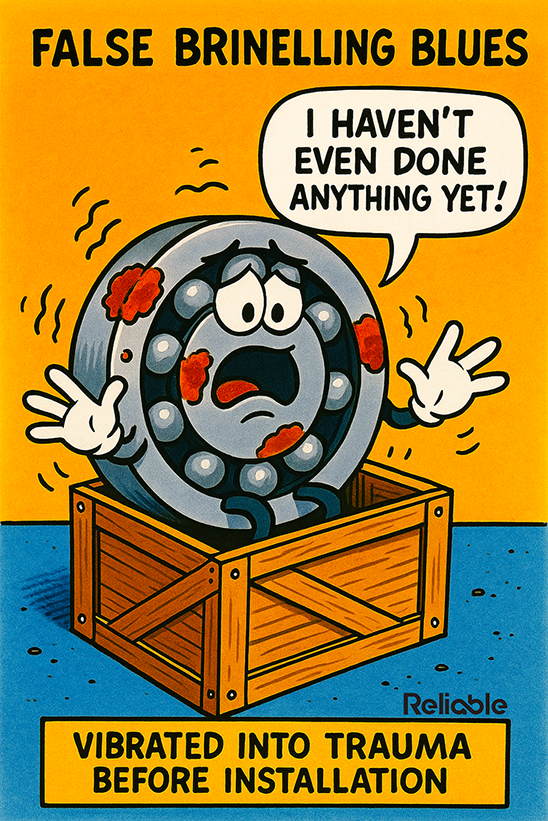
The cartoon says it best: “I haven’t even done anything yet!” That’s the tragedy of false brinelling damage in bearings before installation. Perfectly good components are being sacrificed by inattention to vibration during transport and storage.
To change this, reliability leaders must adopt a life-cycle view of asset health. That means treating the supply chain, storage practices, and pre-installation handling with the same rigor as lubrication analysis or precision alignment. Ask:
- Do your suppliers ship with vibration control measures?
- Does your storeroom have isolation protocols for critical spares?
- Are your maintenance planners aware of how false brinelling presents itself?
Reliability isn’t just what happens after startup. It begins long before, with procurement, with logistics, with the culture of care we apply to every component. Bearings deserve respect from the moment they leave the factory. When we prevent false brinelling damage in bearings before installation, we extend life cycles, reduce unplanned downtime, and eliminate a hidden drain on OPEX.
The next time a bearing fails prematurely, don’t just look at lubrication or alignment; consider the entire system. Ask the deeper question: Was this component already compromised before we even installed it? That simple shift in perspective can save countless hours, dollars, and headaches. Reliability starts long before rotation.