
The Real Cost of Delaying the Annual Maintenance Budget
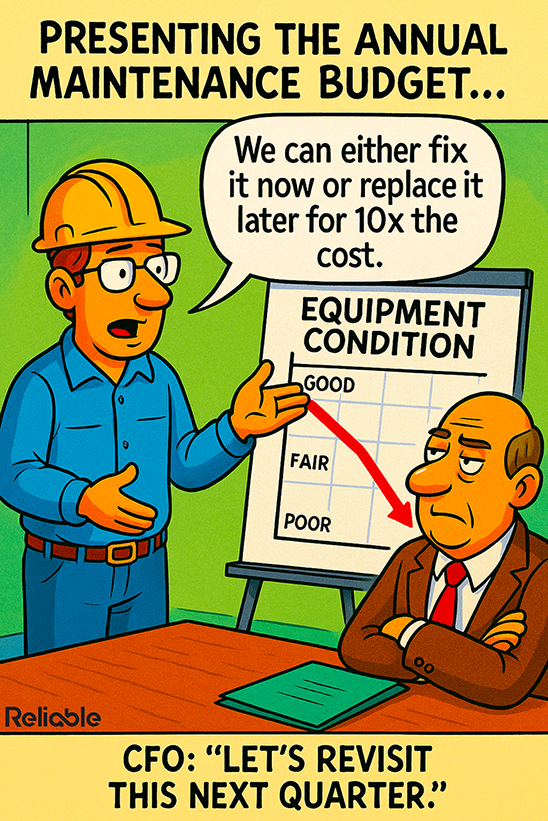
There’s a familiar dance that plays out in almost every industrial operation. The maintenance leader, armed with spreadsheets, condition data, and a sense of urgency, presents the annual maintenance budget to the finance department. The CFO listens, folds arms, and calmly says: “Let’s revisit this next quarter.”
The cartoon captures the moment perfectly – one side sees the steep decline in asset condition, while the other side sees only the near-term expense. What often goes unsaid is that the decision to delay is not neutral. It’s a bet against physics, wear rates, and probability. And it’s a bet the plant almost always loses.
The impact of delaying the annual maintenance budget is not merely about kicking the can down the road. It sets in motion a chain reaction of hidden costs, including accelerated deterioration, unplanned downtime, cascading failures, and ultimately, capital expenditures that exceed the original budget request.
Reliability professionals have known this truth for decades: machines don’t wait for budget cycles. They degrade according to operating stress, contamination, and load. By ignoring this fact, organizations set themselves up for the classic trap: saving pennies now, losing dollars later.
Why Delaying the Annual Maintenance Budget Is False Economy
On a balance sheet, the maintenance budget looks like a controllable line item. Trim it and the quarter looks better. But in reality, the impact of delaying the annual maintenance budget often results in spending far more than was saved.
Take a simple case: lubrication. A $500 investment in oil analysis might flag water contamination that, if left unchecked, will destroy a $50,000 gearbox. Skip the monitoring, defer the repair, and you inherit a catastrophic failure that takes out production for two days. That lost production may cost $200,000. The math is brutal.
False economy manifests in three major ways:
Energy Losses
Degraded equipment draws more power. Bearings running dry, pumps fighting cavitation, or compressors leaking air – all burn cash invisibly.
Cascading Failures
When one component fails, it rarely fails alone. A seized bearing can take out housings, shafts, motors, or entire gear trains.
Emergency Premiums
Parts and labor bought in crisis cost more. Rush orders, contractor call-outs, and expedited shipping turn routine fixes into budget-busters.
Executives often underestimate the steepness of these costs. A dollar deferred is not a dollar saved; it can quickly become ten dollars lost.
Linking Equipment Condition to the Annual Maintenance Budget
The cartoon’s visual, a downward arrow from Good to Poor, captures what asset managers see every day. Equipment condition is not static; it degrades along a curve that accelerates when preventive actions are skipped.
The impact of delaying the annual maintenance budget is best understood through the lens of asset condition:
- Good Condition – Preventive tasks (lubrication, inspections, calibrations) sustain reliability at modest cost.
- Fair Condition – Degradation becomes visible. Corrective tasks and mid-life overhauls are needed to prevent further decline. Costs rise.
- Poor Condition – Failures dominate. The plant is trapped in a cycle of emergency response, replacement, and downtime. Costs spike dramatically.
Budgeting isn’t about appeasing finance, it’s about aligning spend with condition-based needs. Organizations that fail to fund early interventions find themselves writing far bigger checks later.
This is why world-class reliability organizations treat the annual maintenance budget as a strategy document, not a wish list. It’s directly tied to preserving equipment health and, by extension, preserving profitability.
Building the Business Case for the Annual Maintenance Budget
Convincing a CFO requires speaking the language of risk and return, not grease and gearboxes. Maintenance leaders must translate the impact of delaying the annual maintenance budget into financial terms that executives can’t ignore.
Key tactics include:
- Cost Avoidance Demonstrations – Show, with data, how $200,000 in preventive spend avoided $2 million in catastrophic replacements across the last three years.
- Downtime Cost Modeling – Tie each maintenance request to production output. For example: “Skipping this $10,000 pump overhaul risks a $300,000 loss if it fails during peak production.”
- Risk-Based Prioritization – Use criticality rankings to show that the budget isn’t bloated—it’s focused on assets where failure has the largest business impact.
- Lifecycle Extension Arguments – Present evidence that properly funded maintenance extends asset life by 5–10 years, delaying major capex.
- Benchmarking Against Peers – Show how companies with higher maintenance maturity consistently outperform peers in OEE (Overall Equipment Effectiveness), MTBF (Mean Time Between Failures), and profit margins.
When finance views maintenance not as an expense but as a risk mitigation and profit preservation measure, budget approval becomes far more likely.
Moving from Next Quarter to Now
“Let’s revisit this next quarter” is not just a punchline, it’s a red flag. Every deferred quarter compounds risk. Every skipped inspection narrows the PF interval. Every cut in lubrication, alignment, or inspection is another roll of the dice against the laws of physics.
To escape this cycle, reliability leaders must:
- Tie Maintenance to Strategy – Position the annual maintenance budget as an enabler of production reliability, not just overhead.
- Use Visual Storytelling – Charts, PF curves, and cost multipliers make risks real in ways spreadsheets cannot.
- Build Cross-Functional Alliances – Partner with operations, safety, and quality leaders to reinforce the case that underfunded maintenance jeopardizes all performance goals.
The goal is to shift the narrative from maintenance asking for money to the business protecting its own long-term interests. At the end of the day, equipment doesn’t care about fiscal quarters; it only responds to the care it receives.
The impact of delaying the annual maintenance budget is clear: higher costs, greater risks, and lost reliability. Acting now is not just prudent – it’s essential for sustainable profitability.