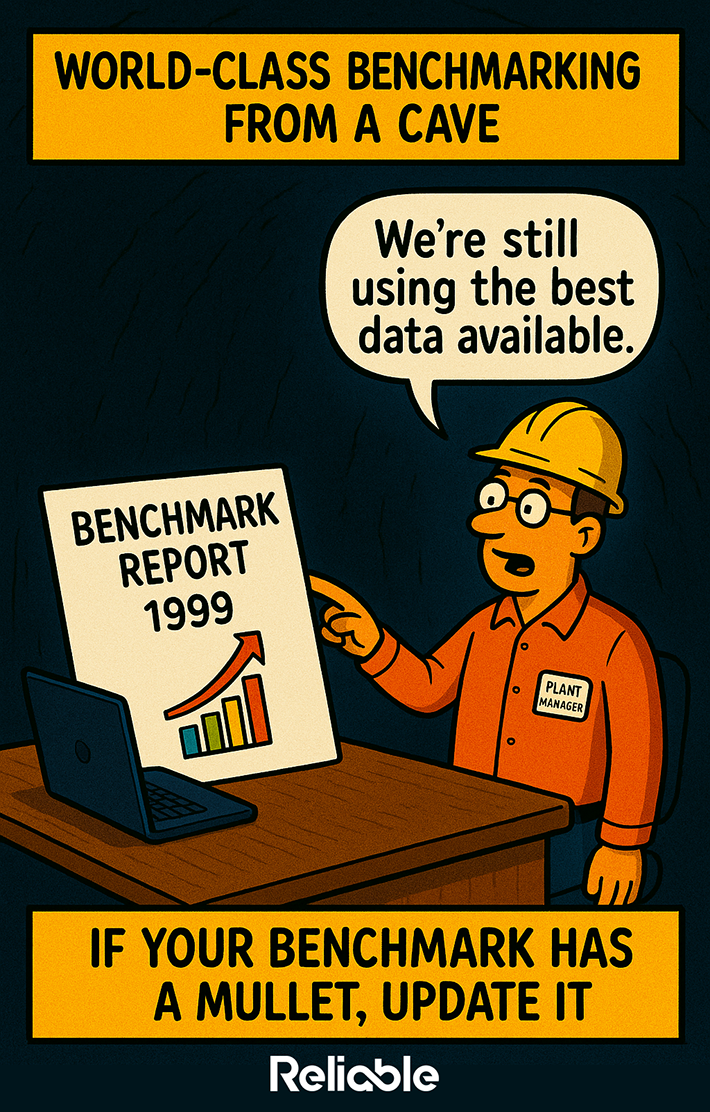

It’s funny because it’s true – and dangerous. This cartoon of a plant manager proudly presenting a 1999 benchmark report in a cave-like office illustrates a common but critical failure in industrial operations: relying on outdated benchmarking data in maintenance. In a world where digital transformation is reshaping industry norms, clinging to legacy data is more than inefficient—it’s a liability.
The Benchmarking Trap: How Legacy Data Becomes a False Security Blanket
Benchmarking should guide performance improvement, not preserve mediocrity. Yet across plants worldwide, leaders still point to dusty reports from the late ’90s as proof of excellence. The reason? Comfort. Old benchmarks are familiar, pre-vetted, and don’t challenge the status quo. But here’s the problem: they don’t reflect today’s operating conditions, technologies, labor realities, or risk tolerance.
- Outdated benchmarking data in maintenance leads to a cascade of misaligned decisions:
- PM frequencies based on equipment no longer in service
- Labor KPIs rooted in pre-automation staffing levels
- OEE targets that don’t consider predictive tools or modern asset strategies
In short, using a 25-year-old benchmark is like diagnosing engine trouble with a horse-and-buggy manual. You’ll miss the actual problem every time.
Outdated Benchmarking Data in Maintenance: A Hidden Performance Killer
The cartoon’s punchline—“If your benchmark has a mullet, update it”—is more than a joke. It points to a hidden but systemic performance drag: the use of obsolete performance targets that create the illusion of success.
When you benchmark against irrelevant data, two things happen:
- You fail to see opportunity. If you’re outperforming a dead standard, you’ll stop pushing.
- You misallocate resources. Trying to hit outdated benchmarks wastes time and capital on goals that don’t matter anymore.
One of the hardest things to do in maintenance is to let go of “what used to work.” But maintenance is not a static science—it evolves with every technological advance and operational shift. And your benchmarking needs to evolve too.
Modernizing Benchmarks: What Today’s Data-Driven Plants Do Differently
The plants that lead the industry don’t rely on outdated benchmarking data in maintenance. Instead, they:
- Leverage real-time data: Pulling performance KPIs from CMMS, sensors, and predictive platforms gives a living view of asset health and performance.
- Use industry consortiums: Groups like SMRP and ISA provide dynamic benchmarking tied to current standards and peer comparisons.
- Tie benchmarks to business outcomes: Instead of arbitrary ratios, modern plants ask, “Does this metric help us reduce downtime, improve ROI, or manage risk?”
- And most critically, they re-benchmark regularly. A 2023 benchmark is already aging. Smart organizations revisit targets at least annually, or after major asset, staffing, or strategic shifts.
How to Replace Outdated Benchmarking Data in Maintenance
Step 1 is admitting the data is stale. Step 2 is replacing it with better inputs. Here’s a roadmap:
- Audit your current benchmarks. Identify which ones are over five years old or no longer tied to active assets or workflows.
- Source new data. Use internal data where you can (from EAM, CMMS, or PdM systems) and blend with external sources (industry surveys, consulting groups).
- Engage SMEs and operators. Tribal knowledge, when curated properly, can validate or challenge outdated assumptions.
- Benchmark forward, not backward. Don’t just ask what the industry did—ask what the leaders are doing next.
Also, apply context. Not every plant needs to chase a “world-class” metric if it doesn’t align with business goals. The key is relevance, not prestige.
Conclusion: The Real Cost of Nostalgic Metrics
Relying on outdated benchmarking data in maintenance may feel safe, but it erodes operational competitiveness silently. If your benchmark has a mullet—or worse, a VHS tape—it’s time to update it. True leaders constantly recalibrate to stay ahead of change, not hide from it.
Benchmarking should be a compass, not a trophy. So next time someone pulls out a 1999 report, hand them a flashlight—and a modern KPI dashboard.