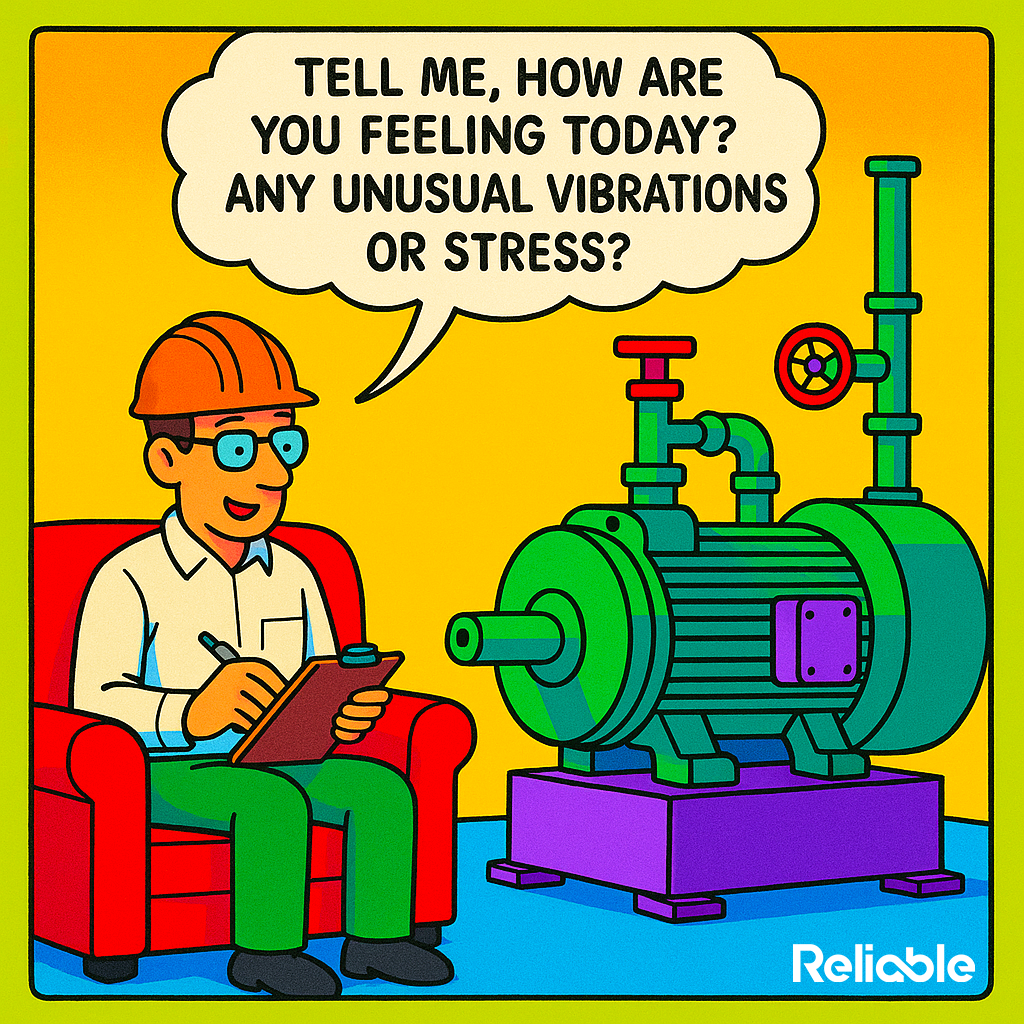

A Diagnostic Couch for Machines: The Power of Listening
In the cartoon, we see a technician interviewing a motor like a therapist with a clipboard—asking it about “unusual vibrations or stress.” While humorous, the concept hits a deeper truth: machines do communicate. They just use vibration, temperature, and sound instead of words. Routine vibration health assessments are the structured way we listen.
These assessments allow maintenance teams to detect early-stage mechanical faults—misalignment, imbalance, bearing wear, or looseness—before they escalate into catastrophic failures.
Much like preventive medical checkups, vibration data gives insight into the machine’s physical and operational condition. And like any good diagnosis, it requires context: what’s normal for this machine, in this application, under this load?
Stress and Vibration: Not Just a Metaphor
Routine vibration health assessments underscore a critical reality: stress and vibration go hand in hand.
When components are under excessive load or experiencing uneven force distribution, they begin to vibrate in abnormal patterns. And if you know what to listen for, you can distinguish between a healthy hum and a cry for help.
Unusual vibrations often reveal latent issues such as shaft misalignment or resonance. Left unchecked, these issues multiply stress throughout the system.
Routine assessments help correlate vibration data with operating context—speed, load, temperature—to flag anomalies before they translate to unplanned downtime or worse, secondary damage across the system.
Turning Data Into Decisions: What Health Assessments Should Include
Effective routine vibration health assessments don’t rely on generic templates or quarterly check-ins alone. They’re tailored programs that consider the criticality of assets, their failure modes, and operational context.
Here’s what best-in-class assessments include:
- Baseline fingerprinting for each asset under normal conditions
- Trend analysis over time, not just snapshot diagnostics
- Cross-referencing with other condition indicators like oil analysis or thermal imaging
- Thresholds and alarms based on severity scales, not arbitrary limits
The goal isn’t just to detect vibration; it’s to diagnose and prioritize actionable maintenance. If a motor’s frequency spectrum shows a rising 2x line, is it imbalance or a cracked rotor bar? Context and corroborating data turn alerts into confident decisions.
Culture Shift: From Reactive to Proactive with Vibration Insight
Introducing routine vibration health assessments also changes how the plant thinks about maintenance. When the machine’s condition speaks louder than the calendar, teams shift from reactive firefighting to targeted intervention. Vibration data gives technicians the confidence to say, “Let’s fix it now—before it breaks.”
Just as the cartoon technician calmly asks the machine about stress, maintenance pros start seeing machines as responsive entities, not just mechanical black boxes. This mental shift is crucial for building a reliability-centered culture—where action is based on evidence, and downtime is no longer accepted as inevitable.
Final Thoughts: Don’t Wait for the Breakdown
The humor in the cartoon lands because it’s rooted in truth: maintenance professionals must ask the right diagnostic questions—just like doctors. The longer you wait, the harder it is to treat the issue.
Routine vibration health assessments are a proven path to lower downtime, higher asset life, and reduced maintenance costs. In a world where machines can’t talk, vibration is their voice. All we have to do is listen.