

Spinning the Wheel of Misfortune
In too many plants, setting preventive maintenance (PM) intervals still resembles a game show. Weekly? Monthly? Annually? Never?
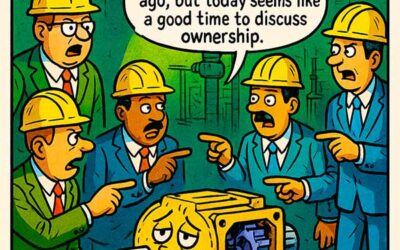
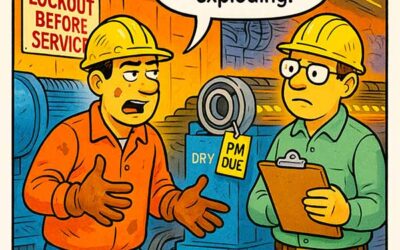
Without real asset data or failure modes analysis, planners are left spinning the wheel—hoping their guess keeps the plant running smoothly. The cartoon captures this dysfunction perfectly: a hard hat-wearing tech pleading for a quarterly interval while the wheel of chance says otherwise.
This kind of tribal knowledge-based planning is dangerous. It’s also expensive. Either you’re wasting time and resources over-maintaining, or you’re exposing assets to premature failure by under-maintaining.
Neither is acceptable when you consider the alternatives—especially the ability to optimize preventive maintenance intervals using structured methodologies and available data.
Why We Still Guess PM Intervals
PM intervals are often legacy assumptions. Someone picked a number years ago, and it stuck. Maybe it was based on the OEM manual. Maybe it was based on a gut feeling. Maybe it was copied from another plant. The point is, very few intervals are validated with actual performance data or failure patterns.
And the consequences? Misallocated labor. Poor spare parts alignment. Maintenance-induced failures. Hidden costs. Worse, inconsistent PMs become impossible to justify to leadership because no one knows if they’re helping or hurting. When you’re operating in the dark, optimize preventive maintenance intervals becomes an unreachable goal.
How to Optimize Preventive Maintenance Intervals
To break free from the wheel of guesswork, a systematic approach is required. Here’s the blueprint:
Gather Historical Failure Data
Mine your CMMS for failure records, work order close-outs, and mean time between failure (MTBF) trends. This gives you a baseline to evaluate how often components fail under current PM conditions—or lack thereof.
Perform Failure Modes and Effects Analysis (FMEA)
FMEA exposes the ways components fail, how critical those failures are, and how frequently they occur. With it, you can assign risk priority numbers and align PM activities to mitigate the highest risks. This is key to knowing whether something should be done weekly, monthly, or quarterly—not just guessing.
Use Condition Monitoring Where It Matters
Technologies like vibration analysis, oil analysis, thermography, and ultrasonic inspection help extend PM intervals by identifying early warning signs. You move from a rigid calendar schedule to an evidence-based, condition-based model.
Pilot and Adjust
Don’t flip the whole program at once. Pick 10-20 assets, revise PM intervals based on data, and compare reliability, cost, and downtime metrics before scaling up. The goal: optimize preventive maintenance intervals by applying data and iteration, not spin-the-wheel randomness.
Cultural Roadblocks and the Way Through
Implementing smarter PM interval strategies often runs into resistance:
- “We’ve always done it this way.”
- “I don’t trust the data.”
- “We don’t have time to analyze failures.”
These aren’t technical objections—they’re cultural ones. Leaders must challenge maintenance teams to rise above guesswork and pursue defensible decisions. That means allocating time to root cause analysis, incentivizing data accuracy, and setting KPIs for PM effectiveness.
A good starting point? Stop asking how often something “should” be done. Start asking what risk you’re mitigating—and how you know.
The Cost of Guessing vs. The ROI of Data
The plant in the cartoon gets a laugh, but the reality isn’t funny: most companies lose 5-10% of their total production to unplanned downtime. A large portion of this can be traced back to poorly defined or poorly executed PM routines.
Conversely, companies that optimize preventive maintenance intervals report fewer failures, higher wrench time efficiency, and lower MRO inventory bloat. The upfront cost of analysis is real, but the long-term payoff is bigger.
Bottom Line:
Spin the wheel if you must—but know you’re gambling with uptime, budget, and credibility. Plants that thrive aren’t playing games. They’re applying data, tools, and structured reasoning to every maintenance decision—especially PM intervals.