
The Legacy Lives On – But at What Cost?
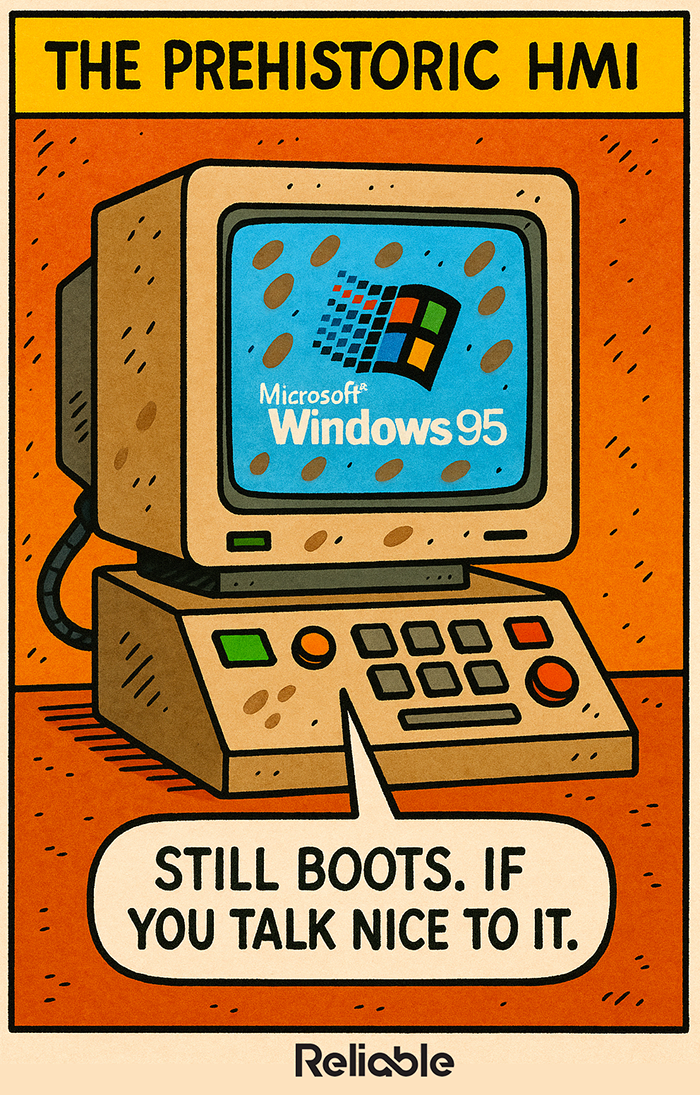
There it is, glowing like an artifact in a digital museum—your plant’s Human-Machine Interface (HMI) running on Windows 95.
A system that, in its heyday, might’ve felt revolutionary, but today feels more like a relic from the Mesozoic era. The cartoon nails it: “Still boots. If you talk nice to it.” It’s funny because it’s true. And it’s dangerous because it’s true.
While some maintenance managers might pride themselves on the longevity of these old systems, relying on them introduces compounding operational risks. Upgrading legacy HMI systems isn’t about chasing shiny new tech—it’s about eliminating failure points that undermine safety, reliability, and productivity.
Why Upgrading Legacy HMI Systems Should Be a Strategic Priority
Let’s be clear: legacy HMIs can work… until they don’t. And when they fail, they rarely do so in a clean, convenient way. A 20-year-old interface running deprecated software poses a cybersecurity threat, lacks compatibility with new automation tools, and often requires tribal knowledge just to keep it limping along.
Upgrading legacy HMI systems creates a foundation for improved diagnostic capability, enhanced alarm management, and better user interface design—essential elements for precision maintenance and informed decision-making. Not only do modern systems reduce operator error, but they also serve as digital windows into real-time asset performance.
Keeping the old stuff around isn’t a cost-saving measure. It’s a deferred failure.
Hidden Maintenance Costs of Prehistoric HMIs
Let’s talk about hidden costs—the kind your budget doesn’t track, but your downtime certainly does.
Training time: Legacy HMIs aren’t intuitive, especially for younger technicians used to modern UIs. You’re investing hours onboarding each new operator.
Parts availability: Good luck finding a replacement CRT, serial port card, or Windows 95 driver that hasn’t been hoarded by some eBay gremlin.
Limited data visibility: These systems weren’t built for modern data architecture. Integration with CMMS, IIoT sensors, or predictive analytics tools is nearly impossible.
Upgrading legacy HMI systems directly reduces these hidden costs and opens the door for scalable system optimization. It’s not just about new buttons—it’s about unlocking the value trapped in your machines.
Modern HMIs Are Built for Human and Machine Intelligence
We don’t just need smarter machines—we need smarter interactions. Modern HMIs offer:
- Contextual displays that reduce cognitive overload
- Alarm rationalization tools that prioritize the right failures
- Touchscreens that eliminate archaic keypads and eliminate operator confusion
- Integration with OPC UA, MQTT, and cloud platforms
By upgrading legacy HMI systems, you’re aligning your plant with Industry 4.0 standards—not in theory, but in practice. The goal is to increase Mean Time Between Failures (MTBF), reduce Mean Time to Repair (MTTR), and empower operators to prevent errors before they occur.
And let’s not forget cybersecurity. You can’t patch Windows 95. That’s not just a technical gap—it’s a gaping hole in your plant’s risk profile.
Take the Leap—Without Falling into the Pit of Shiny Object Syndrome
Let’s be pragmatic. Not every upgrade is worth doing just because it’s new. The real question is: Will it improve system availability, reduce human error, or extend asset life?
Upgrading legacy HMI systems doesn’t have to mean complete system overhauls. Start with high-risk nodes—systems that impact critical production lines or safety shutdowns. Use standard platforms with open architecture to future-proof your investment. And whatever you do, document the changeover process to eliminate knowledge gaps when the old guard retires.
Modernization should be driven by failure modes, not by marketing cycles. But make no mistake: clinging to ancient HMIs in today’s world is more of a liability than a badge of honor.
Final Thought
Legacy HMIs can still “boot”—but so can problems you haven’t seen coming. In reliability engineering, good intentions are no match for aging interfaces. Whether it’s safety, uptime, or visibility, upgrading legacy HMI systems is no longer optional. It’s a matter of survival. The future of your plant’s reliability depends on it.