
Introduction: Looks Can Kill – Especially in Lubrication
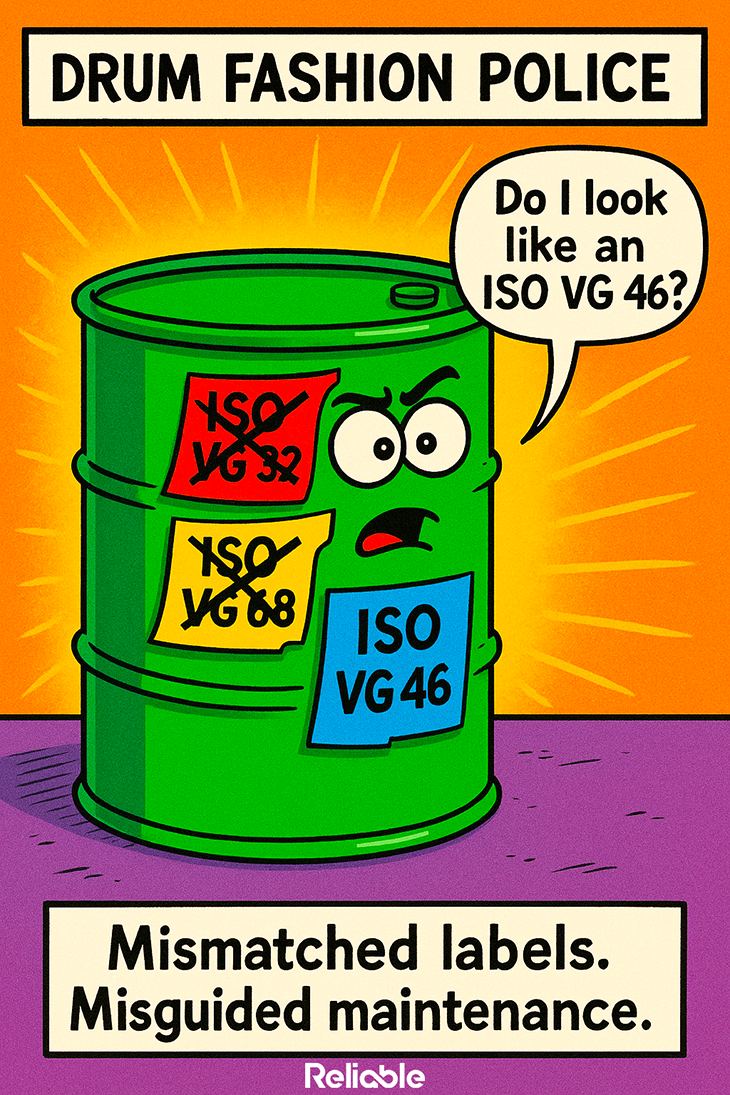
In the world of industrial maintenance, precision isn’t a luxury—it’s a requirement. That cartoon drum with a label identity crisis isn’t just a punchline. It’s a metaphor for one of the most overlooked failure modes in plant reliability: mislabeled or mismanaged lubricant containers.
The consequences of ignoring oil drum labeling best practices range from equipment failure to safety hazards. This post dives deep into why that green drum is angry—and why you should be too.
1. The Hidden Danger of Label Confusion
Mislabeling isn’t just a clerical error—it’s a systemic failure. When multiple labels from different ISO VG oils (e.g., 32, 46, 68) are slapped on a single drum, operators and technicians are left guessing what’s inside. It’s not just embarrassing—it’s dangerous. Using the wrong viscosity grade can result in:
- Inadequate film thickness
- Poor lubrication under load
- Varnish and sludge formation
- Accelerated wear and failure
In an industry where mean time between failures (MTBF) is tightly monitored, introducing the wrong oil due to a label mix-up is like throwing a wrench into your KPIs.
2. Why Oil Drum Labeling Best Practices Matter
Oil drum labeling best practices aren’t optional—they’re foundational to a reliable lubrication program. These practices ensure:
- Visual confirmation of lubricant type and viscosity grade
- Compatibility with receiving equipment
- Easy audits during inspections
- Reduction of cross-contamination risks
Best-in-class plants implement color-coded label systems, use UV-resistant tags, and regularly audit lubricant storage areas. It’s not just about cleanliness; it’s about control.
Let’s be blunt: If your lube room has more tape-covered labels than a crime scene, you’re asking for trouble.
3. Real-World Failures from Label Neglect
This isn’t theoretical. Plants have reported failures of pumps, gearboxes, and hydraulic systems caused by incorrect lubricants traced back to mislabeled or reused drums. Common breakdown scenarios include:
- Topping off a reservoir with ISO VG 68 when ISO VG 46 was specified
- Mixing incompatible base stocks (e.g., PAO with ester or PAG)
- Chemical reactions forming varnish or foam due to misapplied oil
These are not minor oversights—they’re root causes of six-figure repair events and days of downtime. And they’re completely preventable.
4. Building a Labeling Protocol that Works
To enforce oil drum labeling best practices, you need standardization, discipline, and visibility. Here’s how to get it right:
1. Single-label policy:
Never reuse drums with old or multiple labels. One label per drum. Period.
2. Laminated or oil-resistant tags:
Paper peels and fades. Use materials designed for industrial conditions.
3. Color-coded system by ISO VG grade:
Green for 32, Blue for 46, Yellow for 68, etc. Train everyone to understand the code.
4. Barcode or QR tracking:
Tie each drum to an inventory system for accountability.
5. Lube technician training:
Train staff to identify mislabeled containers and to never assume the label is accurate without validation.
It’s time to treat your labeling system like your CMMS—not a side note, but a core infrastructure.
5. Make the Label Match the Lubricant—or Pay the Price
Your lubrication strategy is only as strong as your weakest control. And all too often, that weak link is the labeling process. If you wouldn’t accept mystery ingredients in your food, why tolerate them in your lubrication system?
Oil drum labeling best practices may seem minor in the grand scheme of plant operations, but they prevent some of the most costly, frustrating, and unnecessary equipment failures. Proper labeling isn’t just about looking good—it’s about running right.
Conclusion:
Think of your lubricant drums as frontline soldiers in the reliability war. Outfitting them with mismatched labels is like sending troops into battle wearing the enemy’s uniform. It’s confusing, dangerous, and a guaranteed way to lose. If your plant is serious about uptime, safety, and equipment life, enforce oil drum labeling best practices—relentlessly.