

“Still Running” Is Not a Success Story
In industrial operations, there’s a dangerous misinterpretation of the word “failure.” When a conveyor belt is smoking, leaking fluid, and grinding audibly—but still turns—some folks in production would argue it’s not a failure.
“Still runs,” they say. That logic is as flawed as the machinery in question. We call it a functional failure, and it’s the root cause of cascading costs, safety hazards, and unplanned downtime.
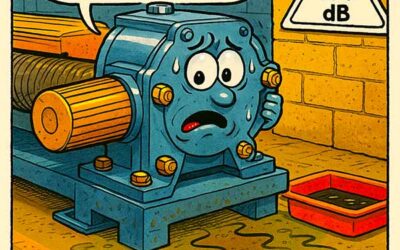
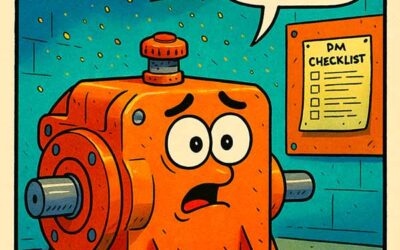
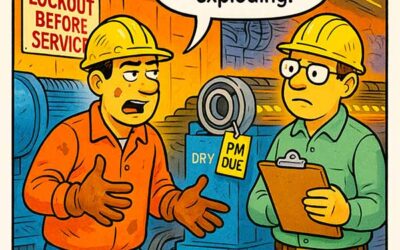
Functional failure is when an asset technically works but can no longer fulfill its intended purpose at required performance standards. In the cartoon, the conveyor limps along with sparks flying and fluid bleeding out, while a hardhat-wearing production employee shrugs it off as serviceable. The implication? If it hasn’t catastrophically failed, it must be fine. That mindset is killing uptime—and credibility.
The Production vs. Reliability Disconnect
This cartoon skewers a classic tension: production wants throughput now; reliability wants sustainability long-term. Functional failures sit right in the middle of that tug-of-war.
Production teams often define success in terms of movement. If it spins, flows, rotates, or moves—even poorly—it’s “operational.”
But reliability practitioners know that partial functionality is a ticking time bomb. Vibrating bearings, clogged filters, and leaking seals all fall under the same umbrella. They don’t stop the line—yet. But they’re signaling system instability, degrading performance, and shrinking asset life cycles.
Here’s the kicker: when a machine operating in a functional failure mode finally dies, it’s often classified as an “unexpected failure.” That’s not just ironic—it’s negligent.
The Cost of Letting It Limp
Let’s quantify the impact of letting machines limp. When assets operate below design intent:
Energy costs increase. A misaligned motor draws more amps. A leaking hydraulic system burns more power. You pay for that inefficiency in every cycle.
Quality suffers. A “functionally failed” pump might still move fluid—but not at the correct flow or pressure, impacting product consistency.
MTTR skyrockets. What could have been addressed in a 30-minute proactive fix becomes an 8-hour emergency job with rush parts.
Morale tanks. Operators and maintainers working around defective systems grow frustrated, disengaged, and burnt out.
There’s a term for this mindset in human health: “walking wounded.” These are individuals who haven’t hit the ER yet, but are one skipped checkup away from collapse. Same goes for machines.
Failure Isn’t an Event – It’s a Process
Functional failure reframes how we define and track “failures.” Most facilities still think of failure as a sudden breakdown, but in reality, most failures are progressive.
The classic P-F curve shows this clearly: by the time we detect symptoms like leakage or vibration, the degradation has already begun. Functional failure is the midpoint between perfect operation and complete failure—and it’s the window where intervention is cheapest, fastest, and safest.
Smart plants track and classify functional failures as rigorously as full breakdowns. This requires:
- Clear asset performance standards.
- Defined operating envelopes (vibration, flow, temperature, etc.).
- Cross-functional alignment on what constitutes a degraded state.
In other words, “it still runs” isn’t a benchmark. It’s a liability.
From Limping to Leading: What to Do Now
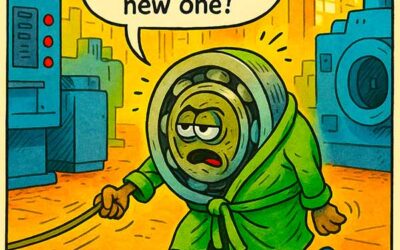
Fix the mindset first. The cartoon’s closing line nails it: “If it limps, it lives—until it doesn’t.” Organizations must shift from reactive heroism to proactive accountability. Here’s how:
- Educate operations on failure modes, functional failure definitions, and early warning signs.
- Deploy performance standards tied to failure thresholds, not just uptime metrics.
- Empower maintainers to act on minor faults before they escalate. Don’t wait for a line stoppage to justify an intervention.
- Track functional failures in your CMMS as a distinct category. Trend them. Report them. Treat them as critical data.
Functional failure isn’t just a reliability issue—it’s a leadership issue. Plants that tolerate “limping” assets are outsourcing their failure to the future. The smart ones take control now.
Bottom Line:
“Still runs” is not a strategy. It’s denial. Let the cartoon be a wake-up call: if your machine looks like it’s bleeding, sparking, or groaning—don’t wait until it’s dead to call it a failure.