

Defining the Problem: Ambiguity in PM Task Instructions
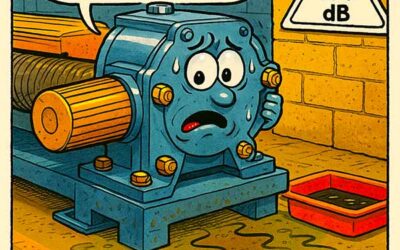
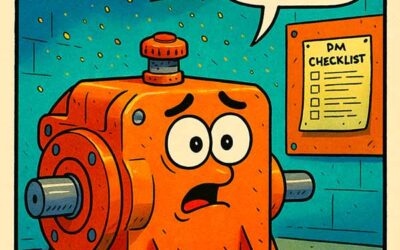
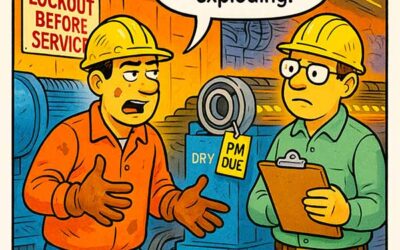
Precision maintenance doesn’t start with a wrench—it starts with a sentence. In this cartoon, a maintenance technician follows a preventive maintenance (PM) task that simply says, “Check bearing.” With a quick glance and a poke, he confirms, “Yep. Still exists.” While this elicits a chuckle, the real-world implications are serious: vague task instructions result in equally vague, ineffective maintenance.
The core issue here is not the technician, but the instruction. “Check bearing” provides no measurable criteria, no inspection standard, no method, and no tool. It relies on tribal knowledge and guesswork. If your PM program is built on ambiguity, your results will be inconsistent at best—and catastrophic at worst.
From Vague to Valuable: The Anatomy of a Good PM Task
Let’s break this down. A high-quality PM task must answer three questions:
- What are we checking?
- How are we checking it?
- What criteria define pass/fail?
Compare “Check bearing” to “Use an ultrasonic probe to detect abnormal noise in drive-end bearing. Record decibel level and trend vs. baseline.” One conveys intent and enables measurement. The other is a placeholder for failure.
A good PM task transforms implicit knowledge into explicit action. When every technician understands not just what to do but why and how to do it, you gain consistency, trendable data, and defensible results. These enable you to make data-driven decisions rather than rely on gut feel.
Consequences of Vague Tasks: Risk, Cost, and Chaos
There’s a hidden cost to vague instructions, and it compounds. If your inspection fails to detect early signs of fatigue, misalignment, or inadequate lubrication, that bearing doesn’t just keep spinning—it’s on a countdown to failure. When it fails, the collateral damage might include seals, shafts, rotors, and unplanned downtime costing tens of thousands per hour.
Worse, when failures occur despite completed PMs, trust in the reliability program erodes. Operators stop taking it seriously. Technicians lose confidence in procedures. Management questions why reliability initiatives aren’t producing ROI. The house crumbles from within.
It’s not enough to “do PM.” You have to do the right PM, the right way, at the right time, with the right instructions. Otherwise, you’re not preventing failure—you’re just recording its progress.
Final Thought: Reliability Lives in the Details
This cartoon may be funny, but it illustrates a profound truth: reliability depends on clarity. Task instructions must be written with precision to yield precision outcomes. Every ambiguous task is a missed opportunity for improvement, a blind spot in your failure detection strategy.
Start by auditing your PMs. Replace hand-wavy instructions with action-based, tool-specific, criteria-driven tasks. Give your technicians the clarity they need to succeed, and you’ll stop finding bearings that “still exist”—and start finding problems before they become disasters.