Maintenance Acronyms for New Employees: Helpful or Hurdle?
Imagine walking into your first day on the job, cup of coffee in one hand and donut in the other, only to be greeted by a whiteboard littered with terms like PM, CMMS, OEE, MTTR, and FMEA. You’re not in a boardroom—you’re on the plant floor. You’re wearing steel toes and a hard hat. But it may as well be a foreign language class.
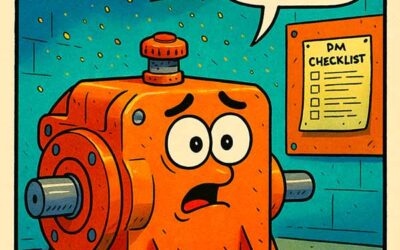
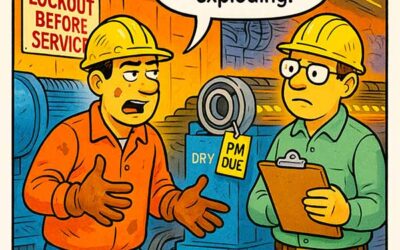
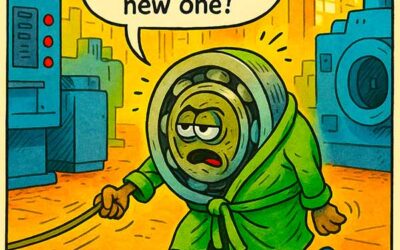
Maintenance acronyms for new employees can feel like a rite of passage—or worse, a deliberate hazing ritual. The cartoon says it best: “He’s got the caffeine. Now he just needs a clue.” These acronyms are essential to how maintenance and reliability professionals communicate, but for someone just starting out, they can be confusing, isolating, and demoralizing.
We shouldn’t expect someone to decode the entire maintenance lexicon on day one. We need a better path from confusion to contribution.
Decoding the Alphabet Soup: From PM to JIT
Let’s be honest: maintenance and reliability professionals love acronyms. Why say “Planned Maintenance” when PM will do? Why explain “Mean Time to Repair” when MTTR rolls off the tongue?
But here’s the catch: acronyms only create efficiency if everyone understands them. For new employees—especially those without prior industrial experience—these shortcuts are roadblocks.
Here’s a quick rundown of the usual suspects:
- PM – Preventive Maintenance
- CMMS – Computerized Maintenance Management System
- MTTR – Mean Time to Repair
- OEE – Overall Equipment Effectiveness
- TPM – Total Productive Maintenance
- RCA – Root Cause Analysis
- FMEA – Failure Modes and Effects Analysis
- JIT – Just in Time
For the seasoned pro, this list is second nature. For the new hire, it’s noise.
To bridge this gap, smart organizations are developing acronym glossaries, visual learning tools, and contextual job aids that define each term not in theory—but in how it applies to your plant, your process, and your people.
Contextual Learning: The Cure for Acronym Overload
Context is everything. Telling a new employee “We do FMEA before implementing PMs on high-risk assets” is a dead-end without explanation. Instead, walk them through an actual example:
“We had a pump that failed three times last year. We did an FMEA on it—basically a structured way to think through what can go wrong and how to prevent it. That led us to adjust the PM schedule to catch the early signs of seal wear.”
Suddenly, FMEA and PM aren’t just buzzwords. They’re problem-solving tools with real-world applications. This is how we transform maintenance acronyms for new employees from confusion to capability.
Use job-shadowing and real-time coaching to reinforce this contextual understanding. Avoid the temptation to “train by PowerPoint.” Nothing replaces on-the-floor learning with someone who’s been there and done that.
Mentorship: Pairing People, Not Just Training Modules
The best way to internalize maintenance concepts and acronyms is through mentorship. Pair new employees with experienced team members who can break down terms as they arise—during toolbox talks, shift change meetings, or even lunchroom conversations.
Formalize the mentorship program if you have to, but keep it natural. Give the mentor a simple mission: help this person become fluent in the plant’s maintenance language over the first 90 days.
Mentorship accelerates learning and boosts confidence. It also builds camaraderie—because let’s face it, shared confusion over what OEE really means is a bonding experience.
Job Aids, Visuals, and Microlearning: Acronyms in Action
Don’t make new hires hunt for answers. Put the information where they need it. A laminated card in the breakroom listing common acronyms. Color-coded labels on equipment referencing the relevant PM schedule. QR codes linking to short videos explaining TPM or RCA.
Even better: embed definitions right into the CMMS interface. If a new user selects a work order labeled “JIT Inspection,” include a popup that defines JIT in the context of your process.
Microlearning—short, targeted bursts of education delivered at the point of need—is a proven strategy for retention. When paired with visuals and humor (like the cartoon above), it helps demystify technical content without dumbing it down.
Culture First: Make It Safe to Ask Questions
The most important ingredient in decoding maintenance acronyms for new employees isn’t a glossary—it’s psychological safety. If your culture discourages questions, no one will ask what “MTBF” means. They’ll fake understanding and stay silent.
That silence becomes costly. Misunderstood instructions lead to missed PMs, data entry errors in the CMMS, and flawed root cause analyses.
Encourage curiosity. Reward questions. Praise the technician who says, “I don’t know what that means. Can you explain it?”
That’s the mindset that drives precision maintenance and long-term reliability.
Conclusion: From Alphabet Soup to Shared Language
Every plant has its own dialect of maintenance acronyms. But it’s up to leadership to decide whether those acronyms become building blocks or barriers.
If you want new employees to succeed fast, start by acknowledging the overload. Then give them tools, mentors, and a culture that transforms those terms into meaning.
Because the goal isn’t just caffeine and donuts. It’s clarity, competence, and contribution—on day one and every day after.