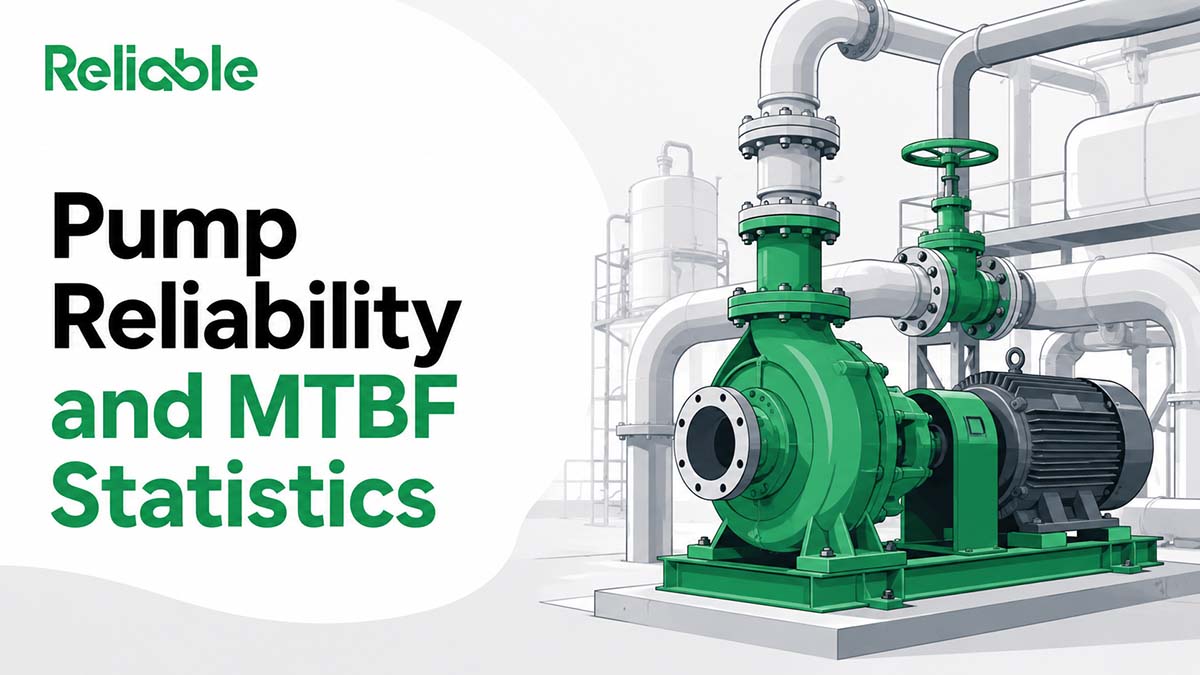

Pumps are often among the most numerous rotating assets in process plants, which makes pump reliability data some of the most quoted numbers in maintenance. It also makes them some of the most abused. MTBF figures get lifted from one industry and applied to another, seal life targets get confused with seal life averages, and vendor survey data gets presented as independent benchmarking. This page compiles the best-supported published figures on pump MTBF, mechanical seal life, failure patterns, and pump energy and lifecycle costs, along with the context needed to use them correctly.
Pump reliability statistics at a glance
| Statistic | Figure | Source |
|---|---|---|
| Refinery centrifugal pump MTBF, typical range | ~3 to 10 years | Bloch, Pump User’s Handbook data |
| Well-managed U.S. refinery, worked example | 7.7 years (1,200 pumps, 156 repair incidents in one year) | Bloch |
| Chemical plant pump lifetimes vs. refinery values | ~50 to 60% (Bloch’s practitioner estimate) | Bloch |
| ANSI/ASME B73.1 process pump MTBF | 2.5 years average; 3.75-year target; 4.5 years excellent; 1.5 to 2.0 years poor | Budris, WaterWorld |
| Seals’ share of recorded pump failures | 60.4% (3,500 failures, 18 end users, 2020s) | European Sealing Association, 2025 |
| Root causes of premature seal failures | Operations 49%, maintenance 28%, engineering 23% | European Sealing Association, 2025 |
| API 682 seal life figure | 25,000 hours (~34 months); a target per ESA (“never a performance guarantee”); being removed in the current API 682 update | API 682 via ESA, 2025 |
| ESA’s suggested site-level seal MTBF benchmark | ~60 months (48 months often acceptable in midstream); some majors target 100 months. Supplier-compiled ESA guidance; should not be read as a statistically representative industry average | European Sealing Association, 2025 |
| Pumping systems’ share of world electrical energy demand | Nearly 20% (longstanding DOE/HI estimate) | DOE / Hydraulic Institute Sourcebook, 2006 |
| Pumping systems’ share of U.S. industrial motor energy | 25% (over 50% in pumping-intensive industries) | Pump Systems Matter / HI material hosted by DOE |
| Typical pumping system lifespan | 15 to 20 years | Hydraulic Institute / Europump LCC Guide |
What is a good MTBF for a centrifugal pump?
The most widely referenced benchmark data comes from Heinz Bloch, whose Pump User’s Handbook drew on decades of failure statistics from U.S. refineries and petrochemical plants. Bloch reported that centrifugal pumps in these facilities typically reach MTBF values ranging from barely 3 years to as much as 10 years, a spread he attributed largely to differences in specification, installation, and operating discipline rather than to the pumps themselves.
His worked example for a well-managed, reliability-focused U.S. refinery: 1,200 installed pumps with 156 repair incidents in one year yields an MTBF of 7.7 years (1,200 divided by 156). Plants at the low end of the range are repairing the same pump population two to three times as often.
Two adjustments matter when applying refinery numbers elsewhere:
- Chemical plants: Bloch’s practitioner estimate, which he framed as what is “generally believed” in the industry, is that pump lifetimes in chemical installations run 50 to 60 percent of refinery values, partly because many small chemical-duty pumps were historically treated as throwaway items and because compact DIN and ASME stuffing boxes limit the seal types that can be fitted.
- ANSI/ASME B73.1 process pumps: Reliability consultant Allan Budris, writing in WaterWorld, put the average MTBF for these pumps at 2.5 years, with a 3.75-year target, 4.5 years rated excellent, and 1.5 to 2.0 years considered poor performance. Component-level ranges (bearings, seals, couplings) determine where a given pump lands.
Reliable has republished Bloch’s own treatment of this data, including his target component lifetimes, in Pump Life Expectancy: Myths, Math, and Meaningful Metrics.
How is pump MTBF calculated?
The method behind a published MTBF number matters as much as the number. The bare-bones approach many best-practice plants adopted in the early 2000s, per Bloch: take the count of installed pumps, divide by the number of repair incidents, and multiply by the observation period. A repair incident counts any parts replacement, which keeps the metric honest but also means the figure is a population average, telling you nothing about the distribution.
Averages hide the bad-actor pumps, and it is that fraction of the population, rather than the mean, that drives repair spend. Best-practice reliability programs track a bad-actor list alongside the site average for exactly this reason; the ESA notes that a top 10 to 15 bad actor list with failure deep-dives is now the favored starting point for seal reliability programs.
Comparisons between plants break down for three reasons:
- Failure definitions differ. Some sites count every repair incident; others count only events above a cost threshold; and tighter emissions requirements can cause leakage that was previously tolerated in service to be classified as failure.
- Timing and calculation methods differ. The ESA notes that some plants date a failure from the moment the work order is written, while others date it from when the pump is pulled into the repair facility. Layer on the difference between a bare-bones population average and a Weibull analysis, and identical hardware can produce very different published numbers.
- Populations differ. Duty, fluid, operating hours, and sparing philosophy vary by site, so a chemical plant benchmarking itself against refinery figures is measuring itself against a population it does not resemble.
The ESA’s own conclusion on metric selection applies to all of it: the most important factor is consistent application of whatever method a site chooses, and comparisons across different reporting methods should be avoided.
Which pump component most often prompts repair?
Mechanical seals, by a wide margin, but the data comes with an important caveat about cause versus symptom.
The European Sealing Association’s 2025 reliability document (ESA-MSD-2025-01) includes a failure distribution compiled over two years in the 2020s covering 3,500 pump failures at 18 different end users. Seals were recorded in 60.4 percent of those failures. The ESA attributes part of the seal’s growing dominance in the failure hierarchy to progress elsewhere: bearing protection and condition monitoring have improved over 25 years, and near-universal laser alignment has made coupling problems rare, so the remaining failures concentrate in the seal.
The caveat, in the ESA’s own framing: it would be wrong to assume the fault always lies with the failed component. A visible leak is what the operator sees when writing the repair notification, so “seal failed” goes in the short text, but that is the symptom, and often the root cause sits elsewhere. When the ESA analyzed the root causes of premature seal failures in that dataset, the split was 49 percent operations, 28 percent maintenance, and 23 percent engineering. Typical operations causes include dry running, cavitation, closed valves, and process upsets; maintenance causes include alignment, assembly, and lubrication issues; engineering causes include pump selection, seal selection, and incorrect duty specification.
This is consistent with the longstanding industry estimate, cited in references such as SealFAQs, that seal-related repairs represent roughly 60 to 70 percent of centrifugal pump maintenance work, and with Bloch’s failure investigations, which traced most recurring pump failures to specification, installation, and operating decisions rather than to defective components. Bearing failures have their own well-documented cause distribution, which we cover separately in our bearing failure statistics page.
How long should a mechanical seal last?
Three numbers get conflated in seal life discussions, and keeping them separate is the whole game:
- The API 682 figure. ESA’s 2025 guidance describes API 682’s longstanding 25,000-hour figure (approximately 34 months) as a target (“never a performance guarantee,” in ESA’s words) and says it is being removed in the current API 682 update.
- The field benchmark. The same ESA document reports that plants were achieving seal MTBF around 70 months as far back as the mid-1990s, though how those figures were calculated is not available. Updated figures reported by seal manufacturers working with end users suggest 60 months is a good benchmark for where most sites want to be, with variation by industry: 48 months is often considered acceptable in midstream pipeline applications, and some major operators target 100 months. These are supplier-compiled benchmarks and suggested goals, and they should be read as such rather than as a statistically representative industry average.
- The regulatory complication. The ESA notes that apparent stagnation in seal reliability over 30 years is partly definitional: emissions regulations have reclassified leakage that was once tolerated in service as failure, so a modern 60-month MTBF represents a materially tighter failure definition than a 1990s 70-month figure. One ESA case history involves seals that had been considered good performers until revised emissions regulations reclassified their leakage readings as compliance failures.
Field seal life at well-run sites routinely exceeds the old API 682 figure, and a site whose seal MTBF sits near or below 34 months has improvement headroom that the ESA benchmarks and case histories indicate is realistic. One documented ESA case: a new-build plant starting at roughly 30 months MTBF reached its 5-year MTBF target within three years of launching a structured seal reliability program, cutting annual seal repair spend by approximately 67 percent within two years.
How much energy do pumps consume?
The energy statistics explain why pump reliability draws so much corporate attention, though the headline figures are longstanding estimates rather than current measured statistics. The 2006 U.S. Department of Energy and Hydraulic Institute sourcebook Improving Pumping System Performance carries the estimate that pumping systems account for nearly 20 percent of the world’s electrical energy demand and 25 to 50 percent of the energy usage in certain industrial plant operations. Pump Systems Matter and Hydraulic Institute material hosted by DOE puts the U.S. figure at 25 percent of the total energy consumed by industrial electric motors, rising above 50 percent in pumping-intensive industries.
On a per-machine basis, the Hydraulic Institute and Europump’s Pump Life Cycle Costs guide (developed with DOE) positions energy as often one of the largest lifecycle costs of a pumping system, and it may dominate for pumps operating more than 2,000 hours annually. The guide also establishes that the initial purchase price is a small part of life cycle cost for high-usage pumps and that pumping systems typically serve for 15 to 20 years, which is why it treats procurement decisions made on purchase price alone as a reliability and cost liability.
The reliability connection: a pump operated away from its best-efficiency point wastes energy and shortens seal and bearing life simultaneously, so MTBF and energy performance tend to move together.
Why published pump reliability numbers vary so much
This is the caveat section most compilations skip. When you see pump MTBF or seal life figures quoted, check for four things before using them:
- Whose data is it, and how was it compiled? The ESA’s benchmark figures, for example, were reported by seal manufacturers working with end users, and the ESA presents them accordingly. Any dataset, whether from a vendor, an association, or a government program, should come with enough methodology to understand what was counted and how.
- What counts as a failure? A cost-threshold definition, an any-repair definition, and an emissions-threshold definition produce different MTBF values from identical hardware.
- What population? Refinery, chemical, and water utility pump populations are not interchangeable benchmarks, and Bloch’s own practitioner estimate puts chemical plant pump lifetimes well below refinery values.
- Average or distribution? A single MTBF average hides the bad-actor pumps that consume most of the repair budget. Best-practice sites track a bad-actor list alongside the mean.
For MTBF and MTTR benchmarks across other equipment classes (motors, compressors, conveyors), see our companion guide. For the methodology behind the metric itself, see our MTBF and MTTR calculation guide.
Frequently asked questions
What is a good MTBF for a centrifugal pump?
In U.S. refineries and petrochemical plants, centrifugal pump MTBF typically ranges from about 3 to 10 years, per reliability data compiled by Heinz Bloch. A well-managed refinery can reach roughly 7 to 8 years. Bloch’s practitioner estimate puts chemical plant pump lifetimes at 50 to 60 percent of refinery values. For ANSI/ASME B73.1 process pumps, Budris puts the average at 2.5 years, the target at 3.75 years, excellent at 4.5 years, and 1.5 to 2.0 years in the poor-performance category.
How is pump MTBF calculated?
The common plant-level method divides the number of installed pumps by the number of repair incidents in the observation period, then multiplies by that period. A refinery with 1,200 pumps and 156 repairs in a year has an MTBF of 7.7 years. Because failure definitions, failure dating conventions, and calculation methods vary, MTBF figures from different plants are not directly comparable without checking all three.
Which pump component is recorded most often in pump failures?
Mechanical seals. A European Sealing Association dataset of 3,500 pump failures across 18 end users, compiled in the 2020s, recorded seals in 60.4 percent of failures. The ESA cautions that a failed seal is often the symptom of a problem elsewhere: its analysis of premature seal failures attributed 49 percent to operations causes, 28 percent to maintenance, and 23 percent to engineering.
How long should a mechanical seal last?
ESA’s 2025 guidance describes API 682’s longstanding 25,000-hour figure (approximately 34 months) as a target (“never a performance guarantee,” in ESA’s words) and says it is being removed in the current API 682 update. ESA’s suggested site-level benchmark, based on figures reported by seal manufacturers working with end users, is about 60 months, with 48 months often considered acceptable in midstream applications and some major operators targeting 100 months.
How much of industrial energy use goes to pumps?
Longstanding DOE and Hydraulic Institute estimates put pumping systems at nearly 20 percent of the world’s electrical energy demand, and Pump Systems Matter/Hydraulic Institute material hosted by DOE puts them at 25 percent of the energy consumed by U.S. industrial electric motors, rising above 50 percent in pumping-intensive industries.
Why do pump MTBF benchmarks differ between industries?
Populations, duties, and failure definitions differ. Bloch’s practitioner estimate puts chemical plant pump lifetimes at roughly half to 60 percent of refinery values due to corrosive services and compact seal chambers, midstream operators often work to a 48-month seal benchmark rather than the 60-month site goal ESA suggests elsewhere, and tighter emissions requirements can cause leakage previously tolerated in service to be classified as failure, which depresses modern MTBF figures relative to historical ones even where hardware reliability improved.
Sources and references
- Heinz P. Bloch, Pump User’s Handbook: Life Extension (Fairmont Press). MTBF methodology, refinery range, and chemical plant comparison, as republished in Pump Life Expectancy: Myths, Math, and Meaningful Metrics (Reliable) and Revisiting Pump Life Expectancy Statistics (The RAM Review)
- Heinz P. Bloch, Best Practices for Pump Reliability, Part 1 (Modern Pumping Today). 3-to-10-year refinery MTBF range
- Allan R. Budris, Improving Pump Component Reliability to Optimize Mean Time Between Failure (WaterWorld). ANSI/ASME B73.1 pump MTBF ranges
- European Sealing Association, Mechanical Seal Reliability (ESA-MSD-2025-01, October 2025). Failure distribution dataset, premature-failure root causes, API 682 25,000-hour figure and its removal, 60-month and 100-month benchmarks, failure-definition history, case histories
- SealFAQs, Failure Analysis. 60 to 70 percent seal-related repair estimate (industry estimate, cited as corroboration)
- U.S. Department of Energy and Hydraulic Institute, Improving Pumping System Performance: A Sourcebook for Industry, Second Edition (NREL, 2006). Global and industrial energy share estimates
- U.S. Department of Energy, Overview of Pump Systems Matter. U.S. industrial motor energy share (Pump Systems Matter/HI material hosted by DOE)
- Hydraulic Institute, Europump, and U.S. DOE, Pump Life Cycle Costs: A Guide to LCC Analysis for Pumping Systems, Executive Summary. Lifespan, energy cost position, purchase price share