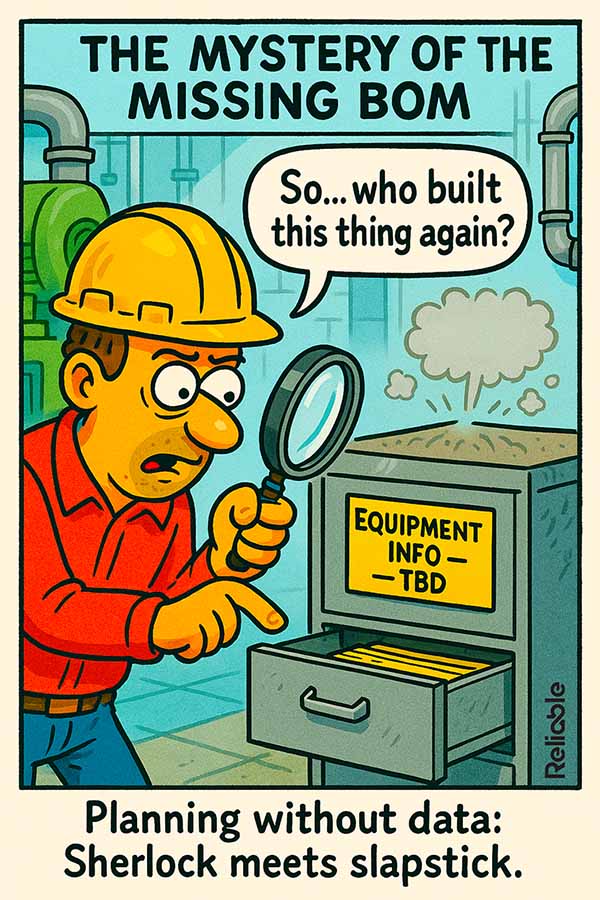

Every maintenance planner has lived this moment: a critical pump goes down, the work order is open, and the parts list reads “TBD.” No component numbers, no vendor specs, no quantities.
Equipment bill of materials best practices exist to prevent exactly this scenario, and the gap between teams that follow them and teams that don’t shows up in every downtime report.
What an Equipment Bill of Materials Actually Contains
A bill of materials for a piece of equipment is the complete inventory of every component, sub-assembly, fastener, seal, and consumable required to maintain or rebuild it. A good one includes part numbers, manufacturer details, quantities, lead times, and interchangeability notes.
A poorly maintained BOM, by contrast, is a blank spreadsheet somebody saved to a shared drive in 2016 and never touched again.
The difference matters because maintenance work without a BOM becomes a scavenger hunt. Technicians waste wrench time tracking down part numbers mid-job. Planners order the wrong bearings.
A complete BOM keeps a four-hour repair a four-hour repair. An incomplete one turns it into a two-day investigation.
Getting this right starts with understanding what belongs in a BOM and committing to keeping it current.
Equipment Bill of Materials Best Practices That Drive Results
Building a functional BOM program requires sustained discipline and consistent process ownership. The teams that get this right share a few common habits.
Start with Your Critical Assets
You don’t need a BOM for every fire extinguisher bracket on site. Start with the equipment whose failure stops production, creates safety hazards, or triggers regulatory consequences. Prioritize based on:
- Equipment criticality ranking (A, B, or C tier)
- Historical failure frequency and total repair cost
- Lead time for replacement components, with anything over two weeks getting immediate priority
Standardize the Format
Every BOM should follow a consistent template across your entire facility. Solid equipment bill of materials best practices start with a standardized format. At minimum, each entry should include:
- OEM part number and plain-language description
- Manufacturer name and current approved vendor
- Quantity per assembly and unit of measure
- Interchangeable part numbers and cross-references
- Storage location, reorder point, and lead time
Standardization prevents the situation where every planner maintains their own system, and institutional knowledge walks out the door with every retirement or transfer.
The value of a BOM drops to zero the moment only one person in the building can interpret it.
Documentation standards matter more than documentation volume. A small number of thorough, verified BOMs beats a database full of unvalidated entries.
Validate Against the Physical Asset
The nameplate on the equipment and the data in your CMMS rarely agree on the first pass. Field verification is the step most teams skip, and it’s the step that determines whether your BOM reflects reality or wishful thinking.
Send a technician to the asset with the draft BOM in hand. Compare every line item against what’s physically installed. Document discrepancies and update the record.
How Incomplete BOMs Undermine Maintenance Planning
When BOMs are incomplete, the damage radiates outward. Maintenance planning depends on accurate parts lists to kit jobs in advance. Without them, planners either guess (and guess wrong) or default to reactive mode, pulling parts from the storeroom mid-job and hoping for the best.
Spare parts management suffers next. Storerooms accumulate orphan inventory because nobody can confirm which parts belong to which assets. Meanwhile, critical spares sit on a six-week lead time that nobody anticipated because the BOM never captured the vendor’s delivery window.
The financial cost is measurable. Plants with mature equipment bill of materials best practices report 15 to 25 percent reductions in emergency parts procurement costs. Plants without them pay a premium on every rush order, every overnight shipment, and every hour a technician spends describing a part by phone to a distributor.
You can’t plan what you can’t identify. And you can’t identify what you never documented.
The operational cost is harder to quantify but just as real. Technicians lose confidence in the planning function when kitted jobs arrive incomplete. They start hoarding parts at their workstations and building personal vendor relationships to bypass official procurement.
Building Your BOM Program from the Ground Up
Starting from scratch (or starting over, which is honestly more common) requires a phased approach. Trying to BOM every asset simultaneously leads to burnout, bad data, and abandoned spreadsheets.
Phase 1: Audit what exists. Pull every BOM currently in your CMMS. Flag the ones that are blank, outdated, or obviously copied from a generic template.
Phase 2: Prioritize and assign. Rank assets by criticality. Assign BOM development to specific planners or reliability engineering staff with hard deadlines.
Phase 3: Field-verify and enrich. Walk down each asset physically. Validate part numbers against installed nameplates and OEM manuals.
Phase 4: Integrate with work order workflows. A BOM that lives in a disconnected spreadsheet adds friction instead of removing it. Link BOMs directly to asset records in your CMMS so planners pull parts lists automatically when building job plans.
Phase 5: Maintain and review. Equipment gets modified and vendors discontinue parts. Schedule an annual BOM review for critical assets and update records every time a modification order closes.
Mistakes That Sabotage Even Good BOM Programs
Even teams that invest heavily in building BOMs undermine their own work with a few predictable errors.
Copying OEM manuals verbatim. Manufacturer parts lists cover every possible configuration, so your BOM needs to be trimmed to reflect the asset as installed and modified on your specific site.
Ignoring consumables. Seals, gaskets, o-rings, and lubricants almost never appear on initial BOMs. They appear on nearly every work order, so include them from the start.
Treating the BOM as a one-time project. A BOM created during commissioning and never updated describes equipment that may have been modified three or four times since. Without ongoing revision, BOMs decay into historical fiction.
The teams that sustain strong equipment bill of materials best practices treat the BOM as a living document, updated after every major repair, modification, and vendor change. The teams that file it as a project deliverable end up rebuilding from scratch every few years.
How to Measure BOM Program Health
Tracking progress keeps the program from drifting into neglect. A few metrics tell you most of what you need to know.
BOM completeness rate. This is the percentage of critical assets with a validated, field-verified BOM on file. Anything below 80 percent means your planning function is operating partially blind.
Parts identification time. Measure how long it takes planners to build a complete parts list for a standard work order. Teams with solid equipment bill of materials best practices bring this down to minutes.
Emergency procurement frequency. Track how often parts are ordered on an expedited basis. A declining trend suggests BOMs are catching parts needs before they become surprises.
Storeroom accuracy. If your storeroom inventory doesn’t match what your BOMs say should be on the shelves, one of those records is wrong (usually both). Regular reconciliation catches errors before they cascade into missed repairs.
These metrics deserve a quarterly review with maintenance leadership. They’re boring to track and invaluable to have when justifying continued investment in data quality.
The bottom line: equipment bill of materials best practices require effort to establish and discipline to maintain. The payoff is a maintenance operation that plans from real data, orders parts proactively, and allocates its budget toward planned work.