How Reliability Professionals Drive ESG Value Across the Asset Lifecycle

Over the last few weeks, I’ve been in several conversations about the recent forest fires sending smoke across Canada, the USA, and Europe; rising energy and transportation costs; and what that could mean for production sites and the community at large. The ‘what-if’ scenarios discussed are all pointing to applying existing Environmental, Social and Governance (ESG) frameworks to evaluate options.
ESG frameworks shape decision-making for companies, regulators, customers, and investors. They are living documents that are periodically reviewed and updated. For asset managers and reliability professionals, ESG is not an abstract consideration; it shapes how assets are managed, risks are assessed, and long-term value is preserved and delivered.
Reliability engineering has always focused on managing assets, optimizing performance, improving equipment availability, reducing downtime, and managing life-cycle costs all at a tolerable risk level. Modern expectations have taken this one step further and now span across the lifecycle. Asset managers connect these reliability objectives with sustainable, socially responsible and well-governed operations.
What is ESG?
ESG is a set of expectations and standards for organizational behavior that stakeholders consider when engaging with your organization or considering potential investment. It applies equally to a municipality as it does to a for-profit company, even if citizens can’t necessarily opt out of using the city services such as water and wastewater treatment or community recycling.
The Environment ‘E’ reflects how your organization performs as a steward of nature, including conservation, emissions, and energy use. Social ‘S’ tends to focus on relationships with employees and contractors, suppliers, customers, local indigenous relations, and the wider community. Governance ‘G’ centers on the organization’s leadership, internal controls, assurance and audit practices and results, as well as stakeholders’, shareholders’ or citizens’ rights.
Environmental Impact Across the Lifecycle
Managing our physical assets, including equipment, infrastructure, and facilities, directly affects the organization’s environmental footprint. Energy and water usage, emissions, carbon footprint, and minimizing waste tie directly to asset performance and lifecycle management.
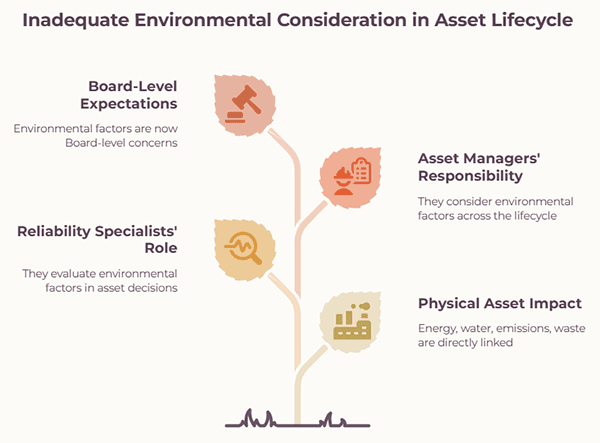
These are the conversations and ‘what-if’ scenarios where reliability specialists and asset management teams contribute their expertise. When reliability specialists and asset managers are asked, ‘should we run, repair or replace this asset?’, we are evaluating more than the cost of repair and the production volume impact. We are also evaluating energy consumption per widget produced, the ability to reuse water within the production circuit, and how to reduce overall emissions, including excess heat.
Environmental factors are now Board-level concerns and expectations.
The asset care strategies for predictive and preventive maintenance that reliability specialists develop and implement not only consider minimizing unplanned and unscheduled downtime and increasing availability, but also look at optimizing asset utilization and extending equipment life. If the equipment can no longer meet the production process requirements, can it be repurposed? Sold to others? Recycled?
Asset managers are now expected to consider environmental factors, the circular economy, and remediation costs at all phases of the lifecycle, from demand and capital planning and purchasing to operate & maintain and end-of-life reclamation.
The asset retirement obligations (ARO) are often included in the original business case for a new mine or natural gas processing plant. Environmental factors are now Board-level concerns and expectations.
Social - Reliability is a Community Issue
Reliability specialists often overlook or don’t place as much importance on the social and community aspects of their work as they do the technical aspects. This is unfortunate. Safe, reliable equipment operation protects the safety and health of workers on our sites, the surrounding community, and our customers.
Investing in improved equipment reliability outcomes is investing in people and our communities.
Frequent safety incidents, equipment failures, unexpected reactive maintenance, and product recalls or food safety notifications not only signal poor technical management but also negatively impact our organization’s social license to operate.
Reliability specialists should recognize that every asset decision has a human impact. Frequent, unscheduled equipment downtime may force workers to accommodate last-minute overtime, reducing morale and job satisfaction.
By contrast, continued upskilling of maintenance and reliability specialists for new technology, a workplace culture of safety, transparency, and continuous improvement, and consistent integration of customer, community, and stakeholder requirements all support a strong ESG mindset. Investing in improved equipment reliability outcomes is investing in people and our communities.
Governance and Reliability Strategic Alignment
Governance centers on the organization’s leadership, internal controls, assurance and audit practices and results, as well as stakeholders’, shareholders’ and citizens’ rights. The ESG framework typically includes approaches to decision-making, performance reporting, assurance, and accountability.
Good governance can support business adaptability and resilience.
From an asset management value perspective, this means decision-making is transparent and data-driven, considers the entire lifecycle from conception to reclamation, appropriately addresses risks, and includes environmental and social costs.
A well-governed asset management system provides assurance that policies and processes are followed, assets are managed appropriately, risks are identified and addressed, and data supports informed decision-making rather than relying on intuition. The AM system also enables compliance with standards such as ISO 55001, other ISO standards, industry sector regulatory standards, and national or local environmental reporting requirements. In a constantly changing world, good governance can support business adaptability and resilience.
ESG Reporting
Reporting is essential in ESG-compliant organizations to show they are meeting not only regulatory requirements but also the goals and objectives they have publicly committed to. ESG reporting gives investors and community stakeholders confidence that the organization is doing what it said it would.
Many of these reportable ESG metrics relate to equipment and asset performance, such as energy usage, emissions, freshwater usage, maintenance-related incidents, asset reliability, the circular economy, and adherence to established maintenance and reliability practices.
Reliability specialists can play a key role in this reporting. Data extracted from the CMMS, asset performance monitoring, condition monitoring, energy and water usage tracking, and root cause analysis investigation outcomes can demonstrate the organization’s commitment to sustainability, safety, and environmental stewardship.
This ESG and reliability information, in turn, can feed into broader business scenario analyses and decision-making that incorporates ESG into strategic, operational, and tactical decision-making.
Conclusion
Integrating ESG into reliability and asset management practices is broader and more integrated than regulatory compliance or public image. It drives long-term value. As discussed above, strong ESG performance can improve company culture, lower risk profiles, increase awareness of operational performance, and build investor and community confidence.
This means that reliability specialists’ roles have expanded beyond asset care strategies and health monitoring to incorporate sustainability, environmental, and social license-to-operate mandates, while enabling long-term business resilience.