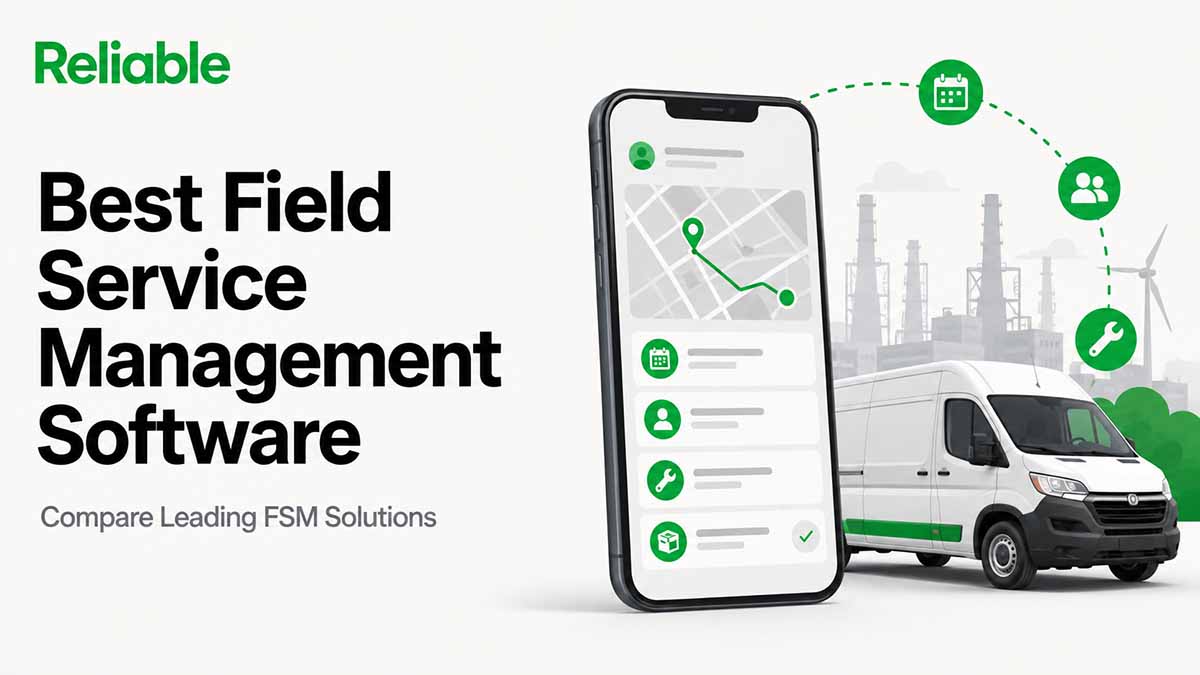

The Short Version: For field-heavy service and reliability teams in 2026, Salesforce Field Service (Agentforce Field Service) is the strongest fit for Salesforce CRM-native field operations. IFS Cloud Field Service Management is built for FSM joined to enterprise asset management and ERP. ServiceMax leads for asset-centric service and contracts. Oracle Fusion Field Service fits utilities work-order handoff on one Oracle cloud. Microsoft Dynamics 365 Field Service suits teams already inside the Microsoft ecosystem. Before choosing, confirm offline mobile behavior at your most remote asset, check how each platform handles parts and depot repair, and map the handoff to your existing CMMS, EAM, or ERP.
How We Evaluated
This guide compares five field service management platforms using each vendor’s public product pages and official documentation. We read what the vendors themselves state, then lined those statements up against the criteria that matter to a service or reliability lead running work across multiple sites: offline mobile at the remote asset, parts and depot handling, contract and SLA visibility on the work order, and the handoff into an existing CMMS, EAM, or ERP.
Where a vendor publishes starting prices, we print the vendor’s own list. Where pricing is not published on the vendor page, we say so rather than estimate. Every product here identifies itself as a field service offering on its own public pages, and every claim below traces to the sources listed at the end.
Reliable does not accept payment for rankings. Vendors may sponsor enhanced listings with additional detail, but editorial rankings are independent. Read our editorial policy.
5 Best Field Service Management Software for 2026, Ranked by Use Case
1. Salesforce Field Service (Agentforce Field Service): Best for Salesforce CRM-native field operations
Salesforce positions Field Service, also named Agentforce Field Service, as an AI-powered platform to manage and optimize frontline field work from repairs and inspections to on-site services, built natively on the Salesforce platform and connecting customer, asset, and operational data. On the floor, the flow starts when Service Cloud creates a work order, an optimization engine matches skill set, location, and availability, and the technician receives job details, directions, contact information, and service history on a mobile app. Dispatchers track location and progress, the customer gets ETA alerts, and data syncs back after signature and close-out.
The mobile app is offline-first for Android and iOS, giving access to thousands of records without an internet connection through delta-sync updates. Named capabilities include scheduling and optimization by travel time, skill matching, and SLAs, asset and inventory handling for parts and tools in the warehouse and on vehicles, and work order management. A Case can convert to a field service work order with customer and asset data carried over. Field Service is an add-on product, purchased separately from standard Service Cloud licenses.
Best for: Teams standardized on Salesforce that want field work native to their CRM, with scheduling, offline mobile, and warehouse and vehicle parts handling.
Starting price: From the product page, in USD per user per month billed annually: Dispatcher $175 (Intelligent Dispatch Console built in the CRM), Technician $175 (field service mobile app), Field Service Plus $230 (Dispatcher, Technician, plus Service Cloud and Sales Cloud), Agentforce 1 Field Service $650 (a complete field service solution with built-in AI and unified data), Contractor $55/user/month or $22/login, and Contractor Plus $80/user/month or $32/login. The guide page directs buyers to contact a sales representative for a customized quote.
2. IFS Cloud Field Service Management: Best for FSM joined to EAM and ERP
IFS presents Cloud Field Service Management as part of a single product family that names IFS Cloud, ERP, Enterprise Asset Management, Field Service Management, and Enterprise Service Management, and its service-industry page states that IFS Cloud integrates field service management, asset management, and ERP. The platform streamlines field service by optimizing scheduling, using AI-powered service resource forecasting and scheduling optimization, and gives real-time visibility into asset history, warranty information, and SLA commitments. Technicians access knowledge, parts, tools, and equipment in real time.
Named features include Mobile Workforce Management (AI-driven scheduling, instant task updates, and field-to-office collaboration), Contractor Management (contractors alongside employees, with onboarding, billing, and compliance), Service Parts Logistics and Depot Repair, and Workforce Planning and Scheduling with IFS.ai matching the best-skilled field worker to each job. The IFS glossary names mobile access with real-time updates, customer information, job-status reporting, job details, and inventory, along with CRM integration and IoT, data analytics, and predictive analytics. It names mobile access without stating offline on the pages used here.
Best for: Organizations that want field service tied directly to enterprise asset management and ERP inside one IFS Cloud product family.
Starting price: Not published on the vendor page.
3. ServiceMax: Best for asset-centric service and contracts
PTC describes ServiceMax as asset-centric field service management covering work management, automation, preventive maintenance, contract management, mobile tools, and customer self-service on one cloud-based platform. It comes in three offerings built on the Salesforce platform: ServiceMax Core, ServiceMax Asset 360 for Salesforce Field Service, and FieldFX. ServiceMax was originally built on Salesforce and is now a standalone platform with its own roadmap that still integrates with Salesforce CRM and Service Cloud. Contracts, warranties, entitlements, and SLA visibility appear on every work order. ServiceMax Go works online or offline and covers asset service history, parts required, entitlement and contract visibility, work orders, data capture, signatures, and inventory.
Scheduling runs through a Service Board by location, skills, availability, and route optimization. Core adds preventive maintenance through automated time-based and condition-based work orders, ServiceMax AI, contractor and Partner Communities, parts and returns, depot repair, trunk stock, and Servigistics, plus analytics that name first-time fix, attach rate, mean time to repair, and cost to serve as metrics. Remote service runs with IoT via ThingWorx or other IoT platforms, plus video, AR, or chat. FieldFX extends FSM to energy service companies, works offline and online and then syncs, and adds modules for job management, e-ticketing, schedule and dispatch, invoicing (quote-to-cash), rental, FieldFX EAM, CPQ (offline), and DataGuide forms offline. In ServiceMax’s own FAQ framing, ServiceMax fits complex asset-centric service and contracts while Salesforce Field Service fits CRM-native workflows. That FAQ names integration with SAP, ERP, CRM, and IoT, where IoT can trigger predictive maintenance and automated work orders, and describes the platform as ideal for large asset-intensive organizations with 50 or more technicians.
Best for: Asset-intensive service organizations that want contracts, warranties, entitlements, and SLA visibility on every work order.
Starting price: Not published on the vendor page.
4. Oracle Fusion Field Service: Best for utilities work-order handoff on one Oracle cloud
Oracle Fusion Field Service (Oracle Field Service) uses automation and embedded AI to plan, schedule, and execute field work. Planning covers AI demand and capacity forecasting, auto-scheduling by skills, location, and priority, rebalancing without impacting SLAs, and a single view of employees, contractors, and seasonal workers. In the field, one mobile app provides maps, instructions, parts lists, knowledge, and work history, works offline and syncs later, and lets technicians reserve parts from the field. Customer-facing tools include online booking, Where’s My Technician live tracking, alerts, self-service reschedule, and ratings. Routing uses real-time traffic, street-level routing, location tracking, and SLA-risk alerts.
Parts handling matches inventory to jobs including depot repair, automates ordering, tracks depots, trucks, and warehouses, confirms parts before dispatch, and automates returns, with barcode and QR, capacity, quota, and booking, contingent workers, smart location and geofencing, and a workflow manager named among the features. Oracle positions the product on one cloud platform connecting CX, supply chain, and ERP, and states that AI is included at no additional charge. On the utilities page, Oracle documents an out-of-the-box integration where Oracle Utilities Work and Asset Cloud Service (WACS) passes an approved work order into Oracle Field Service for scheduling and dispatch, with a hybrid mobile app offering configurable workflows, complete offline availability, and configurable forms, plus prebuilt workflows for new service connections, outage restoration, gas leaks, emergency response, daily maintenance and asset inspection, and mutual aid. The pages used here document the WACS-to-Field-Service dispatch of an approved work order but do not document the exact return-path transaction for history and parts.
Best for: Utilities and asset-heavy operations that want work-order handoff from Oracle Utilities Work and Asset Cloud Service into field scheduling on one Oracle cloud.
Starting price: Not published on the vendor page.
5. Microsoft Dynamics 365 Field Service: Best for Microsoft ecosystem field service
Microsoft Learn describes Dynamics 365 Field Service as delivering onsite service to customer locations with workflow automation, scheduling algorithms, and mobility, plus Copilot in Field Service. It supports four service models: reactive break-fix, preventive agreement-based automatic work orders, predictive IoT via Connected Field Service, and project-based work with Dynamics 365 Project Operations. Named capabilities include work orders, scheduling and dispatch, communication, a mobile app, Copilot summaries, asset management, preventive maintenance, inventory, purchasing, and returns (truck stock), billing, time tracking, and analytics, with roles for agents, service managers, dispatchers, field technicians, and inventory managers, plus a Resource Scheduling Optimization add-in.
Work orders can be created from cases, sales orders, email, phone, agreements, web portals, or IoT, and the schedule board supports drag-and-drop, an assistant, or automated optimization. Resources may be employees, contractors, or equipment, with real-time traffic on the map. The mobile app runs on iOS, Android, and Windows with instructions, assets, history, photos, videos, and digital signature, supports offline download, and on close-out updates history and inventory, where installed parts can become a customer asset and the job can be invoiced for parts and labor. The marketing page names AI agents, IoT, and mixed reality, a customer portal for self-service scheduling built on Microsoft Power Apps, email and text reminders, post-engagement surveys, custom AI agents via Copilot Studio, and a Scheduling Operations Agent to optimize technician schedules as conditions change, now in preview.
Best for: Teams already standardized on Microsoft that want field service inside the Dynamics 365 and Power Platform ecosystem.
Starting price: From the marketing page, paid yearly: Dynamics 365 Field Service $105.00 per user per month, and Dynamics 365 Field Service Contractor $50.00 per user per month.
Comparison Table
| Platform | Best For | Starting Price | Offline mobile | Parts / inventory | SLA / contracts | CMMS / EAM / ERP join |
|---|---|---|---|---|---|---|
| Salesforce Field Service | Salesforce CRM-native field operations | From $175/user/month billed annually (Contractor from $55 or $22/login) | Yes (offline-first, delta-sync) | Warehouse and vehicle parts and tools | Yes (guide) | Native Service Cloud; APIs |
| IFS | FSM joined to EAM and ERP | Not published on the vendor page | Mobile access named; offline not stated on the pages used | Parts Logistics, Depot | Yes (product page) | IFS Cloud integrates FSM, EAM, and ERP |
| ServiceMax | Asset-centric service and contracts | Not published on the vendor page | Yes (ServiceMax Go) | Trunk stock, depot, Servigistics | Yes (on every work order) | SAP / ERP / CRM / IoT named |
| Oracle Field Service | Utilities work-order handoff on one Oracle cloud | Not published on the vendor page | Yes (syncs later; utilities app names complete offline) | Depot, confirm before dispatch | Yes | One cloud: CX, ERP, SCM; WACS-to-Field-Service dispatch |
| Microsoft | Microsoft ecosystem field service | $105.00/user/month paid yearly (Contractor $50.00) | Yes (Learn: offline download) | Truck stock | Agreements named (Learn) | Dynamics 365; work orders from cases, agreements, portals, IoT |
How to Choose Field Service Management Software
- Does the mobile app work offline where your assets actually are? Salesforce, ServiceMax, Oracle, and Microsoft state offline mobile directly on the pages used here, and Oracle’s utilities app names complete offline availability. IFS names mobile access without stating offline on those pages. If your technicians work in basements, remote yards, or dead zones, confirm the offline behavior against your worst-case site.
- How does the platform handle parts, depot repair, and trunk stock? Look for the specific words your operation uses. ServiceMax names trunk stock, depot, and Servigistics; Oracle names depot repair and confirm-before-dispatch; Salesforce names warehouse and vehicle parts; Microsoft names truck stock; IFS names Service Parts Logistics and Depot Repair.
- Is SLA and contract visibility on the work order itself? Salesforce, IFS, ServiceMax, and Oracle name SLA or contract language, and ServiceMax states contracts, warranties, and entitlements appear on every work order. Microsoft Learn names agreement-based work orders rather than SLA language on the pages used here.
- How will field service hand off to your CMMS, EAM, or ERP? IFS integrates FSM, EAM, and ERP inside one product family. Oracle documents a WACS-to-Field-Service dispatch on one cloud connecting CX, ERP, and supply chain. ServiceMax names SAP, ERP, CRM, and IoT integrations. Salesforce is native to Service Cloud with APIs. Microsoft draws work orders from cases, agreements, portals, and IoT inside Dynamics 365.
- Is starting price published, or do you need a vendor quote? Salesforce and Microsoft publish starting prices on their pages. IFS, ServiceMax, and Oracle do not publish pricing on the vendor pages used here, so budget for a quote conversation.
Frequently Asked Questions
What is the best field service management software in 2026?
It depends on your use case. Salesforce Field Service (Agentforce Field Service) is the strongest fit for Salesforce CRM-native field operations. IFS Cloud Field Service Management is built for FSM joined to enterprise asset management and ERP. ServiceMax fits asset-centric service and contracts. Oracle Fusion Field Service fits utilities work-order handoff on one Oracle cloud. Microsoft Dynamics 365 Field Service suits teams already inside the Microsoft ecosystem.
What is field service management software?
Field service management software helps get the right worker to the right place at the right time with the correct tools and data to complete a job onsite. Across the five platforms here, the shared ground is mobile field access and job information, scheduling and dispatch, technician visibility into the asset, and parts handling. Salesforce frames a comprehensive FSM solution as one that integrates with customer data, scheduling, inventory, billing, and support systems, with APIs for custom integrations.
How is FSM different from a plant CMMS?
A field service management platform is built around dispatching people to jobs at customer or remote locations: scheduling, routing, mobile job information, and parts on the truck. A plant CMMS is built around maintaining your own in-house assets: work orders, preventive maintenance schedules, and the asset hierarchy on the floor. Many reliability and service-ops leaders end up owning both, which is why the handoff between them matters when you evaluate an FSM tool.
Which platforms state offline mobile?
Salesforce, ServiceMax, Oracle, and Microsoft state offline mobile directly on the pages used here. Salesforce describes an offline-first app with delta-sync, ServiceMax Go works online or offline, Oracle’s app works offline and syncs later with the utilities app naming complete offline availability, and Microsoft Learn names offline download. IFS names mobile access without stating offline on those pages.
Which platforms name SLAs and contracts?
The Salesforce guide, the IFS product page, ServiceMax, and Oracle name SLA or contract language. ServiceMax states contracts, warranties, entitlements, and SLA visibility appear on every work order. Microsoft Learn names agreement-based automatic work orders rather than SLA language on the pages used here.
How does FSM join to a CMMS, EAM, or ERP?
Each vendor frames the join differently. IFS Cloud integrates FSM, EAM, and ERP in one product family. Oracle documents a WACS-to-Field-Service dispatch of an approved work order on one cloud connecting CX, ERP, and supply chain. ServiceMax names SAP, ERP, CRM, and IoT integrations. Salesforce Field Service is native to Service Cloud and exposes APIs. Microsoft Dynamics 365 pulls work orders from cases, agreements, web portals, and IoT.
What FSM pricing is public?
Salesforce and Microsoft publish starting prices. Salesforce lists per-user monthly pricing billed annually across Dispatcher, Technician, Field Service Plus, Agentforce 1 Field Service, Contractor, and Contractor Plus, and directs buyers to a sales quote. Microsoft lists Field Service at $105.00 per user per month and Field Service Contractor at $50.00 per user per month, paid yearly. IFS, ServiceMax, and Oracle do not publish pricing on the vendor pages used here.
How do ServiceMax and Salesforce Field Service compare, as the vendors frame it?
In ServiceMax’s own FAQ framing, ServiceMax fits complex asset-centric service and contracts, while Salesforce Field Service fits CRM-native workflows. ServiceMax’s three offerings are built on the Salesforce platform, and ServiceMax describes itself as originally built on Salesforce and now a standalone platform with its own roadmap that still integrates with Salesforce CRM and Service Cloud.
Related Guides
- Best CMMS Software for 2026
- Best EAM Software
- CMMS vs EAM
- Best CMMS for Manufacturing Plants
- Maintenance and Reliability Glossary
Sources & References
-
- Salesforce Field Service Management
- Salesforce Field Service Management Guide
- IFS Field Service Management
- IFS Field Service Management Glossary
- IFS Service Industries
- PTC ServiceMax
- PTC ServiceMax Core
- PTC ServiceMax FieldFX
- Oracle Fusion Field Service
- Oracle Utilities Field Service
- Microsoft Dynamics 365 Field Service
- Microsoft Learn: Dynamics 365 Field Service Overview