
A bearing can be damaged before it ever spins in service. It can sit in a crate, properly lubricated and sealed, and still come out of storage with wear marks or dents on the races. Preventing bearing damage during storage means accepting that idle equipment can be affected by vibration, static loading, temperature swings, and handling damage.
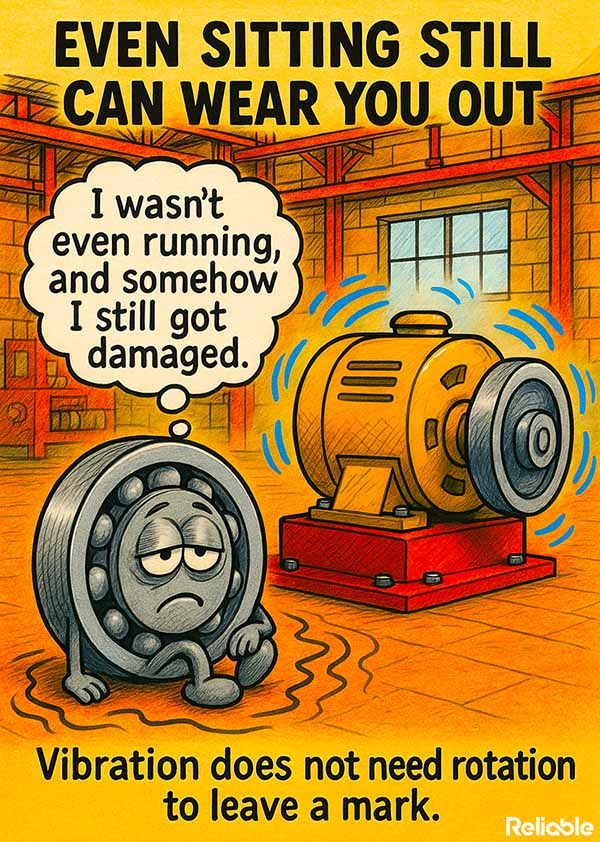
The culprit is often motion you cannot see. A bearing parked next to a running compressor, a forklift rumbling past, or a truck out on the highway can transmit small vibrations into a stationary bearing. With no rotation to redistribute lubricant, repeated micromotion can disturb the film and concentrate wear at the same contact points.
Why Preventing Bearing Damage During Storage Matters More Than People Think
Most teams treat a spare bearing as a finished product. It went into the box clean, so it will come out ready. The reality is harsher than that.
A bearing is a precision part measured in microns. The tight clearances that let it spin smoothly are the same clearances that record every insult it takes while sitting on the shelf.
Two failure modes do most of the harm in storage. False brinelling happens when small vibrations or oscillation cause fretting wear marks at rolling-element contact points. True brinelling happens when a shock load or excessive static load dents the raceway, often from impact or poor handling.
- False brinelling: vibration-driven wear marks spaced exactly at rolling-element intervals
- True brinelling: dents from a single impact or a sustained static overload
- Lubricant changes: grease bleeding, oil separation, hardening, or oxidation during extended storage
- Corrosion: condensation forming inside the bearing as temperatures swing
Any one of these can shorten the life of a spare, and they can build quietly while the bearing simply sits there.
Installed standby equipment carries the same risk. Sealed bearings help limit contamination, but they do not eliminate vibration, static loading, or long idle-period risks transmitted through the shaft and housing.
Stillness can create its own risk, especially when storage conditions, vibration exposure, or lubricant shelf-life limits are ignored.
The damage hides well. A false-brinelled bearing often spins smoothly by hand and passes a casual visual check, then fails early once it is loaded and turning at speed.
Storage Conditions That Quietly Wear Bearings Out
Three conditions decide whether a stored bearing survives: vibration, orientation, and environment.
Get all three right and a bearing has a much better chance of reaching installation in usable condition. Miss one and the risk starts building the day it arrives at the dock.
Isolate stored bearings from vibration
Keep spares away from running equipment. A shelf bolted to the same structure as a reciprocating compressor transmits every stroke straight into whatever sits on it.
Use anti-vibration isolation where needed, and avoid stacking or storing heavy bearings in ways that allow sustained vibration, point loading, or bearing-to-bearing contact for months on end.
Mind orientation and static load
Store large bearings according to the manufacturer’s instructions, with adequate support so weight is distributed and races are not distorted. Unsupported vertical storage or poor support can concentrate load at a few contact points and increase the risk of marking or deformation.
Heavier bearings deserve extra care. Long storage on the same contact points, especially with vibration or poor support, can increase the risk of false brinelling, fretting, or raceway marking.
A bearing in a warehouse is still in service. It is just being tested by the building instead of by the machine.
Periodic rotation can help protect critical spares and installed standby equipment when it follows the manufacturer’s guidance. Turning a shaft enough to change the rolling-element contact points helps redistribute lubricant, which is why standby pumps and motors often benefit from a scheduled rotation routine.
Inspection and Condition Checks Before You Install
Catch storage damage before the bearing goes into a machine, while a swap is still cheap and planned. A short incoming check and a pre-install check together save a lot of unplanned downtime.
Vibration analysis on a test stand may reveal damage that a hand-spin check misses on critical assemblies, and it gives you a baseline to compare against once the unit is running.
Build the check into receiving, so a damaged bearing gets caught at the dock instead of in the machine. A five-minute inspection at intake beats a failed startup and an emergency teardown every time.
- Log the receive date and storage location for every bearing, so age on the shelf stays visible
- Rotate critical spares on a schedule and record each turn
- Inspect grease for separation or hardening before install
- Where inspection is appropriate, check races under magnification for evenly spaced marks that may signal false brinelling
When a unit does come out of storage damaged, a quick bearing failure analysis tells you whether to blame handling, environment, or shelf time, so the next batch fares better.
First-in, first-out matters here. A bearing that sits for years generally carries more storage risk than one stored for a few months, and steady stock rotation keeps older units moving before lubricant condition or packaging integrity becomes questionable.
Labeling matters as much as location. A bin tag with the receive date turns a guessing game into a glance, and it makes first-in, first-out something the crew can actually follow.
A Simple Routine for Preventing Bearing Damage During Storage
Good bearing storage comes down to a handful of habits applied consistently, and most plants already have the space to do it.
Treat the storeroom as part of the reliability program. The spares waiting there are the difference between a one-hour swap and a full day of downtime when something critical lets go.
Keep storage clean, dry, and temperature-stable to limit condensation. Leave bearings sealed in their original packaging until installation unless inspection is required. Date every unit and rotate stock so nothing ages out unnoticed.
Idle equipment can accumulate damage slowly, and the marks it picks up in storage can show up later as early failures on the floor. A little structure around storage protects the spares you are counting on for the next breakdown, and that protection is what preventing bearing damage during storage is really about.