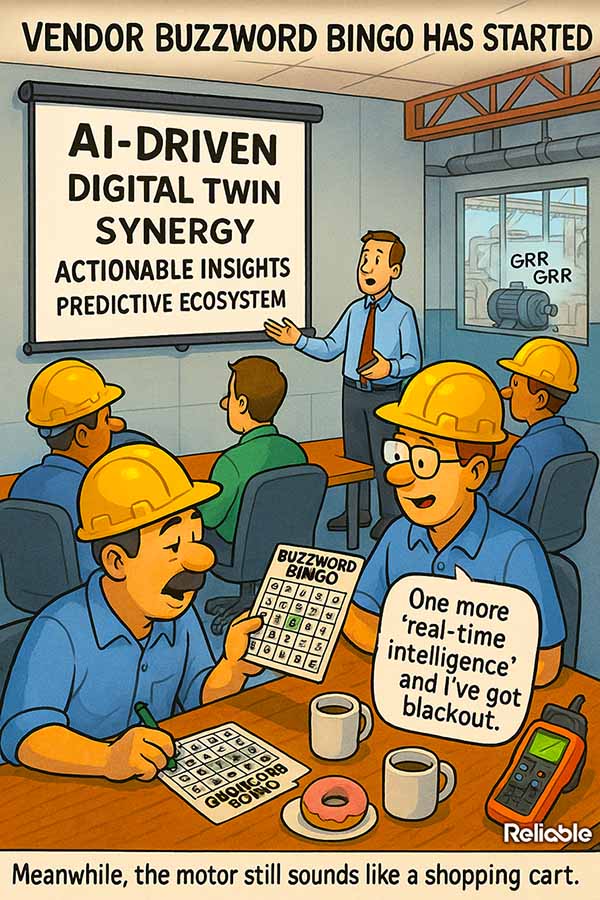

Maintenance technology conferences have a rhythm to them. Every booth promises “AI-driven insights,” “predictive ecosystems,” and “digital twin synergy.” The slide decks glow with dashboards. The demos run flawlessly on perfect data. And back at the plant, Motor 7 still sounds like a shopping cart with a bad wheel. Knowing how to evaluate maintenance technology vendors separates plants that buy solutions from plants that buy expensive shelf-ware.
The maintenance software market hit $5.7 billion in 2024 and is projected to reach $9.1 billion by 2029, according to MarketsandMarkets. With that much money in play, vendors have powerful incentives to sell capabilities their products can’t yet deliver in a real industrial environment. Your job as the buyer is to see past the presentation and ask the questions that actually matter.
How to Evaluate Maintenance Technology Vendors: Start With the Problem
The most expensive maintenance technology mistake is buying a solution before defining the problem it’s supposed to solve. It sounds obvious, and yet plant after plant purchases condition monitoring platforms, AI analytics packages, or CMMS upgrades without first documenting the specific gap they’re trying to close.
Before you talk to a single vendor, answer three questions internally:
- What specific failure modes, losses, or inefficiencies are costing us the most money right now?
- What data do we already collect, and what are we actually doing with it (or failing to do with it)?
- If this technology works perfectly, what measurable outcome changes in the next 12 months?
If you can’t answer those questions crisply, you’re shopping without a list. And shopping without a list at a maintenance technology trade show is how you end up with a $200,000 platform that nobody uses past the pilot phase.
The most expensive maintenance technology mistake is buying a solution before you’ve written down the problem it’s supposed to solve.
This problem-first approach also protects you from a common vendor tactic: redefining your problem to fit their product. A plant struggling with spare parts management doesn’t necessarily need an AI forecasting tool. It might need a cleaner bill of materials, better min-max settings, and someone checking the storeroom weekly. Technology can help, but only after the foundational process exists to support it.
Red Flags When You Evaluate Maintenance Technology Vendors
Once you’ve defined the problem and started talking to vendors, certain patterns should raise immediate concerns. These aren’t automatically disqualifying, but they warrant deeper scrutiny and tougher questions.
The Demo Uses Their Data, Never Yours
A vendor demo running on curated sample data tells you what the software can do under ideal conditions. It tells you nothing about how it handles your data: your sensor gaps, your inconsistent naming conventions, your CMMS records that go back 15 years and include three different coding schemes developed by three different managers.
Ask for a proof-of-concept on your actual data. Any vendor confident in their product will agree to this, even if it takes a few weeks to set up. Vendors who resist this request are usually hiding integration complexity they’d rather you discover after the contract is signed.
A demo on curated sample data tells you what software can do under ideal conditions. A proof-of-concept on your data tells you what it will actually do in your plant.
During the proof-of-concept, pay close attention to how much data cleaning, formatting, and manual setup is required on your side. That effort doesn’t disappear after the sale. It becomes your team’s ongoing burden, and it’s rarely factored into the vendor’s ROI projections.
Buzzwords Without Benchmarks
“AI-driven” means nothing without context. Ask what specific algorithm or model the platform uses, what training data it requires, what its false-positive rate looks like in practice, and how long it takes to reach useful accuracy on a new asset class. Vendors with genuine capability will answer these questions with specifics and data. Vendors selling vaporware will pivot to another buzzword.
The same scrutiny applies to “predictive” claims. Predictive maintenance technology requires quality data from properly installed sensors and sufficient time to learn normal operating patterns for each asset. Any vendor claiming their tool delivers accurate predictions on Day One is either stretching the truth or redefining “predictive” to mean something closer to “threshold-based alerting,” which is a perfectly valid approach but costs a lot less.
A solid predictive maintenance strategy depends on the technology being honest about what it can and can’t detect, and how much organizational effort is required to make it work reliably. The same standard of honesty should apply to the vendor selling it to you.
The Integration Question Nobody Asks Early Enough
Maintenance technology rarely exists in isolation. It needs to talk to your CMMS, your historian, your ERP system, your sensor network, and possibly your building management system. Integration complexity is the single most underestimated cost in maintenance technology purchases, and it’s the one that blows timelines and budgets most reliably.
Key questions to ask before you sign anything:
- Does the platform offer a documented, supported API for two-way integration with our specific CMMS?
- What data formats and communication protocols does it support natively (OPC-UA, MQTT, Modbus, REST)?
- Who is responsible for building and maintaining the integration over time: the vendor, your IT team, or a third-party integrator?
- What happens to our data if we cancel the contract? Can we export everything in a standard format, or is it locked in a proprietary system?
That last question matters more than most buyers realize. Data portability is leverage. If you can’t leave without losing years of historical condition monitoring data and failure records, you’re locked in, and your vendor knows it. Negotiate data export rights before signing, when you still have bargaining power.
Data portability is leverage. If you can’t leave a vendor without losing years of historical data, you’re locked in, and they know it.
Integration also extends to your people. Technology that requires a dedicated data scientist to operate is a poor fit for most maintenance departments. The tool should be usable by your reliability engineers, planners, and technicians with reasonable training. If you also need to figure out how to start a condition monitoring program alongside the technology rollout, factor that organizational readiness work into both the timeline and the budget.
Building a Scoring Framework That Cuts Through the Noise
Structure your evaluation of maintenance technology vendors around four categories, weighted by what matters most to your specific plant and situation:
- Problem fit (40%): Does this tool directly address the documented losses or gaps you identified? Can the vendor demonstrate measurable improvement at a comparable facility with similar equipment and operating conditions?
- Integration and data (25%): How cleanly does it connect to your existing systems? What’s the realistic timeline and cost for full integration? What data quality prerequisites must be met before go-live?
- Total cost of ownership (20%): Include licensing, integration labor, training, ongoing support contracts, internal staff time for administration, and the cost of any sensors or hardware the platform requires. The sticker price is often less than half the real number.
- Vendor viability and support (15%): How long has the company existed? How many active installations do they have in your industry? What does their support model look like after the sale ends and the implementation team moves on? Can you speak with three reference customers who’ve been live for more than 12 months?
Score each vendor against this framework using identical criteria. It removes the emotional pull of a slick demo and forces the conversation back to measurable outcomes and documented evidence.
The sticker price of maintenance technology is often less than half the real number. Total cost of ownership includes integration, training, support, sensors, and the staff time to keep it running.
Reference calls deserve special attention. Ask references specifically about implementation timelines (planned versus actual), support responsiveness after go-live, and whether the vendor’s ROI projections matched reality. The gap between projected and actual ROI in maintenance technology is consistently 30 to 50%, according to a 2023 Verdantix survey. Good maintenance optimization requires honest numbers from the start, and honest numbers come from honest conversations during the evaluation phase.
After the Purchase: Protecting Your Investment
Even after careful evaluation, technology purchases can underperform if the rollout is handled poorly. Assign an internal champion with enough authority to resolve integration issues and enough dedicated time to manage the implementation properly. Set 90-day milestones tied to the specific outcomes you defined at the start of the process.
Review progress honestly and regularly. If the tool isn’t delivering measurable value by month six, escalate with the vendor before the relationship goes stale and the implementation team loses momentum. The best maintenance technology purchases happen when the buyer knows exactly what problem they’re solving, evaluates vendors against that problem specifically, and builds integration and organizational readiness into the plan from day one. Everything else is just buzzword bingo with an expensive entry fee.