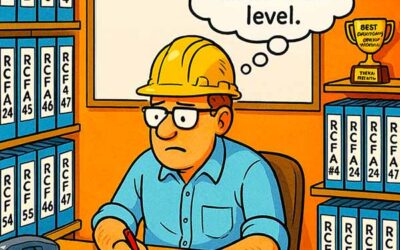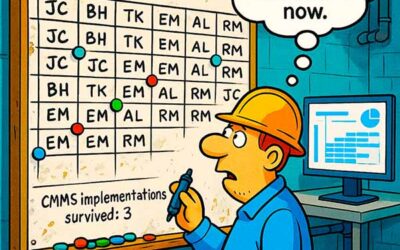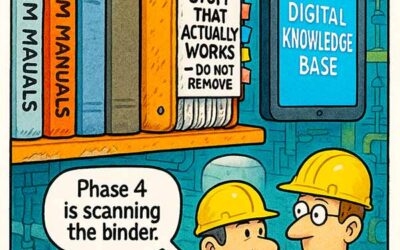
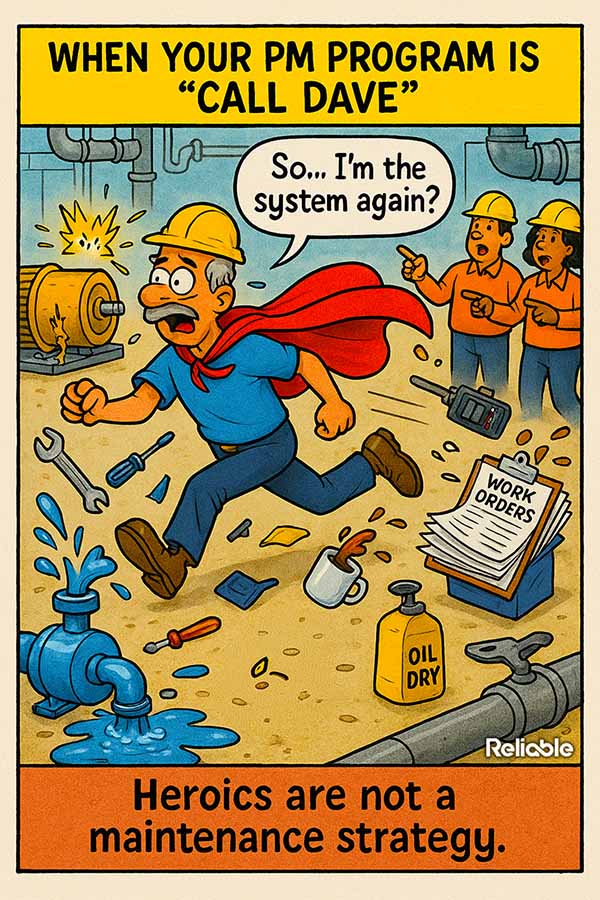

Every maintenance department has a Dave. Dave knows which bearing on Line 4 hums before it seizes. He knows the bypass valve on the boiler needs a quarter-turn past the mark. He carries 20 years of tribal knowledge in his head, and the entire PM schedule revolves around his availability.
Figuring out how to build a preventive maintenance program that works without Dave is the difference between a real system and an expensive illusion. When Dave retires, takes a new job, or calls in sick for a week, the whole operation feels it. That’s the diagnostic. If one person’s absence can destabilize your maintenance output, you have a personality, not a process.
How to Build a Preventive Maintenance Program on Systems, Not Heroes
Hero-dependent maintenance is remarkably common. A 2022 Plant Engineering survey found that 43% of maintenance organizations relied on fewer than three senior technicians for the majority of critical equipment knowledge. Those same plants reported 35% more unplanned downtime whenever any of those technicians were unavailable.
The fix requires dismantling the hero model deliberately, and doing it without insulting the heroes in the process. The Daves of the world earned their expertise through years of hands-on problem solving. The problem is organizational: nobody ever captured, structured, or made that knowledge transferable.
If one person’s absence destabilizes your maintenance output, you have a personality, not a process.
Building a real preventive maintenance program means converting tacit knowledge into documented procedures, standardized task lists, and decision trees that any competent technician can follow. The system holds the knowledge, even when the person who generated it walks out the door.
The Foundation: Asset Criticality and PM Task Development
Before writing a single PM task, you need to know which assets matter most. Asset criticality ranking determines where your limited resources go first. A straightforward approach works best here:
- Rank assets by consequence of failure: safety impact, production loss per hour of downtime, environmental risk, and average repair cost
- Assign each asset a criticality tier (A, B, or C) based on the combined score
- Concentrate detailed PM development on Tier A assets first, then work down to B, then C
- Review and update rankings annually, or immediately after any significant process or equipment change
For each critical asset, develop PM tasks based on manufacturer recommendations, your specific operating context, and actual failure history. This is where maintenance planning and scheduling discipline becomes essential. A PM task that says “inspect pump” is useless. A task that says “check seal face for leakage, measure vibration at drive end bearing, verify suction pressure reads between 12 and 15 PSI” gives any technician a clear standard to execute against.
Writing PM Tasks That Transfer Knowledge
The single biggest upgrade most plants can make to their PM program is rewriting vague tasks into specific, measurable ones. Every PM task should answer four questions:
- What exactly am I checking, measuring, or doing?
- What does “acceptable” look like? Include specific ranges, tolerances, or visual benchmarks.
- What do I do if the result falls outside the acceptable range?
- What tools, safety precautions, or replacement parts are required before I start?
This level of specificity does something powerful: it breaks the dependency on tribal knowledge. When Dave’s inspection instincts get translated into written criteria with measurable tolerances, any trained technician can perform the same check to the same standard. Pairing these documented PMs with vibration analysis data and oil sample trends makes the program even more robust, because you’re catching failures through objective measurement rather than relying solely on one person’s ears and intuition.
When Dave’s instincts get translated into written criteria with measurable tolerances, any trained technician can perform the same check to the same standard.
This documentation effort takes time. Plan for six to twelve months to fully develop PM task libraries for your critical assets. The investment pays for itself the first time a key person leaves and the program keeps running without a hiccup.
Scheduling, Compliance, and the Feedback Loop
A common trap: plants build a thorough PM program on paper, load it into the CMMS, and then watch compliance hover around 50% because nobody aligned the schedule with production reality. PM tasks need realistic time estimates baked into the schedule, and that schedule needs genuine buy-in from operations leadership.
Target 90% or higher maintenance schedule compliance. Anything below 80% signals a systemic problem: either the schedule is unrealistic, parts aren’t staged, or operations won’t release equipment for the work. All three are fixable, but only if someone tracks compliance weekly and asks specific questions when it drops.
The feedback loop matters as much as the schedule itself. Every completed PM should include a technician’s field observations: what looked different from last time, what’s trending in the wrong direction, what needs follow-up work. This data feeds back into planning, updates task content over time, and continuously improves the program. Without it, your PM library is static while your equipment ages and operating conditions shift.
Making It Last
A preventive maintenance program built on documented systems rather than individual expertise has a few clear hallmarks. Procedures live in the CMMS with enough detail that a competent technician can execute them without calling someone for clarification. New hires can perform PMs within their first month because the tasks are specific enough to follow. Compliance gets tracked, reported on, and acted on every week.
- Task libraries are reviewed and updated at least annually based on failure trends and technician feedback
- Knowledge transfer is built into the onboarding process, not left to chance or buddy-system shadowing
- The program’s performance is measured by equipment outcomes (uptime, failure rates) rather than just task completion counts
And when someone leaves (because people always leave), the program absorbs the change without triggering a crisis or a scramble to figure out what that person used to do.
That’s how to build a preventive maintenance program that survives turnover, retirement, and the inevitable sick days. Make the system smart enough that the people don’t have to be irreplaceable.