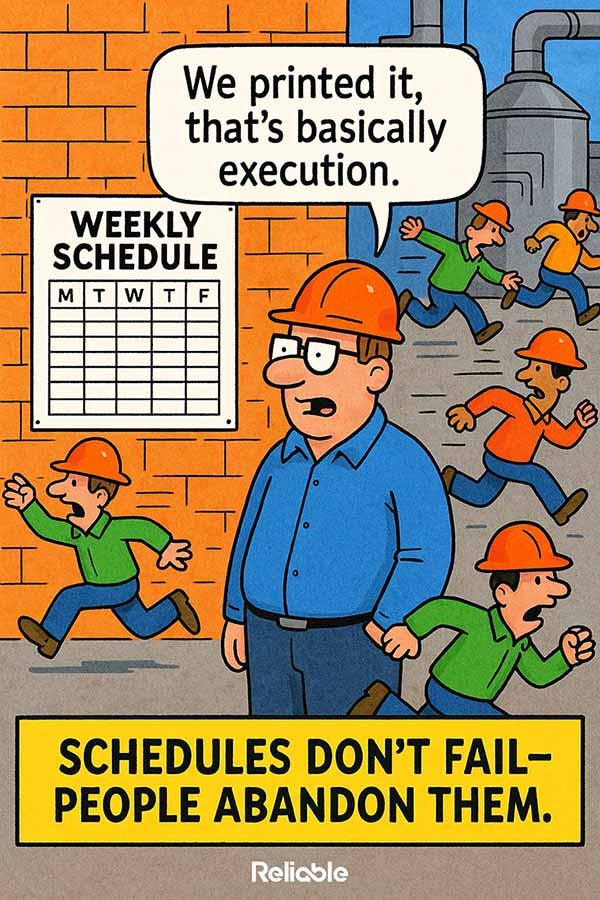

Most plants have a weekly maintenance schedule. Fewer plants actually follow it. The question of how to improve maintenance schedule compliance comes up in every reliability improvement initiative, and the answer almost always points to the same set of breakdowns: unclear priorities, weak accountability, and a planning process that produces schedules nobody trusts.
Schedule compliance below 80% signals a systemic problem in planning, parts management, or leadership commitment. And most industrial facilities hover somewhere between 30% and 60%, which means the weekly schedule functions more as a suggestion than a commitment.
Fixing this requires work on both the schedule itself and the organizational habits around it. The schedule has to be realistic enough to follow, and the team has to treat it as a binding agreement rather than a starting point for negotiation.
Why Schedule Compliance Collapses
Schedules fail for predictable reasons. Understanding which ones are driving your compliance numbers is the first step toward improving maintenance schedule compliance at your facility.
The most common culprits:
- Reactive work overwhelms the schedule. Emergency breakdowns consume the labor hours that were allocated to planned jobs, and the planned work slides to next week (or disappears entirely).
- The schedule is overloaded. Planners pack in more work than the available labor can execute, so the crew falls behind by Tuesday and stops consulting the schedule by Thursday.
- Parts or materials are missing. A job is scheduled, the technician shows up, and the parts aren’t staged. The job gets deferred, and the technician moves on to unscheduled work.
- Operations won’t release equipment. Scheduled jobs require downtime windows that production doesn’t honor, so the work gets pushed repeatedly until something breaks and forces the issue.
- Nobody enforces compliance. The schedule exists, the score is tracked somewhere, but nobody reviews it, and missing the target carries no consequences.
Each of these failure modes has a different fix, but they rarely appear in isolation. A plant with 40% schedule compliance usually has three or four of them running simultaneously.
Schedule compliance below 80% signals a systemic problem in planning, parts management, or leadership commitment. Most industrial facilities hover between 30% and 60%.
The reactive work problem is the most visible. When a bearing seizes on a critical conveyor at 6 AM, nobody argues about pulling a technician off planned work. The problem is structural: if reactive work consistently consumes more than 20% of available labor, the schedule will always collapse because there is no buffer for the inevitable emergencies.
Overloaded schedules are harder to spot because they look like ambition. A planner who schedules 50 jobs when the crew can realistically complete 35 creates the appearance of robust planning. In practice, the crew knows by Monday afternoon that the list is unachievable, and they stop treating it as a commitment.
How to Improve Maintenance Schedule Compliance Step by Step
Improving schedule compliance requires coordinated changes in planning, scheduling, parts management, and leadership behavior. Tackling any one of these in isolation produces temporary improvement that fades within a few months.
Build Schedules That Can Actually Be Executed
The single biggest planning error is overloading the schedule. A realistic weekly schedule should allocate no more than 80% to 85% of available labor hours to planned work. The remaining 15% to 20% serves as a buffer for the reactive work that will inevitably show up.
Solid maintenance planning also means every job on the schedule has a complete job package before it gets scheduled: scope, parts, tools, permits, and an estimated duration based on historical data. When a planner puts a job on the schedule without confirming that parts are in the storeroom, the schedule has a hole in it before the week even starts.
Verify parts availability before the schedule is finalized. This sounds obvious, but it gets skipped constantly. The planner checks the CMMS, sees a quantity on hand, and schedules the job.
The technician walks to the storeroom and finds the shelf empty because the inventory record was wrong. One missed parts check can derail an entire day of scheduled work.
A realistic weekly schedule should allocate no more than 80% to 85% of available labor hours to planned work. The rest serves as a buffer for inevitable emergencies.
Use a formal scheduling meeting to lock the schedule before the work week begins. This meeting should include maintenance supervision, operations, and planning.
Its purpose is to confirm equipment availability, labor assignments, and material readiness for every job on the schedule. Once the schedule is locked, changes require a defined escalation process.
Protect the Schedule from Reactive Disruptions
Reactive work is the primary schedule killer. Plants that want to improve maintenance schedule compliance need a strategy for handling emergencies without gutting the planned work list.
The most effective approach is a dedicated reactive crew. Separate a small team (or even one technician per shift) whose only job is to handle the unplanned work that comes in during the week.
Everyone else stays on the schedule. This separation protects planned work completion rates and gives the reactive crew a clear mission.
If a dedicated crew is not feasible, define explicit rules for when planned work can be interrupted. A tiered system works well:
- Tier 1 (safety or environmental): immediate response, pull any available technician
- Tier 2 (production-critical): respond within 2 hours, pull from the reactive buffer first
- Tier 3 (everything else): add to next week’s schedule, do not interrupt today’s planned work
Without clear rules, every breakdown gets treated as an emergency by the person reporting it, and the schedule disintegrates by midweek.
Another schedule protection strategy is a formal break-in work process. When someone requests unplanned work during the week, it goes through a gatekeeper (typically the maintenance supervisor or planner) who evaluates the urgency, estimates the labor impact, and decides whether it justifies pulling a technician off planned work. This single checkpoint prevents casual requests that individually seem harmless but collectively destroy schedule compliance.
Track the volume and source of break-in work weekly. If one production area consistently generates 60% of the reactive calls, that area needs a focused reliability effort. Condition monitoring on those assets, improved operator care, or a targeted PM optimization can reduce the reactive load and protect the schedule from its biggest threat.
Build Accountability Around the Numbers
Schedule compliance improves when people know the score and care about it. That requires two things: visible tracking and leadership attention.
Post the weekly schedule compliance score where the crew can see it. Track it over time. A maintenance scheduling discipline that includes visible scorekeeping creates a feedback loop that reinforces follow-through.
Hold a brief weekly review meeting to examine what broke the schedule. Go job by job through every planned task that was not completed and categorize the reason: parts issue, operations did not release equipment, reactive work pulled the technician, job took longer than estimated, or technician reassigned. This categorization turns a compliance score into actionable intelligence.
Track schedule compliance over time and review what broke the schedule every week. Categorize each missed job. That turns a compliance score into actionable intelligence.
Over a few months, the data will show clear patterns. Maybe 35% of schedule breaks come from parts availability issues, which means the storeroom needs attention. Maybe 25% come from operations refusing to release equipment, which means the coordination process with production needs rework.
The review meeting also creates accountability without blame. The question is always what broke the schedule, and the answers point to process failures. This approach builds trust with the crew while driving maintenance optimization through system-level improvements.
The Long Game on Schedule Compliance
Improving maintenance schedule compliance from 40% to 90% typically takes 12 to 18 months of sustained effort. The early gains come fast (fixing the obvious planning and parts problems), but sustained improvement requires changing habits and expectations across the organization.
Operations has to accept that scheduled maintenance windows are commitments, and that deferring planned work creates more unplanned downtime downstream. Supervision has to resist the urge to pull technicians off planned work for every squeaky wheel. Planners have to accept that a realistic schedule with 15 jobs is better than an aspirational one with 30.
Operations has to accept that scheduled maintenance windows are commitments. Deferring planned work creates more unplanned downtime downstream.
Set incremental targets. If current compliance is 45%, aim for 60% in the first quarter, 70% in the second, and 80% by year-end. Each milestone should come with a specific process improvement: better parts staging, a dedicated reactive crew, a formal scheduling meeting, or an updated escalation policy.
Celebrate the milestones. When the team hits 60% compliance for the first time, recognize it.
When a full week goes by without a single planned job getting bumped for reactive work, call it out. These wins build momentum and reinforce the idea that schedule compliance belongs to everyone.
Measure the downstream impact, too. As schedule compliance improves, track the corresponding changes in unplanned downtime, overtime hours, and emergency parts spending.
These metrics tell the financial story that justifies continued investment in planning and scheduling discipline. A plant running at 85% schedule compliance typically sees 30% to 50% less unplanned downtime than one running at 45%.
The plants that achieve and sustain high schedule compliance treat the weekly schedule as a promise, and they build the systems, habits, and accountability structures to keep it. That is the real answer to how to improve maintenance schedule compliance: make the schedule worth following, and then hold the organization to it.