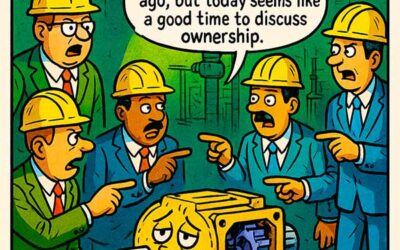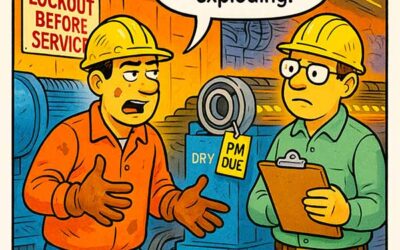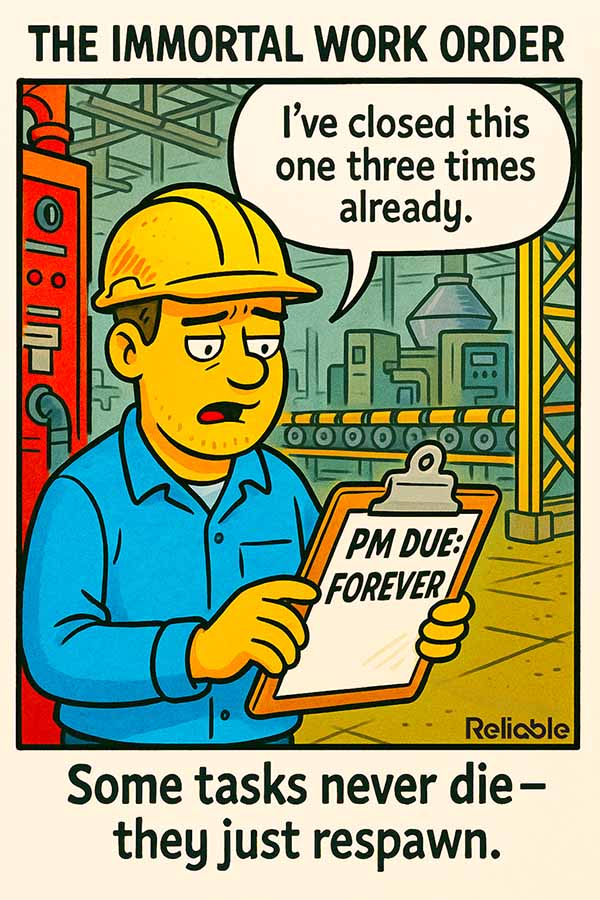

Every maintenance department has them: the work orders that get closed on Tuesday and reopened by Thursday. Same asset, same failure mode, same temporary fix. Understanding why work orders keep coming back requires looking past the symptom and into the systems that allow repeat failures to persist.
Recurring work orders are expensive in ways that go beyond the obvious labor and parts costs. They erode technician morale (nobody wants to fix the same pump seal for the fourth time this quarter), inflate backlog counts, and quietly drain reliability from the overall maintenance program.
The Root Causes Behind Why Work Orders Keep Coming Back
A work order that recurs is a signal, and it’s telling you that something in the repair process, the asset strategy, or the operating environment is fundamentally unresolved. The most common culprits fall into a few categories.
Symptom Repairs Instead of Root Cause Fixes
The most frequent driver of recurring work orders is treating symptoms rather than causes. A technician replaces a failed bearing, closes the order, and moves on. Two months later, the bearing fails again because the underlying misalignment was never corrected. A proper root cause failure analysis would have caught the misalignment on the first repair, but the pressure to close work orders and move to the next job often pushes root cause work to the bottom of the priority list.
A closed work order with an unresolved root cause is a future work order with a scheduled arrival date.
This pattern compounds. Each repeat failure consumes labor hours that could have been spent on proactive work, which creates more reactive failures, which generates more repeat work orders. The cycle is self-reinforcing.
Inadequate Repair Standards
When repair procedures are informal or left to individual judgment, quality varies. One technician torques a coupling to spec and documents the alignment readings. Another tightens it until it “feels right” and moves on. Both close the same work order, but only one repair will last.
Standardized job plans with clear acceptance criteria reduce repeat failures significantly. The job plan should define what “done” looks like: torque values, alignment tolerances, test run parameters, and required documentation before the work order can close.
Wrong Parts or Inadequate Spares
Recurring failures sometimes trace back to spare parts management problems. Substituted bearings that meet dimensional specs but lack the correct load rating. Seals made from a material that degrades in the process fluid. Filters purchased on price rather than performance.
Each of these substitutions looks fine on paper and fails in practice. The work order closes with the replacement installed. The replacement fails because it was never the right part for the application.
How to Break the Recurring Work Order Cycle
Stopping the pattern requires changes at three levels: the CMMS, the repair process, and the review cadence.
Flag and Track Repeats in Your CMMS
Most CMMS platforms can generate reports on assets with the highest work order frequency. Run this report monthly and flag any asset that has generated three or more corrective work orders for the same failure mode within a rolling 12-month window. That flag triggers a mandatory root cause review before the next repair closes.
The key fields to capture on every corrective work order:
- Failure mode (what failed)
- Failure cause (why it failed, if known)
- Corrective action taken (what was done to fix it)
- Recommended follow-up (what should be done to prevent recurrence)
That last field is the one most teams skip. It’s also the one that breaks the cycle.
The recommended follow-up field is where recurring work orders go to die, but only if someone actually reads it and acts on it.
Require Root Cause on Repeat Failures
When a work order recurs, escalate the response. The second occurrence should trigger a 5 whys analysis at minimum. The third occurrence should trigger a formal investigation with engineering involvement.
This escalation model does two things. First, it ensures that repeat failures get progressively more attention. Second, it creates a natural accountability loop: if the same issue keeps showing up, someone has to explain why previous corrective actions didn’t hold.
Build a Review Cadence
Set aside 30 minutes in your weekly planning meeting to review the top five recurring work orders. For each one, ask three questions:
- What was the stated root cause on the last closure?
- Was the recommended follow-up action completed?
- Has the failure recurred since the last corrective action?
This review takes minimal time and catches repeat failures before they become entrenched patterns. It also sends a clear message to the team: closing a work order without addressing the underlying cause will get noticed.
Thirty minutes a week reviewing your worst repeat offenders saves more downtime than thirty hours of reactive repairs.
Closing the Loop for Good
Recurring work orders persist because the systems around them allow it. When closing a work order is easier than solving the underlying problem, technicians will close work orders. When the CMMS accepts a closure without a cause code, the data to identify patterns never gets captured.
The fix requires a combination of better data capture, disciplined root cause investigation, and a regular review rhythm that holds the team accountable for permanent solutions. It also requires leadership to accept that a work order closed without a root cause fix is simply a work order deferred, and to fund the time and resources needed to do repairs right the first time.
The maintenance departments that crack this problem share a philosophy: every recurring work order is a process failure, and process failures are leadership’s responsibility to fix. Adopt that mindset, build the systems to support it, and the immortal work orders will finally stay closed.