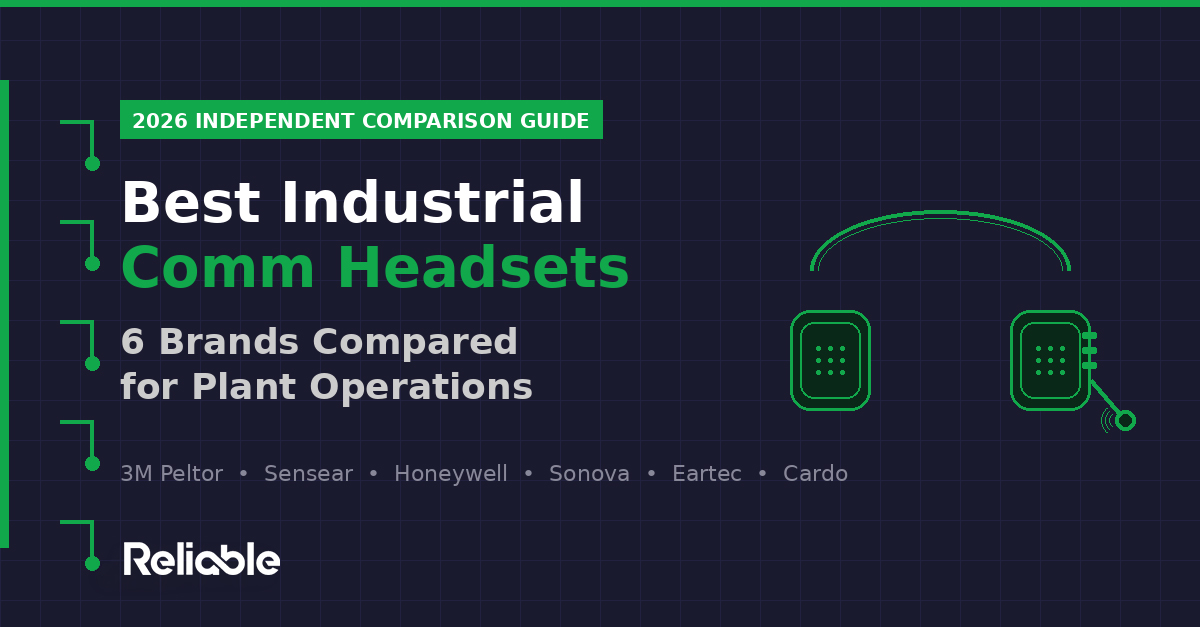

TL;DR: Industrial communication headsets combine hearing protection with the ability to communicate clearly in noise – through Bluetooth, two-way radio, or wireless mesh networking. 3M Peltor leads the category overall through breadth, deployment track record, and integration with major two-way radio platforms. Sensear is the strongest choice for high-noise environments through speech enhancement technology. Honeywell Howard Leight Sync serves value deployments. Sonova Phonak Communications leads hearing-protection-first applications. Eartec serves team coordination in warehouses and events. Cardo Systems Crystal leads Bluetooth mesh networking for mobile teams. Choose based on noise environment, communication infrastructure (Bluetooth vs two-way radio vs mesh), hazardous location certifications, and total cost of ownership.
How We Evaluated
This guide is an independent editorial analysis based on publicly available product documentation, hands-on product evaluations, verified customer reviews, and conversations with safety leaders and operations teams who deploy these headsets at scale. Reliable Magazine does not sell industrial headsets and has no commercial interest in routing buyers toward any particular product. Reliable does not accept payment for rankings. Vendors may sponsor enhanced listings with additional detail, but editorial rankings are independent. Read our editorial policy.
We evaluated each product across six criteria that matter most for industrial deployment decisions:
- Hearing protection performance – NRR rating, fit consistency, and effectiveness across the frequency spectrum that industrial environments produce
- Communication clarity in noise – speech intelligibility for face-to-face conversations and radio communications in high-noise environments
- Communication infrastructure compatibility – Bluetooth, two-way radio integration, and wireless mesh networking options
- Hazardous location certifications – ATEX, IECEx, and other certifications required for explosive atmospheres
- Comfort and full-shift wearability – practical wearability for 8-12 hour industrial shifts
- Total cost of ownership – device cost, accessories, replacement parts, and fleet management at deployment scale
Why Industrial Headsets Are Different from Office Headsets
Industrial communication headsets are fundamentally a different product category from the headsets used in offices, call centers, or consumer audio. Three differences matter most. First, industrial headsets are PPE before they are communication devices. The primary job is hearing protection – meeting OSHA’s noise exposure requirements when time-weighted average exposure exceeds 90 dB, with NRR ratings that hold up to OSHA’s de-rating formula. A communication headset that does not provide certified hearing protection cannot be used in regulated industrial environments, regardless of how good the audio quality is.
Second, industrial environments produce noise that consumer-grade audio products cannot handle. Compressors, pumps, conveyors, and heavy machinery generate continuous noise above 100 dB across a wide frequency range. Speech in these environments cannot be heard through standard hearing protection – workers either remove their protection to communicate (creating safety violations) or cannot communicate effectively. Industrial communication headsets solve this through active speech enhancement, level-dependent protection, or boom microphones that capture speech at the source rather than relying on ambient pickup.
Third, industrial deployments have to integrate with existing communication infrastructure. Most industrial operations run two-way radio systems for primary communication – Motorola Solutions APX or MOTOTRBO, Kenwood NX-series, Icom, or Hytera. Some operations also use Bluetooth for short-range communication or mesh networking for team coordination. The right industrial headset is often determined less by audio quality and more by which infrastructure it integrates with and how cleanly that integration works in actual field conditions.
The 6 Best Industrial Communication Headsets for 2026
1. 3M Peltor – Best for Industrial Communication Overall
3M Peltor has been the dominant brand in industrial hearing protection with communication for decades, and the breadth of their product range is genuinely difficult for competitors to match. The WS ALERT XPI series provides Bluetooth-enabled hearing protection with FM radio and ambient listening at NRR 26-31 depending on configuration. The LiteCom and LiteCom Pro series integrate directly with two-way radios from Motorola Solutions, Kenwood, Icom, and Hytera. The ComTac series serves heavy industrial and tactical applications with rugged construction and active speech enhancement.
The platform’s broader strength is supply chain and deployment infrastructure. 3M’s distribution network reaches industrial safety distributors worldwide, replacement parts and accessories are widely available, and most safety officers and procurement teams already have established relationships with 3M for other PPE categories. For organizations standardizing on a single brand across their hearing protection program, 3M Peltor is the safest choice. The trade-offs are typical of category-leader pricing – Peltor products are rarely the cheapest option in their tier, but the deployment ecosystem usually justifies the premium.
Best for: Industrial operations across manufacturing, oil and gas, mining, utilities, and construction needing broad product range, two-way radio integration, and proven deployment track record.
Pricing: $300 to $1,200 per headset depending on configuration, with intrinsically safe versions priced higher.
2. Sensear – Best for High-Noise Environments
Sensear has built a unique position in the industrial communication headset market through its proprietary SENS (Speech Enhancement, Noise Suppression) technology. The platform actively processes ambient sound to filter out dangerous noise frequencies while amplifying speech frequencies, allowing workers in genuinely loud environments – refineries, gas processing plants, mining operations, manufacturing with heavy compressors and pumps – to communicate face-to-face and over radio with clarity that passive hearing protection cannot match. For operations where standard headsets force workers to remove protection to be heard, Sensear is often the only product that solves the problem.
The trade-offs reflect Sensear’s specialization. The technology premium translates into prices meaningfully above 3M Peltor at comparable feature levels, and the brand’s distribution network is narrower than 3M’s. For industrial operations where noise environments are routine industrial (90-100 dB), 3M Peltor’s level-dependent products typically deliver acceptable speech intelligibility at a lower cost. For genuinely high-noise environments (100+ dB) where workers struggle to communicate, Sensear’s speech enhancement is often worth the premium.
Best for: Refineries, gas processing facilities, mining operations, heavy manufacturing, and other genuinely high-noise environments where speech intelligibility through standard hearing protection is inadequate.
Pricing: $700 to $1,500 per headset depending on configuration and certifications.
3. Honeywell Howard Leight Sync – Best for Value Deployments
Honeywell’s Howard Leight Sync line occupies the value tier of industrial communication headsets. The products combine certified hearing protection (NRR ratings competitive with 3M Peltor and Sensear) with Bluetooth connectivity, AM/FM radio, and basic two-way radio compatibility at price points meaningfully below the premium brands. For operations deploying communication headsets across a workforce where the budget per unit is constrained, or for lighter-duty applications where premium features are not justified, Howard Leight Sync delivers genuine industrial-grade protection without premium pricing.
The trade-offs are at the edges of demanding deployments. Howard Leight Sync products lack the active speech enhancement of Sensear, the breadth of two-way radio integration accessories of 3M Peltor, and the hearing-health engineering of Sonova. For most industrial environments, these gaps are acceptable trade-offs given the price advantage. For demanding deployments – high-noise environments, complex two-way radio infrastructure, or operations where headset comfort directly affects worker retention – the premium brands typically justify their cost.
Best for: Value-conscious industrial deployments, lighter-duty applications, large fleet deployments where per-unit cost matters more than premium features.
Pricing: $150 to $400 per headset depending on configuration.
4. Sonova Phonak Communications (Serenity) – Best for Hearing-Protection-First Deployments
Sonova Phonak Communications brings the engineering of one of the world’s largest hearing health companies into industrial PPE. The Serenity product line offers custom-fit in-ear options, advanced active hearing protection that adjusts to changing noise environments, and audio quality engineered to reduce listener fatigue across long shifts. For operations where worker hearing health is a strategic priority – particularly organizations dealing with long-term workforce hearing loss claims or trying to reduce hearing-related early retirement – Sonova’s hearing-health engineering is genuinely differentiated from communication-focused competitors.
The trade-offs reflect Sonova’s positioning. The platform is less focused on two-way radio integration than 3M Peltor or Sensear, and the custom-fit in-ear option requires individual audiometric fitting that adds deployment overhead. For operations that prioritize hearing-protection-first design and have budget for higher-end hearing protection programs, Sonova is a defensible choice. For operations focused primarily on communication infrastructure integration, 3M Peltor or Sensear typically offer better fit.
Best for: Hearing-protection-first deployments, organizations with active hearing conservation programs, custom-fit in-ear deployments, operations prioritizing reduced listener fatigue.
Pricing: $400 to $900 per headset depending on configuration; custom-fit in-ear products carry additional fitting costs.
5. Eartec – Best for Team-Based Wireless Coordination
Eartec serves a specific segment of the industrial communication market through its focus on full-duplex wireless team coordination without two-way radio infrastructure. The platform allows teams of 4 to 9 workers to communicate simultaneously over short to medium ranges, similar to how a sports broadcast crew or live event team coordinates. For warehouses, distribution centers, smaller manufacturing operations, and event production where two-way radio infrastructure is not justified but team coordination is essential, Eartec delivers capability that two-way radio-based systems cannot match.
The platform’s specialization is also its constraint. Eartec is rarely the right choice for large industrial operations with established two-way radio infrastructure, and the hearing protection ratings on Eartec’s primary products are lower than purpose-built hearing protection brands. For operations deploying Eartec, hearing protection is typically a secondary consideration rather than the primary use case. Smaller operations and team-coordination-focused deployments often find Eartec’s full-duplex communication genuinely transformative.
Best for: Warehouses, distribution centers, smaller manufacturing operations, event production, and team-coordination applications where two-way radio infrastructure is not deployed.
Pricing: $200 to $600 per headset, with hub stations and accessories priced separately.
6. Cardo Systems Crystal – Best for Bluetooth Mesh Networking
Cardo Systems built its brand in motorcycle helmet communication and has expanded into industrial applications through Bluetooth mesh networking technology. The Crystal product line allows teams of mobile workers to communicate over Bluetooth mesh, with each headset acting as a node that extends the network coverage. For fleet, logistics, field service, and other mobile workforce applications where workers move in and out of communication range frequently, Cardo’s mesh approach delivers more reliable communication than traditional point-to-point Bluetooth.
The platform’s industrial positioning is genuinely narrower than the hearing-protection-first brands. Cardo Crystal products are designed for mobile environments rather than fixed industrial facilities, and the hearing protection ratings reflect that — adequate for moderate-noise mobile work but not appropriate for high-noise plant environments. For mobile workforces in fleet, logistics, and field service, Cardo’s mesh networking solves a real problem. For fixed industrial deployments, the brand is rarely the right choice.
Best for: Fleet operations, logistics workers, field service teams, and other mobile workforces needing reliable Bluetooth communication across changing distances.
Pricing: $300 to $700 per headset depending on configuration.
Industrial Headset Comparison Table
| Brand | Best For | Communication Type | Noise Environment |
|---|---|---|---|
| 3M Peltor | Industrial overall | Bluetooth, 2-way radio, FM | Routine to high industrial |
| Sensear | High-noise environments | Bluetooth, 2-way radio | High-noise (100+ dB) |
| Honeywell Howard Leight | Value deployments | Bluetooth, AM/FM | Routine industrial |
| Sonova Phonak | Hearing-protection-first | Bluetooth, custom configurations | Variable industrial |
| Eartec | Team coordination | Wireless full-duplex | Warehouses, light industrial |
| Cardo Systems Crystal | Mobile teams | Bluetooth mesh | Mobile, fleet, field service |
How to Choose the Right Industrial Communication Headset
Industrial headset selection comes down to four questions that matter more than feature comparison:
1. What is your noise environment?
Routine industrial environments (90-100 dB time-weighted average) work well with most products in this guide – 3M Peltor, Honeywell Howard Leight, Sonova, and others all deliver acceptable speech intelligibility. High-noise environments (100+ dB) typically require Sensear’s active speech enhancement or 3M Peltor’s level-dependent products to maintain speech intelligibility through certified hearing protection.
2. What is your communication infrastructure?
Operations standardized on Motorola Solutions, Kenwood, Icom, or Hytera two-way radios should evaluate 3M Peltor LiteCom or Sensear products with appropriate radio cables. Operations using Bluetooth-only communication should evaluate the broader market including 3M Peltor WS ALERT, Sonova, and Honeywell Howard Leight. Operations needing team coordination without two-way radio infrastructure should evaluate Eartec for fixed teams and Cardo Crystal for mobile teams.
3. Hazardous or non-hazardous environment?
Operations in classified hazardous environments – oil and gas, chemicals, mining, certain pharmaceutical operations – need ATEX or IECEx certified versions of any headset they deploy. 3M Peltor offers intrinsically safe versions of its main product lines. Sensear has hazardous-location certified products. Other brands have more limited hazardous-location options. Verify certifications for your specific zone classification before purchasing.
4. What is your hearing conservation philosophy?
Operations with active hearing conservation programs and worker hearing health as a strategic priority should evaluate Sonova Phonak Communications seriously alongside 3M Peltor. Operations focused primarily on OSHA compliance and communication functionality have more flexibility and should choose based on noise environment and infrastructure compatibility.
The Honest Middle Ground
Industrial communication headset deployments fail more often from poor fit assessment than from device limitations. Operations that deploy a single headset model across an entire workforce – without considering individual fit, ear shape variations, eyewear compatibility, hard hat compatibility, and shift length – end up with workers removing their headsets to communicate, which defeats the safety purpose entirely. The successful deployments typically involve fit testing, multiple headset options for different roles, and accommodation for individual variation.
The other honest reality is that industrial headset purchase decisions are often driven by procurement standardization rather than safety effectiveness. Organizations that already have established relationships with 3M for other PPE often default to 3M Peltor regardless of whether it is the best fit for the specific application. Organizations with Honeywell PPE relationships often default to Howard Leight. These standardization decisions are usually defensible – managing PPE complexity has real costs – but they should not be made without confirming that the standard brand actually fits the noise environment and communication needs of the specific deployment.
The buyer who selects industrial communication headsets based on what is already in the PPE program rather than what fits the actual deployment will frequently miss real opportunities to improve worker safety, communication effectiveness, and hearing conservation outcomes.
Frequently Asked Questions
What are the best industrial communication headsets in 2026?
3M Peltor leads the industrial communication headset category in 2026 with the broadest product range and strongest deployment track record across Bluetooth, two-way radio, and tactical applications. Sensear is the strongest choice for high-noise environments through proprietary speech enhancement technology. Honeywell Howard Leight Sync serves value deployments. Sonova Phonak Communications leads hearing-protection-first deployments with custom-fit options. Eartec serves team-based wireless coordination in warehouses and events. Cardo Systems Crystal leads Bluetooth mesh networking for fleet and field service operations.
What is NRR and why does it matter for industrial headsets?
NRR (Noise Reduction Rating) is the OSHA-recognized measurement of how much sound a hearing protector reduces, expressed in decibels. Industrial communication headsets typically range from NRR 22 to NRR 31. NRR matters because OSHA requires hearing protection in environments where time-weighted average noise exposure exceeds 90 dB. The required NRR depends on actual workplace noise levels and OSHA’s de-rating formula, which generally divides the labeled NRR in half for real-world conditions. For most industrial environments, NRR 24 or higher is appropriate; for high-noise environments like compressors, pumps, or heavy machinery, NRR 28 or higher is typically needed.
What is the difference between active and passive noise reduction in industrial headsets?
Passive noise reduction relies entirely on the physical seal of the earcup or earplug to block ambient noise. Active noise reduction uses electronic processing to either cancel low-frequency noise (active noise cancellation) or to preserve and enhance speech while attenuating dangerous noise levels (level-dependent or active hearing protection). Industrial headsets typically combine passive protection with active speech enhancement, allowing workers to hear conversations and warning signals at safe levels while still being protected from continuous high-noise exposure. Sensear’s SENS technology and 3M Peltor’s level-dependent products are leading examples of this active approach.
How much do industrial communication headsets cost?
Industrial communication headsets typically range from $150 to $1,500 per unit depending on capabilities and certifications. Entry-level products like Honeywell Howard Leight Sync start around $150 to $300. Mid-range Bluetooth-enabled products from 3M Peltor and Sonova typically run $400 to $700. Premium products with active speech enhancement, two-way radio integration, and intrinsically safe certifications like Sensear high-end models and 3M Peltor LiteCom Pro can run $800 to $1,500. Hazardous-location certified models for oil and gas or chemicals operations carry premiums of 30 to 50 percent over standard configurations. Volume pricing for fleet deployments typically reduces per-unit costs by 10 to 20 percent.
Are industrial communication headsets compatible with two-way radios?
Most industrial communication headsets support two-way radio integration, but compatibility varies significantly by radio manufacturer and model. 3M Peltor LiteCom and FLX2 connectors support most major radio brands including Motorola Solutions, Kenwood, Icom, and Hytera. Sensear and Honeywell Howard Leight typically support the major brands as well. Cardo Systems and Eartec are primarily Bluetooth-based and may require radio adapters. Before purchasing, verify the specific radio model and confirm the headset uses a compatible cable connector or wireless protocol. Most industrial radio manufacturers publish compatible headset lists on their websites.
What certifications matter for industrial communication headsets?
The most important certifications for industrial communication headsets are ANSI S3.19 or ANSI S12.6 (the standard methods for measuring NRR), CSA Z94.2 (Canadian hearing protection standard), and ATEX or IECEx (intrinsically safe certification for hazardous locations including explosive atmospheres). Hazardous location certification matters specifically for oil and gas, chemicals, mining, and similar environments. Most major industrial headset brands offer ATEX-certified versions of their flagship products, but certifications vary by specific model — verify before purchasing for hazardous environments.
Related Guides
- Best Smart Glasses and Head-Mounted Displays for Industrial Workers 2026
- Best Connected Worker Platforms 2026
- Best Thermal Cameras for Industrial Inspection 2026
- Best CMMS Software 2026: Independent Comparison of 7 Platforms
Sources
- 3M Peltor product documentation – 3m.com
- Sensear product documentation and SENS technology specifications – sensear.com
- Honeywell Howard Leight Sync product documentation – honeywell.com
- Sonova Phonak Communications product documentation – phonak-communications.com
- Eartec product documentation – eartec.com
- Cardo Systems Crystal product documentation – cardosystems.com
- OSHA 1910.95 occupational noise exposure standards
- ANSI S3.19 and ANSI S12.6 hearing protection measurement standards
- G2 and Capterra verified customer reviews from industrial users (April 2026)
- Reliable Magazine independent product evaluations and conversations with deployment teams
Last updated: April 29, 2026. This guide is editorial analysis by Reliable Magazine. No vendor paid for ranking consideration or editorial input.