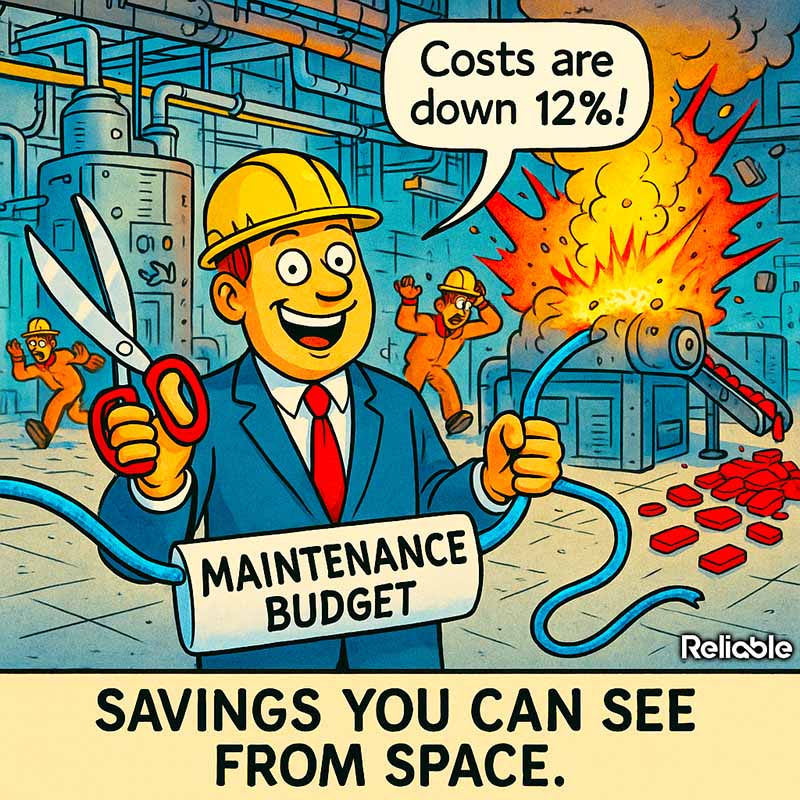

When quarterly earnings need a boost, the maintenance budget is one of the first places executives look. It’s easy to defer a rebuild, cancel a condition monitoring contract, or reduce spare parts inventory without any immediate consequence.
The consequences come later. And they come with interest.
According to a 2023 Fiix by Rockwell Automation report, unplanned downtime costs industrial manufacturers an estimated $50 billion annually in North America alone. A significant share of that cost traces directly back to deferred maintenance.
The Logic Behind the Cuts
Maintenance budgets are vulnerable because they don’t produce revenue directly. In a cost-center framework, every dollar spent on preventive maintenance looks like a dollar that could have gone to production capacity, new equipment, or headcount.
CFOs under pressure to hit short-term targets often treat maintenance as discretionary. The reasoning sounds logical: if the equipment is running fine today, why spend money on work that addresses problems that haven’t happened yet?
This mindset is reinforced by accounting practices that treat maintenance as an operating expense rather than an investment. Capital expenditures appear on the balance sheet; maintenance spending just disappears into overhead.
Preventive maintenance is the only budget line where success looks like nothing happening. That makes it dangerously easy to cut.
The problem with this logic is that it confuses the absence of failure with the absence of risk. Equipment doesn’t send warning emails before it breaks down.
By the time a deferred PM schedule produces a visible failure, the damage has already compounded. What would have been a $3,000 bearing replacement becomes a $75,000 gearbox rebuild with two weeks of lost production.
What Actually Happens When You Cut
The first few months after a maintenance budget cut usually look fine. Equipment keeps running, production targets get met, and the balance sheet improves.
Then the failures start. They’re rarely dramatic at first: a bearing runs hot, a seal starts leaking, a conveyor belt drifts slightly off track. Each incident feels minor in isolation.
But these small failures compound rapidly. One neglected component stresses adjacent systems, and before long you’re dealing with cascade failures that affect entire production lines.
- Unplanned downtime increases by 15-30% within 12 months of significant PM deferrals (per Marshall Institute data)
- Spare parts costs spike as emergency orders replace planned inventory replenishment
- Overtime labor costs escalate because reactive repairs happen at the worst possible times
- Cascade failures multiply when one neglected component takes out adjacent systems
The compounding effect is what catches most organizations off guard. A single deferred bearing replacement on a critical pump can trigger a chain of events that shuts down an entire production line for 36 hours.
Reactive maintenance also wears out your best people. Technicians stuck in firefighting mode burn out faster, make more errors, and leave for employers who run better-organized programs.
The Safety Equation
Budget cuts don’t just affect production. They affect people. When maintenance is deferred, equipment operates outside its designed safety envelope.
OSHA’s data consistently shows a correlation between maintenance spending reductions and workplace injury rates. A 2021 analysis of OSHA investigation records found that inadequate maintenance was a contributing factor in 28% of serious industrial incidents.
Guard interlocks that aren’t tested regularly can fail silently. Pressure relief valves that miss their inspection dates can stick closed. Emergency shutdown systems that skip their proof tests may not work when they’re needed most.
You can defer a PM task on a spreadsheet, but you can’t defer the physics of metal fatigue, fluid degradation, or electrical insulation breakdown.
The liability exposure alone should give executives pause. A single serious injury claim can exceed an entire year’s worth of the maintenance budget that was cut.
Insurance carriers have started paying attention, too. Several major industrial insurers now audit maintenance records as part of their underwriting process. Plants with documented PM deferrals face higher premiums, sometimes 15-25% above standard rates.
The False Economy in Real Numbers
The math is straightforward. A reactive repair typically costs three to five times more than the preventive task that would have prevented it, according to data from the U.S. Department of Energy’s Federal Energy Management Program.
Consider a basic example. A preventive vibration analysis route on 50 critical motors costs roughly $15,000 per year. Skipping it saves $15,000 on paper.
- One undetected motor bearing failure: $8,000 to $25,000 in repair costs
- Associated production downtime (8-16 hours at $5,000/hour): $40,000 to $80,000
- Expedited parts shipping: $2,000 to $5,000
- Overtime labor for emergency repair crew: $3,000 to $6,000
A single failure event wipes out years of the supposed savings. Condition monitoring would have caught the problem weeks in advance, allowing a planned repair during a scheduled shutdown.
Multiply that scenario across a plant with hundreds of rotating assets, and the total cost of deferred maintenance can easily reach seven figures annually.
Protecting the Budget Without Overspending
The answer to budget pressure is not unlimited maintenance spending. It’s smarter allocation based on actual risk.
Reliability-centered maintenance analysis helps plants focus their limited dollars on the assets that matter most. A criticality ranking based on failure consequences lets maintenance teams prioritize without wasting resources on low-risk items.
Condition monitoring technologies offer another path forward. By tracking actual equipment health rather than following calendar-based schedules, plants can reduce unnecessary PMs while catching genuine problems earlier.
The goal is not to spend more on maintenance. It is to stop pretending that spending less is free.
Data from the condition monitoring program also gives maintenance leaders a powerful tool for budget discussions. When you can show that a $20,000 annual investment prevented $300,000 in potential failures, the conversation with finance changes completely.
Making the Case to Leadership
Maintenance managers who want to protect their budgets need to speak the language of finance. Total cost of ownership, risk-adjusted ROI, and failure probability data resonate far more than technical jargon about PM intervals and lubrication schedules.
Building a rolling 12-month cost-of-failure report gives leadership a clear view of what deferred maintenance actually costs. Every reactive repair should be tagged with the PM task that would have prevented it, along with the cost differential.
The plants that maintain stable maintenance budgets through economic downturns are the ones that treat maintenance as an investment with measurable returns, not as an expense to be minimized whenever the balance sheet needs help.