
In most manufacturing plants, maintenance and production occupy the same building but operate in different worlds. Production wants maximum uptime; maintenance needs downtime to keep equipment healthy.
The tension between those two priorities creates friction that costs the industry billions each year. A 2023 Plant Engineering survey found that 46% of maintenance professionals identified poor communication with production as a significant barrier to effective maintenance.
The problem is structural, not personal. Both departments are usually measured on metrics that actively conflict with each other.
How the Divide Takes Root
Production managers are measured on output, efficiency, and on-time delivery. Every hour of downtime shows up as a red number on their scorecard. Their incentive is clear: keep the lines running at all costs.
Maintenance managers are measured on equipment reliability, PM completion rates, and repair costs. Their incentive is equally clear: take the lines down for planned work before something breaks unexpectedly.
These competing incentives create daily friction at the floor level. Both sides are doing exactly what they’ve been told to do, and yet those instructions put them in direct opposition.
When production gets rewarded for uptime and maintenance gets rewarded for planned downtime, you have built a system that guarantees conflict.
This structural misalignment starts at the budget level and flows all the way down to shift-level interactions. A production supervisor who refuses to release a machine for scheduled maintenance is responding rationally to the metrics they’re judged on.
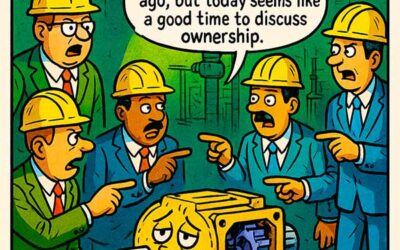
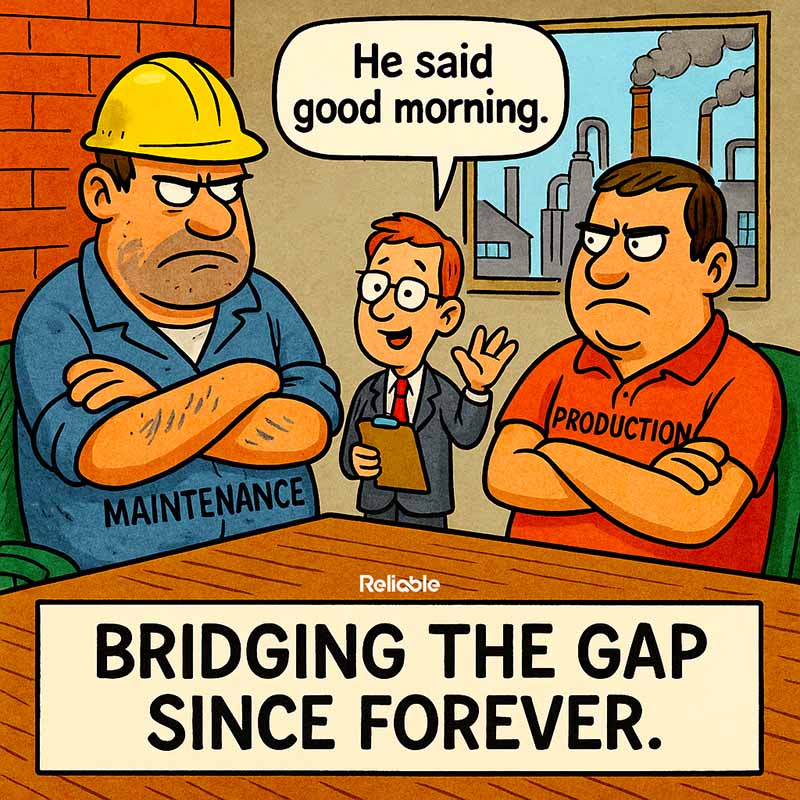
Over time, these small daily conflicts harden into departmental identities. Maintenance sees production as reckless operators who abuse equipment. Production sees maintenance as slow responders who always want to shut things down.
Once those identities solidify, they become self-reinforcing. New hires absorb the antagonism within their first month, and the cycle continues for decades.
The Cost of Operating in Silos
The financial impact of the maintenance-production divide is substantial but often invisible. It hides in categories that nobody tracks as a single line item.
- Emergency repairs triggered by deferred PMs that production refused to release equipment for
- Overtime costs when breakdowns happen during off-hours because planned work was repeatedly postponed
- Quality defects caused by equipment running outside specification because operators did not report early warning signs
- Spare parts expediting fees that result from unplanned failures instead of scheduled replacements
Aberdeen Group research has shown that best-in-class manufacturers (top 20% by OEE) have one thing in common: formal collaboration processes between maintenance and production. Their unplanned downtime runs 3.5% compared to 12% for average performers.
The gap in performance is striking, and it comes down to communication and alignment more than technology or talent.
Why Joint Planning Changes Everything
The single most effective intervention for breaking down silos is a joint weekly planning meeting between maintenance and production leadership. It sounds simple because it is.
During this meeting, both departments review the upcoming production schedule alongside the maintenance backlog. They negotiate downtime windows together rather than fighting over them in real time on the floor.
The meeting format matters. It should be structured around a shared calendar, with both departments presenting their priorities for the week ahead. Thirty minutes is usually sufficient.
When maintenance and production plan the week together, you stop having arguments about shutdowns and start having conversations about priorities.
The meeting also creates a feedback loop that rarely exists in siloed plants. Maintenance learns which production runs are most critical and can adjust their priorities accordingly. Production learns which equipment is most at risk and can adjust scheduling to accommodate necessary repairs.
Plants that implement this practice consistently report a 20-40% reduction in scheduling conflicts within the first quarter. The investment is minimal: 30 minutes per week from a handful of leaders.
Shared Metrics That Drive Alignment
Metrics shape behavior. If you want maintenance and production to collaborate, you need metrics that reward collaboration rather than individual department performance.
Overall Equipment Effectiveness (OEE) is the most common shared metric, and for good reason. It combines availability, performance, and quality into a single number that neither department can optimize alone.
But OEE alone is not enough. Plants need a balanced scorecard that captures the specific ways both departments contribute to (or undermine) equipment reliability.
- OEE as a shared KPI for both department leaders, weighted equally in performance reviews
- Planned vs. unplanned downtime ratio tracked jointly (target: 80% planned or higher)
- Mean time between failures reported at the production line level, not just the equipment level
- Maintenance schedule compliance measured as a joint responsibility: production releases and maintenance executes
When both departments share accountability for the same outcomes, the adversarial dynamic loses its foundation. A production supervisor who helps maintenance access a machine for a planned PM is now improving their own scorecard, not sacrificing for someone else’s.
Condition Monitoring as Common Ground
Condition monitoring programs offer a natural bridge between the two departments. When operators are trained to recognize early warning signs (unusual vibrations, temperature changes, abnormal sounds), they become the first line of defense for equipment health.
This shifts the dynamic from reactive to collaborative. Instead of maintenance showing up unexpectedly to shut down a line, an operator flags a developing problem and both teams plan the response together.
Condition monitoring turns operators from bystanders into active participants in equipment reliability, and that changes the entire relationship between departments.
The data from condition monitoring also depoliticizes maintenance decisions. When a vibration trend clearly shows a bearing degrading toward failure, the conversation shifts from opinion to evidence.
Several plants have reported that condition monitoring data shared openly between departments reduced maintenance-production conflicts by over 50% within six months. Data replaces arguments.
Building Cross-Functional Relationships
Structural fixes like shared metrics and joint planning are essential, but they work best when supported by genuine relationships between the people involved.
Some of the most effective plants rotate supervisors between departments for short periods. A production supervisor who spends two weeks shadowing the maintenance team comes back with a fundamentally different understanding of what maintenance work actually involves.
- Cross-departmental shadowing programs (two weeks, rotating quarterly)
- Joint root cause analysis teams for significant equipment failures
- Combined training sessions on equipment operation and maintenance fundamentals
These relationship-building activities don’t require budget approval or organizational restructuring. They require a plant manager who recognizes that the divide exists and is willing to address it deliberately and consistently.
The informal connections built through shadowing and joint problem-solving often prove more durable than formal process changes. People cooperate with people they know and respect.
Making the Change Stick
The maintenance-production divide did not develop overnight, and it will not disappear overnight. Plants that successfully bridge the gap treat it as an ongoing process, not a one-time initiative with a completion date.
The most durable changes come from aligning incentives, creating regular communication channels, and giving both departments shared ownership of equipment performance. When people on both sides see themselves as part of the same team, the arguments about downtime windows become collaborative problem-solving sessions.
Manufacturing has plenty of genuine challenges: supply chain disruptions, workforce shortages, and rising material costs among them. The conflict between maintenance and production should not be one of those challenges, because it is entirely within a plant’s power to fix.