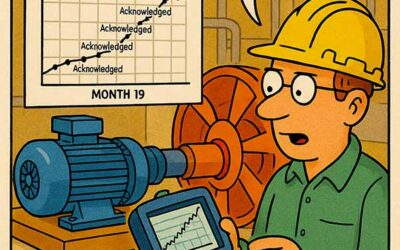


Pumps, like people, reveal their condition through behavior. Some hum smoothly, others clatter, buzz, or rattle their frustration into the piping network. That sound is vibration; the mechanical language of imbalance, misalignment, and hydraulic chaos. The cartoon’s humor about a pump “working on its issues” hits home because in real life, many pumps do precisely that, operate with chronic symptoms no one takes seriously until they fail.
Understanding the causes of centrifugal pump vibration isn’t just an engineering exercise. It’s an operational safeguard that protects uptime, efficiency, and energy costs. A vibrating pump doesn’t just wear itself out; it shakes the entire system, transferring stress to bearings, seals, and couplings, triggering a chain of avoidable failures.
Let’s unpack how to identify, interpret, and eliminate the root causes of pump vibration before they erode performance or credibility.
The Primary Centrifugal Pump Vibration Causes
Every vibration signal is a clue, a trace of energy escaping where it shouldn’t. In practice, several common culprits account for nearly all recurring issues:
1. Imbalance
A slight imbalance in the impeller – caused by corrosion, scale buildup, or manufacturing error – creates a centrifugal force that multiplies with speed. At 3,600 RPM, even a few grams of mass offset can translate into hundreds of pounds of oscillating force.
2. Misalignment
Shafts that are offset or angularly misaligned between the motor and pump coupling create cyclical stress. It shows up as a mix of radial and axial vibration. Over time, it fatigues shafts, wears out bearings, and destroys mechanical seals.
3. Cavitation
A top contributor among centrifugal pump vibration causes, cavitation is hydraulic violence. When vapor bubbles form and collapse, they produce shock waves and micro-pits on the impeller. The sound may resemble gravel in the casing—always a bad sign.
4. Mechanical Looseness
Bolts loosen, foundations settle, and structural rigidity fades. The resulting “soft foot” conditions allow movement that amplifies vibration amplitude, even if alignment and balance were once perfect.
5. Bearing Defects
Worn or contaminated bearings create vibration patterns that repeat at specific frequencies. The failure often starts with poor lubrication or contamination and ends with catastrophic seizure if unchecked.
6. Piping Stress
When suction or discharge piping exerts mechanical strain on the casing, the pump housing distorts slightly. This distortion causes shaft misalignment and introduces vibration that looks mechanical but is rooted in poor installation.
Each condition produces a distinct vibration signature that modern analysis tools can isolate. The real challenge isn’t detection. It’s discipline.
Diagnosing Vibration Before It Destroys Equipment
The earlier you detect and interpret vibration, the cheaper the fix. Every reliability professional should treat vibration analysis as a form of continuous communication with machinery.
Start with a baseline measurement when a pump is healthy. This creates a reference profile against which all future readings can be compared. When new peaks emerge at 1× or 2× shaft speed, investigate alignment and balance. When high-frequency peaks appear, check bearings or lubrication.
Key diagnostic tools include:
- Accelerometers mounted near the bearing housings.
- FFT (Fast Fourier Transform) analyzers that convert motion into frequency data.
- Laser alignment systems for precise coupling alignment.
- Ultrasonic detectors that catch cavitation long before the human ear can.
Data doesn’t fix anything by itself. The insight comes from knowing which centrifugal pump vibration corresponds to each pattern. That interpretation skill – combining analytics with field experience – is what separates data collection from condition intelligence.
Eliminating Vibration at the Source
Preventing vibration isn’t about tightening bolts after the fact. It’s about designing and maintaining pumps to withstand the forces that act on them.
Improve Suction Conditions
Ensure Net Positive Suction Head (NPSHa) always exceeds NPSHr. Avoid excessive suction lift, reduce sharp pipe bends, and install strainers that don’t restrict flow. Stable suction flow is the best defense against cavitation-induced vibration.
Align Precisely, Not Approximately
Coupling alignment within thousandths of an inch matters. Thermal growth and dynamic movement mean “eyeballing” isn’t enough. Use laser alignment every time a motor or pump is installed or serviced.
Balance Rotating Components
Balance impellers both statically and dynamically. Even minor corrosion, coating buildup, or repair welds can reintroduce imbalance. Periodic balancing should be standard practice in every maintenance plan.
Reinforce the Foundation
Vibration problems often originate from a soft or cracked baseplate. Shimming, regrouting, and torque checks are as vital as mechanical work. Stability starts from the floor up.
Monitor Bearings and Lubrication
Vibration from bearing wear increases exponentially as clearances widen. Oil analysis, grease sampling, and temperature tracking all help predict bearing distress before it cascades into vibration and shaft damage.
When these controls are enforced consistently, centrifugal pump vibration causes a sharp decline, and so does unplanned downtime.
From Monitoring to Predictive Mastery
Modern condition monitoring doesn’t stop at vibration. It integrates temperature, current draw, oil condition, and flow rate into a unified picture of health. Predictive systems powered by AI and machine learning can correlate vibration patterns to real-time operating conditions, warning maintenance teams days before a failure curve accelerates.
However, technology alone doesn’t deliver reliability; habit does. The plants that win against centrifugal pump vibration causes are those that inspect, trend, and act without delay. They view every anomaly as a chance to refine operating discipline, not just to repair.
Routine vibration trending allows engineers to detect the inflection point between healthy operation and destructive oscillation. The most successful programs log vibration spectra monthly, align mechanical work to data insights, and tie performance metrics to MTBF (Mean Time Between Failure).
It’s not glamorous work. But the payoff (stable pumps, predictable maintenance windows, and higher efficiency) defines operational excellence.
Changing the Attitude Toward “Minor” Vibration
The cartoon’s closing line, “Red flags? I prefer to call them intermittent performance characteristics,” captures a common mindset. Teams often normalize minor vibrations until they become catastrophic. It’s the maintenance equivalent of ignoring a low oil light.
This mindset needs to change. A slight imbalance today is tomorrow’s cracked shaft. A little cavitation noise is the next quarter’s bearing failure. Every vibration pattern is a diagnostic breadcrumb leading to an avoidable outcome. Treat it with the same urgency as an oil leak or pressure drop.
Vibration is a machine’s way of whispering before it screams.
Reliability isn’t achieved through inspection alone; it’s achieved through action. Each decision to align, rebalance, or monitor reinforces a standard that others follow. When maintenance precision becomes routine, vibration becomes the exception rather than the expectation.
The Payoff of Precision
Eliminating centrifugal pump vibration causes produces measurable financial returns. Lower vibration reduces bearing failures by 50–70%, extends seal life by several thousand hours, and can improve energy efficiency by up to 10%. That’s not just maintenance improvement, it’s bottom-line optimization.
Quiet pumps are efficient pumps. They consume less energy, require fewer rebuilds, and operate with predictable performance. The sound of smooth rotation is the sound of profitability.
In reliability, excuses are easy, but vibration never lies. Pumps don’t “get better on their own.” When you hear it, measure it. When you measure it, interpret it. When you interpret it, act decisively.
Understanding and managing centrifugal pump vibration causes separates reactive plants from world-class ones. Precision isn’t just a maintenance philosophy. It’s a competitive advantage.