
The Cost of Slow Changeovers
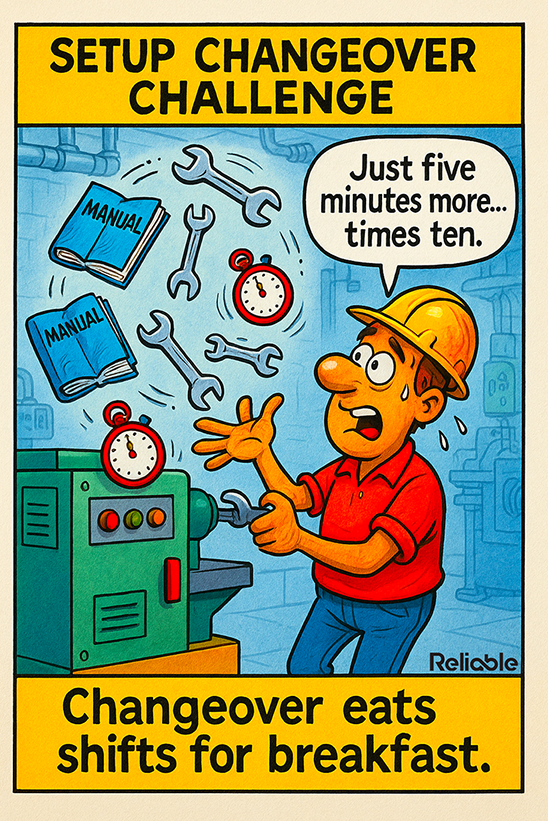
Every maintenance manager has heard it: “Just five more minutes.” But in the world of setup and changeover, those “five minutes” multiply: ten times, twenty times, sometimes an entire shift’s worth of time lost. The cartoon says it best: changeover eats shifts for breakfast.
Hidden losses like these rarely show up in dashboards. They don’t trigger alarms or appear as machine failures, yet they devour capacity and efficiency. When operators spend hours adjusting fixtures, retrieving tools, and flipping through outdated manuals, the cost compounds invisibly.
Every extra minute in changeover isn’t just lost time – it’s lost capacity, quality, and trust in the process.
For a line that changes over four times a day, even 15 minutes of delay per changeover adds up to a full hour of lost production. Multiply that across weeks and plants, and the number becomes staggering. SMED changeover reduction — short for Single-Minute Exchange of Dies — was designed to tackle this exact problem. It’s not just about speed; it’s about reliability, consistency, and flow.
Why SMED Changeover Reduction Matters
In today’s manufacturing world, flexibility is a competitive advantage. Plants that can shift between product lines quickly respond faster to customer demand, handle smaller batch sizes, and keep inventory lean. But flexibility is impossible without SMED changeover reduction.
When changeovers drag on, production teams lose rhythm, schedules slip, and operators grow frustrated. Equipment sits idle while technicians search for wrenches, gauges, or alignment tools. Quality control is compromised when rushed startups lead to defects. Maintenance schedules are disrupted as downtime windows disappear.
Implementing SMED changeover reduction converts this chaos into a repeatable process. It establishes a disciplined rhythm where every operator knows exactly what to do, in what order, and with what tools. It also builds reliability by reducing variation, ensuring every changeover is executed safely, efficiently, and predictably.
The most successful manufacturers view changeover as a controllable process rather than an unavoidable cost. They measure and improve it the same way they track MTBF or OEE. In this mindset, setup time becomes a KPI of operational excellence.
Implementing SMED Changeover Reduction Step by Step
Adopting SMED changeover reduction isn’t about installing automation; it’s about eliminating waste. The foundation is simple: separate, streamline, and standardize.
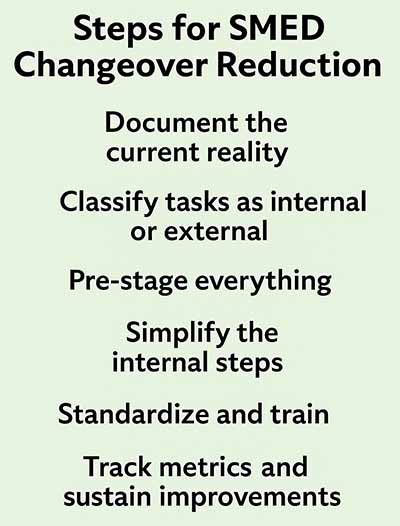
- Document the current reality.
Record each changeover from start to finish. Capture video, timestamps, and operator notes. Observe delays, repeated actions, tool searches, and unnecessary adjustments. This data becomes the baseline. - Classify tasks as internal or external.
Internal tasks require the machine to be stopped; external tasks can be done while it runs. The first big leap in SMED changeover reduction comes from converting internal tasks into external ones. - Pre-stage everything.
Tools, fixtures, and documentation should be ready before shutdown begins. Waiting until the line stops to find a wrench or calibration gauge is a classic time sink. - Simplify the internal steps.
Use quick-release fasteners, alignment pins, and standardized tools. Eliminate adjustments through precision setup jigs or digital presets. - Standardize and train.
Develop a repeatable process: the same steps, the same sequence, the same tools. Provide checklists, photos, and visual references. Consistency is what turns improvement into a habit. - Track metrics and sustain improvements.
Measure setup time, variation, and impact on OEE. Hold review sessions after each improvement round to identify further opportunities.
Manufacturers who apply these principles often reduce setup time by 30–70% within the first six months, through process discipline, not expensive automation.
Common Barriers to SMED Changeover Reduction
Despite its simplicity, SMED changeover reduction faces cultural friction. Many operators equate long setups with thoroughness, the belief that “taking our time” ensures quality. But efficient changeovers are not shortcuts; they are precision routines that prevent mistakes.
A second barrier is ownership. Changeover touches multiple functions: production, maintenance, engineering, and quality. Without a clear process owner, improvement efforts scatter. Successful plants assign a dedicated changeover leader, often from reliability or continuous improvement, to unify all stakeholders.
When no one owns changeover, everyone loses time – and no one owns the results.
Another frequent obstacle is poor data capture. Many CMMS or MES systems record changeovers as “planned downtime” without details. Without accurate timestamps or coded losses, managers can’t quantify improvement—the solution: track setup start and end times with purpose-built codes that expose variation and delay causes.
Lastly, changeover complexity grows when equipment design works against operators. Machines designed for high-volume production often require cumbersome tool or die swaps. Long term, SMED changeover reduction influences capital decisions, pushing manufacturers toward modular, quick-change designs that support lean flexibility.
Sustaining Gains with Predictive and Digital Tools
Once the fundamentals are in place, digital systems can accelerate SMED changeover reduction. Advanced analytics, machine vision, and digital work instructions are reshaping how changeovers are managed.
Predictive scheduling tools can anticipate optimal changeover windows by analyzing production demand, batch size, and maintenance requirements. Augmented reality (AR) guides technicians through complex setups step by step, reducing dependency on tribal knowledge.
IoT-enabled tools can confirm correct torque, alignment, and sequence execution. When integrated with MES or CMMS platforms, this creates a feedback loop, turning every changeover into a data-rich event for continuous improvement.
Some plants are even using AI-driven cameras to analyze operator movements and identify micro-delays invisible to the human eye. This fusion of lean methodology and digital technology defines the next evolution: Predictive SMED.
With predictive SMED changeover reduction, downtime forecasts become as routine as energy reports. Plants know precisely how setup variation affects throughput, and leaders can adjust resource allocation in real time.
Advanced SMED Strategies for World-Class Manufacturing Performance
Once the fundamentals of SMED changeover reduction are established, the next challenge is integration, connecting setup efficiency with broader manufacturing reliability systems. This stage transforms SMED from a standalone lean activity into a core component of operational excellence, directly influencing metrics like OEE (Overall Equipment Effectiveness), MTBF (Mean Time Between Failures), and maintenance scheduling efficiency.
Integrating SMED with TPM and Reliability Engineering
The most advanced plants don’t treat SMED as an isolated improvement — they embed it into Total Productive Maintenance (TPM) and Reliability-Centered Maintenance (RCM) frameworks. By aligning SMED changeover reduction with proactive maintenance planning, plants can synchronize setup tasks with inspection, lubrication, and minor service activities. This dual-purpose downtime approach minimizes total equipment downtime while improving reliability metrics across production cells.
World-class plants don’t just speed up changeovers – they transform them into reliability events that strengthen every production run.
Integration with TPM pillars like Focused Improvement and Autonomous Maintenance ensures that operators become active participants in changeover optimization. They’re not just following procedures; they’re identifying root causes of setup delays, tool misalignments, or recurring adjustment errors.
Leveraging Digital Transformation and Data Analytics
Digital transformation elevates SMED by making performance visible. IoT-connected sensors, machine learning models, and real-time dashboards give supervisors instant feedback on setup duration, operator consistency, and tool usage efficiency. With AI-driven analytics, plants can identify hidden correlations between changeover time, batch size, and product complexity.
Tools like digital work instructions (DWIs), augmented reality (AR) overlays, and mobile CMMS integration standardize best practices across shifts and sites. These technologies remove dependency on tribal knowledge and ensure that every setup, from first shift to weekend crew, follows the same high-reliability process.
Cross-Functional Collaboration and Continuous Improvement
True SMED mastery requires collaboration between engineering, operations, and maintenance teams. Design engineers must ensure new equipment supports modularity and quick-release mechanisms. Maintenance leaders should use SMED changeover reduction data to refine preventive maintenance intervals and enhance asset reliability strategies.
Ongoing Kaizen events, value stream mapping, and 5S audits help sustain results. When combined with predictive maintenance, condition-based monitoring, and workflow automation, SMED becomes a living process, one that continually evolves with the plant’s performance goals.
Through this holistic approach, SMED changeover reduction evolves from a speed exercise into a reliability-driven, data-backed, and operator-led competitive advantage that defines world-class manufacturing systems.
Turning Changeovers into a Competitive Advantage
When executed well, SMED changeover reduction transforms production agility. Instead of viewing product changeovers as interruptions, leading plants use them as strategic levers, switching between product families seamlessly, increasing responsiveness to customer demand, and reducing inventory.
Operators feel ownership rather than frustration. Maintenance gains predictable access to assets. Quality teams see fewer startup defects. Leadership sees capacity expand without new equipment investment.
This cultural shift – from reactive firefighting to precision setup – is what separates world-class reliability organizations from the rest. Changeover no longer eats shifts for breakfast; it fuels the next run with confidence, discipline, and flow.