
The Hidden Cost of Ignoring Maintenance Schedules
In every plant, there’s a familiar scene: a production supervisor insisting that scheduled maintenance is unnecessary, “The machine’s running fine!” Yet history shows that neglecting maintenance isn’t efficiency; it’s deferred failure. The reality is that common mistakes in maintenance scheduling don’t just waste labor hours; they quietly erode reliability, drive up costs, and destroy trust between maintenance and production.
Neglecting maintenance doesn’t save time; it only delays the breakdown that’s already on the way.
Preventive and predictive programs succeed or fail based on scheduling discipline. Without it, maintenance becomes reactive firefighting, chasing failures instead of preventing them. Understanding these scheduling mistakes and correcting them is the foundation of sustainable reliability.
Failing to Prioritize by Asset Criticality
The first common mistake in maintenance scheduling is treating all assets equally. Maintenance calendars often list tasks by date rather than by importance. A critical compressor and a secondary conveyor get the same attention. That’s a recipe for downtime.
Criticality analysis identifies which equipment has the most significant operational, financial, and safety impact. These assets warrant a higher inspection frequency and more detailed PMs. Low-risk components can run to failure or receive minimal intervention.
Tip: Develop a risk matrix that combines the consequences of failure (production, cost, safety, environment) with failure probability. This allows you to schedule smarter, spending maintenance resources where failure hurts most.
Ignoring criticality not only wastes resources but also causes production chaos when a bottleneck machine unexpectedly fails.
Over-Reliance on Calendar-Based Intervals
The second significant error among common maintenance-scheduling mistakes is blind adherence to time-based PMs. A gearbox running continuously in a hot environment will degrade oil faster than one operating intermittently in climate control. Yet, both often share the same PM interval.
Calendar-based scheduling assumes uniform wear, which rarely exists in reality. The more innovative approach: combine usage hours, operating conditions, and condition monitoring data (vibration, oil analysis, temperature) to trigger maintenance.
Example: Instead of changing oil every three months, use particle count and viscosity trends to decide when an oil change is necessary. This reduces waste, prevents over-maintenance, and extends asset life.
Condition-based scheduling is precision in action: doing the right task at the right time for the right reason.
Lack of Coordination Between Maintenance and Production
One of the most politically charged common mistakes in maintenance scheduling is scheduling without production buy-in. Maintenance teams create PM calendars in isolation, only to find work orders canceled because production “can’t afford the downtime.”
When maintenance plans are made in isolation, production treats them as suggestions rather than commitments.
When production and maintenance aren’t aligned, schedules are ignored, PMs are skipped, and the backlog grows—the result: more breakdowns, overtime, and resentment.
Fix: Develop a shared master schedule. Hold weekly planning meetings where both departments commit to priorities. Use visual dashboards that show both PM compliance and production performance side-by-side. When teams see that downtime prevention supports throughput, they become allies instead of adversaries.
Skipping Root-Cause Analysis on Missed or Failed PMs
Every missed PM or post-maintenance failure carries a story, but few organizations stop to read it. The lack of analysis is a subtle but devastating common mistake in maintenance scheduling.
When a PM doesn’t prevent a failure, the root cause often lies not in the procedure but in the planning. Maybe the wrong component was maintained, the frequency was off, or technicians weren’t adequately trained. Without reviewing the schedule’s effectiveness, plants repeat the same errors over and over.
Solution: Track PM compliance, measure PM-to-CM (corrective maintenance) ratio, and perform failure mode reviews quarterly. Treat every deviation as data, not blame. A continuous feedback loop keeps the maintenance plan evolving instead of stagnating.
Underestimating the Power of Schedule Discipline
The best plans collapse without adherence. Schedule compliance, the percentage of planned work completed on time, is a leading reliability indicator. Plants operating below 80% compliance typically fight constant reactive work. Those above 90% see measurable gains in uptime and cost stability.
Among the common mistakes in maintenance scheduling, poor discipline is the easiest to fix and the hardest to sustain. Enforce scheduling accountability through digital CMMS visibility, shift handoff reviews, and leadership reinforcement. Reliability thrives when planning, scheduling, and execution operate as one system, not separate silos.
Ignoring Data Feedback from CMMS and Predictive Tools
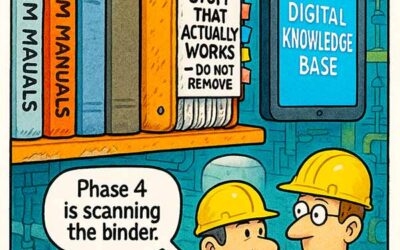
Modern maintenance isn’t guesswork. Every work order, vibration reading, and oil sample produces actionable insight. The tragedy is that many teams collect this data but never use it to refine their schedules —a common, critical mistake in maintenance scheduling.
Use CMMS analytics to identify recurring work, premature failures, or unnecessary PMs. For predictive systems, trend deviations and trigger work orders before thresholds are exceeded. In short: close the loop between data and action.
Predictive and preventive aren’t opposites; they’re partners. The strongest programs integrate both into one adaptive scheduling framework.
Treating Maintenance as an Interruption, Not an Investment
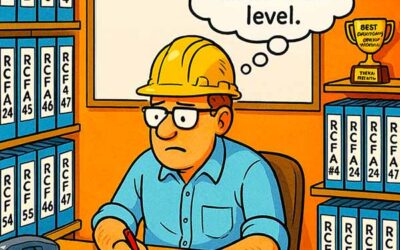
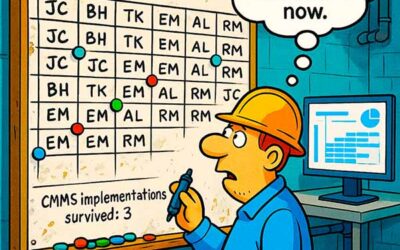
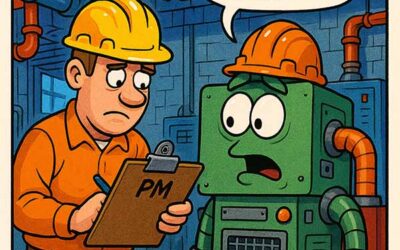
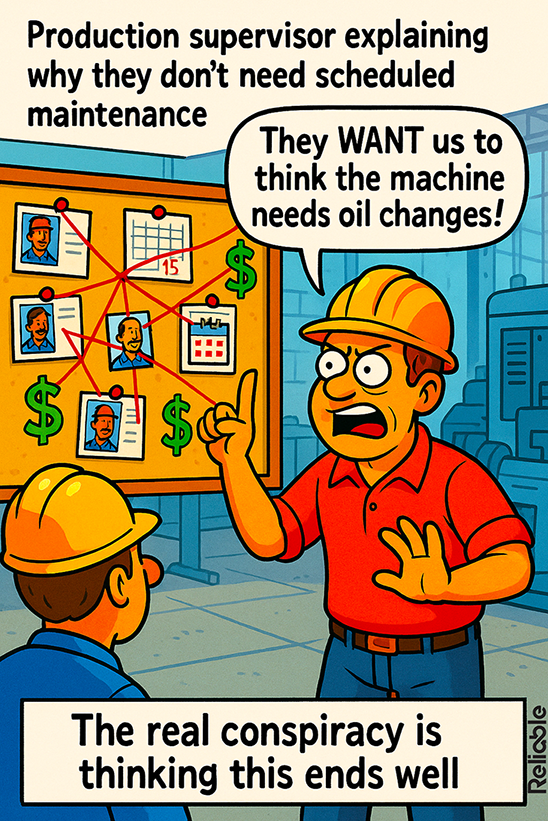
The cartoon nails the mindset: a supervisor connecting red strings like a detective, convinced oil changes are a plot. The reality? Thinking maintenance is a conspiracy wastes more money than any “big oil” scheme ever could.
Maintenance scheduling is an investment that multiplies returns through improved uptime, energy efficiency, and safety. Plants that track avoided costs —such as lost production hours or savings on replacement parts— see tangible proof that scheduling discipline pays off.
Changing culture begins with how success is measured. Reward uptime, not just output. Celebrate maintenance that prevents a crisis, not just the crew that fixes one.
From Chaos to Control: Building a Reliable Future
Reliability isn’t a product of luck or heroics; it’s a result of disciplined planning and learning from mistakes. Every plant must address its own standard maintenance scheduling errors and fix them one by one.
Start small:
- Rank assets by criticality.
- Use real-time data for PM triggers.
- Align production and maintenance calendars.
- Track compliance relentlessly.
- Review and refine quarterly.
What emerges is not just better scheduling, it’s a culture of foresight. Maintenance stops being reactive and becomes strategic, predictive, and aligned with business value.
Summary Takeaway
Machines don’t conspire against you. The actual conspiracy is believing that skipping maintenance saves time or money. By eliminating standard maintenance scheduling mistakes, your team gains more than just uptime; you gain control, confidence, and consistency across the plant.
Reliability is not an event; it’s a disciplined habit. And it starts with one calendar, one conversation, and one commitment: schedule, execute, and learn.