Best UPS Systems for Data Centers in 2027
Last updated November 28, 2026.
Data Center UPS Comparison Table
| Vendor and products | Best for | Capacity in the US catalog | Efficiency, as the vendor states it | Energy storage named | Published price |
|---|---|---|---|---|---|
| Vertiv Trinergy and PowerUPS 9000 | AI campuses building in 1.5 to 2.5 MW blocks | Trinergy 1,500 to 2,500 kW at 480 V; PowerUPS 9000 250 to 1,250 kW | Trinergy: at least 97% in double conversion, at least 99% in Dynamic Online mode. PowerUPS 9000: up to 97.5% in double conversion, up to 99% in Dynamic Online mode | Lithium-ion, nickel-zinc, VRLA (VRLA for Trinergy per its brochure) | By quote |
| Schneider Electric Galaxy VXL | High power density where floor space is tight | 500 to 1,250 kW at 480 V in 125 kW modules | Up to 97.5% in double conversion; eConversion not available on the 480 V VXL | Lithium-ion, VRLA | By quote |
| Eaton 9395XC | Operators who want the UPS to take part in grid programs | 1,125 to 2,250 kW at 480 V | Up to 97.5% in double conversion; 99% in Energy Saver System mode | VRLA, lithium-ion | By quote |
| ABB HiPerGuard | Protecting large blocks at medium voltage | 2.5 MW per unit, up to 25 MW in parallel; US catalog up to 24 kV; 34.5 kV version announced April 2026 | Above 98% in ABB's technical data; 98% stated for the 34.5 kV version | Lithium-ion, supplied separately | By quote |
| Mitsubishi Electric 9900D and SUMMIT Series | Double-conversion efficiency with a published 9900D performance guarantee | 9900D 1,200 to 2,000 kVA; SUMMIT 500 and 750 kVA | Up to 97% (9900D); up to 98.2% (SUMMIT) | Lithium-ion, VRLA, pure lead | By quote |
| Toshiba G9000 and G9400 | A UPS and lithium titanate batteries from one maker | G9000 100 to 1,050 kVA; G9400 1,200 to 2,000 kVA | Up to 97% | SCiB lithium titanate, VRLA, NiCad named on the product pages; ask about other types | By quote |
| Piller UNIBLOCK UB-V | Kinetic energy storage in place of UPS battery banks | 1.0 to 3.24 MW (1,100 to 3,600 kVA) per unit | Up to 98% at full load and 97% at half load, stated for the battery version | Flywheel or battery | By quote |
"Size the UPS for the load you expect in three years, then ask what it costs to run at the load you have today," says Mike Ramsey, publisher of Reliable. "In a redundant design, many of these systems spend their lives well below nameplate, and that is where the efficiency numbers start to separate."
7 Best Data Center UPS Systems for 2027, Ranked by Use Case
1. Vertiv Trinergy: Best for AI Campuses Building in 1.5 to 2.5 MW Blocks
Vertiv's Trinergy is a large three-phase UPS best suited to AI and hyperscale campuses that want to add protected power in blocks of 1.5 MW or more.
Vertiv's US page lists Trinergy models at 1,500, 1,600, 2,000, and 2,500 kW for 480 V three-wire systems, plus 415 V four-wire versions up to 2,000 kW. It states efficiency of at least 97% in double conversion and at least 99% in Dynamic Online mode.
Vertiv's 2024 Trinergy brochure covers the 1,500, 2,000, and 2,500 kW models. It describes 500 kVA cores that isolate themselves on a fault, service without a system shutdown, and system capacity up to 20 MW.
For AI loads, the US page names three features: Input Power Smoothing, Battery Shield, and fault ride-through. Vertiv says fault ride-through keeps the data center connected during grid disturbances. These are vendor-stated features.
Below Trinergy, the PowerUPS 9000 covers 250 to 1,250 kW with 125 kVA power modules. Vertiv states up to 97.5% efficiency in double conversion and up to 99% in Dynamic Online mode. The Liebert APM2 covers 10 to 600 kW for smaller rooms.
Vertiv's page names lithium-ion and nickel-zinc batteries for Trinergy, and the brochure adds VRLA. Its EnergyCore lithium-ion cabinets are UL 9540A tested and carry a ten-year warranty on battery modules. Its catalog also lists the ZincFive BC 2 nickel-zinc cabinet.
In November 2026 Vertiv announced the PowerNexus MV UPS, an outdoor medium-voltage system with up to 98.5% peak efficiency. Vertiv expects shipments to begin in mid-2027.
Not the best fit for: Rooms under 250 kW, where the Liebert APM2 or a small modular UPS from another maker is the closer match. Vertiv's site shows no prices for three-phase systems. Its warranty page lists a three-phase warranty document, so get the term and start date in writing.
2. Schneider Electric Galaxy VXL: Best for High Power Density Where Floor Space Is Tight
Schneider Electric's Galaxy VXL is a modular three-phase UPS best suited to data halls where floor space limits how much protected power can be installed.
Schneider's US page describes the Galaxy VXL as a 500 to 1,250 kW UPS built from 125 kW power modules that are 3U high. Schneider's 480 V installation manual gives the cabinet as 1,200 mm wide and 1,000 mm deep, or 1.2 square meters, at every rating.
Schneider says the VXL uses 70% less space than its predecessor. Those are cabinet figures. Batteries, switchgear, conduit, and service clearances add to the installed footprint, so compare complete layouts.
Schneider states up to 97.5% efficiency in double conversion. Power modules can be added or replaced while the UPS runs, a function Schneider calls Live Swap and describes as TÜV-verified.
Schneider rates its eConversion mode at up to 99% efficiency on other Galaxy models, and its US range page says eConversion is not available for the Galaxy VXL at 480 V. The installation manual does refer to ECO mode, so ask which modes the quoted configuration offers and for the efficiency curve of each.
The range page says the VXL is built and validated for AI environments. The installation manual specifies both lithium-ion and VRLA batteries, with 40 to 48 VRLA blocks. Below the VXL, the Galaxy VS covers 20 to 150 kW at 480 V, and the Galaxy VL covers 200 to 500 kW.
Schneider's US pages show no prices for these ranges. As a price example for a much smaller system, SHI, a US reseller, listed a 20 kW, 480 V Galaxy VS (part GVSUPS20KGS) at an MSRP of $32,830.00 in late November 2026. The listing excludes batteries and includes 5x8 start-up service, and SHI lists a one-year on-site limited manufacturer warranty for that part. Check it for the current selling price and stock.
Not the best fit for: Buyers specifying a 480 V UPS for eConversion, who should choose another model. Sites above 1,250 kW per unit need parallel frames or the older, larger Galaxy VX. Schneider's US pages show no warranty term for the Galaxy VXL.
3. Eaton 9395XC: Best for Operators Who Want the UPS to Take Part in Grid Programs
Eaton's 9395XC is a large monolithic three-phase UPS best suited to operators who want their UPS and batteries to earn revenue or cut demand charges through grid programs.
Eaton's US page gives the 9395XC ratings of 1,125 to 2,250 kW at 480 V and calls it a monolithic UPS. Eaton states up to 97.5% efficiency in double conversion and 99% in its Energy Saver System mode.
The differentiator is EnergyAware, which Eaton describes as native to the 9395XC. Eaton lists four main uses: frequency regulation, peak shaving, time-of-use shifting, and demand response. Its page names the PJM region of the Mid-Atlantic for frequency response deployment, with other regions to follow.
Before counting on revenue or savings, confirm program eligibility, interconnection requirements, the battery reserve kept for backup, recharge time, and the effect of cycling on battery life and warranty.
Eaton includes a one-year subscription to its PredictPulse remote monitoring with each 9395 purchase. The 9395XC supports VRLA and lithium-ion batteries.
Buyers who put modularity first have two other Eaton lines. The 9395XR is a modular UPS that Eaton lists at 1,500 kW, built from twelve 125 kW modules, at 415 V and 480 V. Eaton's 93PM page lists ratings of 50, 100, 150, 200, and 250 kW in a 250 kW frame.
Eaton's warranty overview says most of its warranties run 18 months from shipment or one year from startup, whichever comes first. Eaton's site shows no prices.
As a price example for a much smaller system, SHI listed a 60 kW, 480 V 93PM without batteries (part 9AC206JZ29E20R0) at an MSRP of $96,595.00 in late November 2026. Confirm with Eaton that this exact configuration is still offered, and check the listing for the selling price and stock.
Not the best fit for: Sites relying on frequency regulation revenue that have yet to confirm EnergyAware availability and program eligibility, since Eaton's page names PJM specifically. Buyers who want to add capacity in small hot-swap modules should look at the 9395XR or another modular design, because Eaton describes the 9395XC as monolithic.
4. ABB HiPerGuard: Best for Protecting Large Blocks at Medium Voltage
ABB's HiPerGuard is a medium-voltage static UPS best suited to large campuses that want to protect multi-megawatt blocks upstream of the low-voltage switchgear.
ABB's technical data lists 2.5 MW units that parallel up to 25 MW with ten units, efficiency above 98%, and lithium-ion batteries supplied separately. That page and ABB's US product page describe voltages up to 24 kV.
In April 2026 ABB announced a 34.5 kV version, stated 98% efficiency for it, and described a range spanning 4.16 kV to 34.5 kV. ABB said the new version would be available to order in summer 2026. Confirm with ABB whether it can be ordered now and when it ships.
UL Solutions said in April 2026 that it had certified HiPerGuard to UL 9540, the standard for energy storage systems, and named two certified models, 2UCP410201 and 2UCP410211. UL called it the first such certification for a system with a medium-voltage static inverter designed to work as a UPS. Ask ABB for the certificate that covers your voltage, model, and battery.
ABB says the architecture supports peak shaving and frequency regulation. Its release names two AI data center campuses in North Dakota as deployments.
For conventional low-voltage designs, ABB's MegaFlex UL covers 1,000 to 1,600 kW at 480 V with 400 kW core power blocks, at up to 97% in double conversion.
Not the best fit for: Smaller projects, which may not justify a medium-voltage UPS built from 2.5 MW units. A medium-voltage UPS changes the electrical design, the protection scheme, and the skills needed to operate it. In Reliable's judgment it suits new builds more readily than retrofits. ABB's US product page shows no price or warranty term.
5. Mitsubishi Electric 9900D and SUMMIT Series: Best for Double-Conversion Efficiency With a Published 9900D Performance Guarantee
Mitsubishi Electric's 9900D and SUMMIT Series are three-phase UPS systems best suited to buyers who plan to run in double conversion all the time, and the 9900D carries a published performance guarantee.
The 9900D covers 1,200 to 2,000 kVA at 480 V with up to 97% efficiency. Mitsubishi's page states a guarantee for the 9900D: if it fails to comply in a verified performance test, the company will refund up to $10,000 a year for three years. The page gives no test criteria, so get them in the contract. The guarantee is stated for the 9900D only.
The SUMMIT Series, at 500 and 750 kVA, uses silicon carbide semiconductors. Mitsubishi's product overview lists it at up to 98.2% efficiency. The SUMMIT Series appears on the ENERGY STAR list of certified UPS as a double-conversion product, which certifies the listed configuration.
The 9900D page lists compatibility with lithium-ion, VRLA, and pure lead batteries and compliance with UL 1778.
Not the best fit for: Buyers whose plan depends on a high-efficiency eco mode or on grid programs, who should ask Mitsubishi directly, since the 9900D page centers on double-conversion operation. Mitsubishi's product pages give no standard warranty term and no price.
6. Toshiba G9000 and G9400: Best for a UPS and Lithium Titanate Batteries From One Maker
Toshiba's G9000 and G9400 are three-phase UPS systems best suited to buyers who want the UPS and a long-life lithium titanate battery built by the same company.
The G9000 Series covers 100 to 1,050 kVA at 480 V. Toshiba states up to 97% efficiency at 50 to 100% load and more than 94% at loads down to 20%. The 300 to 750 kVA models run up to eight units in parallel.
The G9400 Series covers 1,200, 1,600, and 2,000 kVA at 480 V, with 380 to 415 V versions from 1,050 to 1,750 kVA. It parallels up to six units, and Toshiba says it is assembled in the USA.
Both work with Toshiba's SCiB energy storage system, which uses lithium titanium oxide cells. Toshiba says it makes the cells, modules, and system itself, warrants SCiB batteries for 12 years, and has put the 480 VDC system through UL 9540A fire risk testing. Its page says up to ten cabinets can run in parallel for longer backup times.
Toshiba's pages state a three-year onsite warranty for the G9000 and the G9400. Ask for the SCiB warranty document to see which components and conditions the 12 years cover.
In May 2026 Toshiba added the 3000 TP Series, a modular UPS for edge data centers at 40 to 200 kW and 480 V.
Not the best fit for: Buyers whose plan depends on a 99% eco mode or on grid programs, who should ask Toshiba directly, since its G9000 and G9400 pages lead with double-conversion efficiency. Runtime with SCiB depends on how many cabinets are paralleled, so ask for a runtime curve at your load. Toshiba's pages show no prices.
7. Piller UNIBLOCK UB-V: Best for Kinetic Energy Storage in Place of UPS Battery Banks
Piller's UNIBLOCK UB-V is a rotary UPS best suited to large data centers that want flywheel energy storage and long service intervals in place of UPS battery banks.
Piller's page gives the UB-V ratings from 1.0 MW (1,100 kVA) to 3.24 MW (3,600 kVA) in a single unit, in battery and kinetic energy storage versions, at low or medium voltage. Piller states online efficiency of up to 98% at full load and 97% at half load, in a comparison it frames around the battery version.
Ask for the efficiency curve of the kinetic version you are quoted, with flywheel standby and recharge losses and auxiliaries included.
Piller says the UB-V has no power capacitors or electric fans. It says its e-VENTLOG remote monitoring service can remove the need for an operational shutdown for up to five years in controlled environments.
For smaller loads, Active Power, part of the Piller group, makes CleanSource flywheel UPS. Its CleanSource HD data sheet lists 675 kW at 480 V, with flywheel run times of 15 seconds at rated load and 29 seconds at half load.
Not the best fit for: Sites that need minutes of ride-through from kinetic storage. Flywheel runtime is short and depends on the stored energy and the load, so check it against the full generator start, transfer, and load acceptance sequence, with reserve. Rotating machines call for different maintenance skills from static UPS, and Active Power's data sheet names a bearing change every third year. Piller's pages show no prices.
Modular UPS Vendors Compared: Schneider Electric, Eaton, Vertiv, and Siemens
Buyers often ask how these four compare on lithium-ion options, monitoring, DCIM integration, and grid-interactive features. In the offering Siemens announced with Delta in November 2025, Delta supplies the UPS and batteries and Siemens supplies power distribution and engineering.
The modular models are Schneider's Galaxy VXL, with 125 kW modules, Vertiv's PowerUPS 9000, with 125 kVA modules, and Eaton's 9395XR, with 125 kW modules. Vertiv's Trinergy is built from 500 kVA cores, and Eaton calls the 9395XC monolithic.
All five of those models list lithium-ion options, so confirm the battery system for the exact model. On grid interaction, Eaton is the most specific: its EnergyAware page names programs and the PJM region and describes the feature as native to the 9395XC. Vertiv's brochure lists Dynamic Grid Support as a Trinergy option. Schneider's US Galaxy VXL page names no grid program.
On monitoring, a vendor's management platform and the UPS's monitoring interfaces are separate questions. Schneider points to EcoStruxure IT, and Eaton to Brightlayer and PredictPulse. For a multi-vendor site, ask each maker which interfaces the exact model supports, such as SNMP, Modbus, or BACnet, and for the point list, alarm mapping, access controls, and any license.
Reliable's guides to DCIM software and data center power monitoring software cover the platforms that collect UPS data.
Lithium-Ion, VRLA, Nickel-Zinc, or Flywheel: Choosing UPS Energy Storage
The UPS and its energy storage are two purchases with different lifespans. Valve-regulated lead-acid (VRLA) batteries remain the familiar default, and most static UPS in this guide list them.
Lithium-ion often costs more up front and can offer longer service life in less space, depending on chemistry, cycling, environment, and warranty. Vertiv gives its EnergyCore cabinets 10 to 15 years of performance. Toshiba warrants its lithium titanate SCiB batteries for 12 years. ZincFive's BC 2 data sheet says its nickel-zinc batteries showed no thermal runaway in five cell-level UL 9540A tests, so ask for cabinet-level evidence too.
Fire and electrical codes shape the choice. NFPA 855 is the installation standard for stationary energy storage systems. UL 9540 is a safety standard for energy storage systems, and UL 9540A is a test method for thermal runaway fire propagation.
UL Solutions says the 2026 edition of NFPA 855 puts new weight on large-scale fire testing. Its FAQ says the sixth edition of UL 9540A was published on March 13, 2026, and UL says an effective date of January 1, 2027 will be set for that edition.
What applies to a given battery room depends on the chemistry, the quantity, the application, and the codes your jurisdiction has adopted. Where UL 9540A testing applies, ask for the test report and its edition for the proposed configuration, and confirm UL listings separately.
"The battery decision is a fire code decision as much as an engineering one," says Reliable publisher Mike Ramsey. "Bring the fire marshal and your insurer into the conversation before you pick a chemistry, because they can change the room you have to build."
Flywheels and other kinetic storage take the place of UPS battery banks, with much shorter runtime.
For battery-backed UPS installations, dedicated battery monitoring systems provide individual battery condition measurements and string-level diagnostics that complement UPS monitoring.
What a Point of UPS Efficiency Is Worth
Several low-voltage double-conversion models here state about 97% or more at their best point. Some state about 99% in an alternative mode: Vertiv's Trinergy, Eaton's 9395XC, and ABB's MegaFlex UL. The modes work differently, so compare them on more than the percentage.
Reliable's arithmetic shows the stakes. UPS loss equals the output load times (1 divided by efficiency, minus 1), times the hours run. For a constant 1,000 kW output load over 8,760 hours, a UPS at 96% loses about 365,000 kWh and one at 97% loses about 271,000 kWh.
The difference is about 94,000 kWh a year, or roughly $9,400 at an assumed 10 cents per kWh. The sum assumes constant load and constant efficiency and leaves out cooling and other system losses.
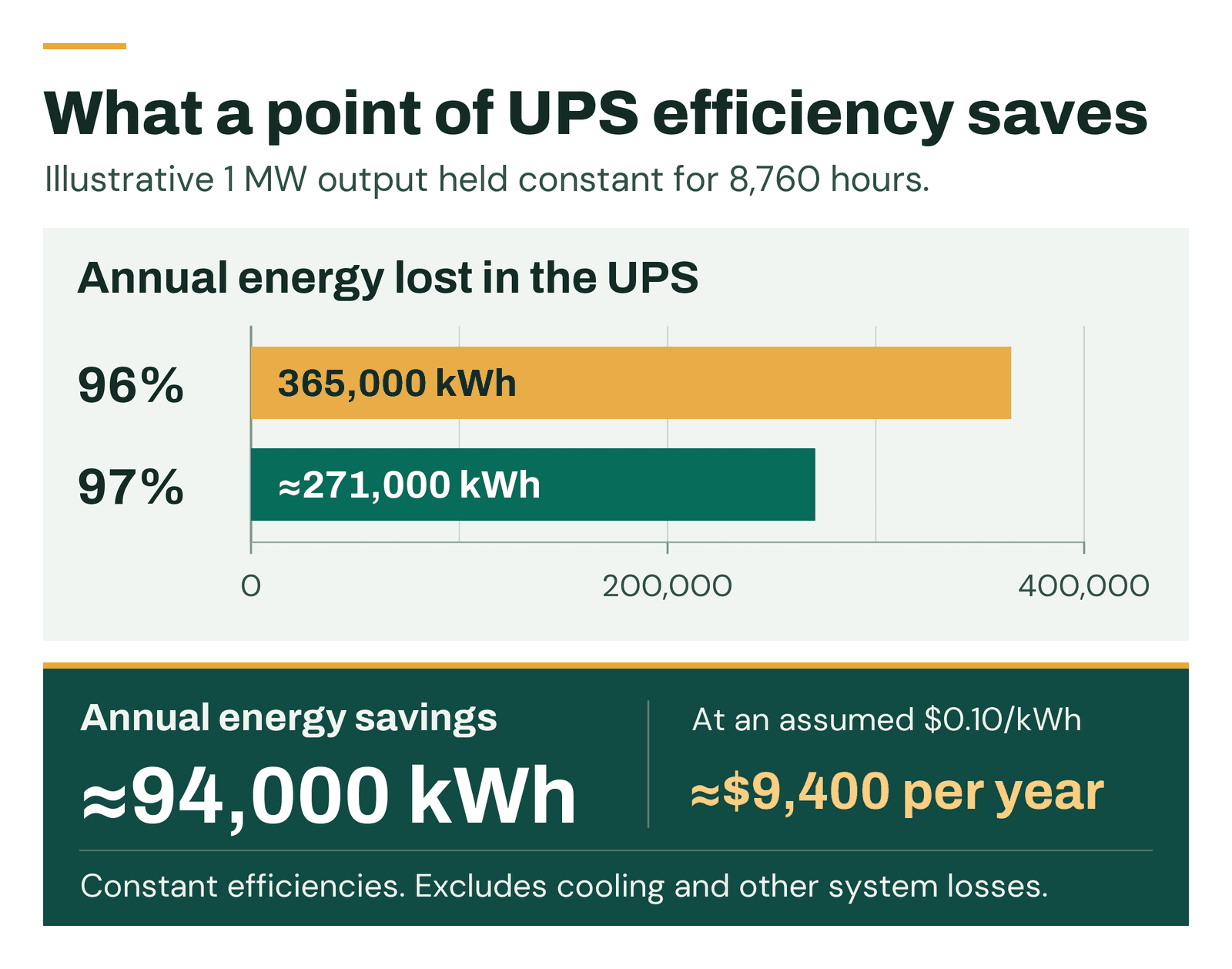
ABB puts a larger number on it: about $880,000 a year for each percentage point of efficiency in a 100 MW AI data center. ABB states no electricity price, and its method may differ from the sum above.
Two cautions apply. Stated figures are peaks, and a UPS in a redundant design may run at half load or less, so ask for the efficiency curve at 25% and 50% load. High-efficiency modes change how the UPS protects the load, and a mode has to exist on the model you buy: Schneider's eConversion is unavailable on the 480 V Galaxy VXL.
UPS for AI Data Centers: What Is Changing
AI training loads rise and fall together across thousands of processors. In Uptime Institute's 2026 Annual Outage Analysis, power was the primary cause of 45% of respondents' most recent impactful outages in its 2025 survey (n=96). The report says failures of UPS systems, transfer switches, and generators dominate.
UPS makers have responded in three ways. The first is control features for pulsing load, such as Vertiv's Input Power Smoothing and Schneider's validation of the Galaxy VXL for AI environments. Ask for test results against a documented load profile: the size, speed, and frequency of the swings and their effect on the batteries.
The second is moving protection to medium voltage. UL Solutions certified two HiPerGuard models to UL 9540, and ABB names deployments. Vertiv expects its PowerNexus MV UPS to ship from mid-2027, and GE Vernova announced an MV-UPS platform in August 2026.
The third is direct current. In November 2026 Vertiv announced 800 VDC power architectures, including a solid-state transformer that converts medium-voltage AC to 800 VDC in one stage. Backup energy then connects on the DC side, which changes the role of a central AC UPS. It is one option among several, so ask how each vendor's UPS fits if your roadmap includes it.
Rack-Mount and Single-Phase UPS for Server Rooms and Edge Sites
This guide ranks three-phase systems. Single-phase UPS that mount in the rack are a common fit for network closets and small, distributed loads, and the same makers sell them. Vertiv's US catalog lists the Liebert GXT5 double-conversion line from 500 VA to 20 kVA, and Eaton's 9PX runs from 700 VA to 11 kVA.
Reliable's guide to intelligent rack PDUs covers the metering and switching layer between the UPS and the servers.
Which UPS Type Fits Which Site?
The table below gives illustrative ranges. They overlap, and none is a sizing recommendation.
| Site | UPS type | Examples in this guide | What to ask the vendor |
|---|---|---|---|
| Network closet or small distributed load | Single-phase rack UPS | Vertiv Liebert GXT5 (to 20 kVA), Eaton 9PX (to 11 kVA) | Usable kW, circuit capacity, and runtime at your load at end of battery life |
| Small or edge data center, roughly 10 to 250 kW | Small three-phase modular UPS | Schneider Galaxy VS, Eaton 93PM, Toshiba 3000 TP, Vertiv Liebert APM2 | Module size, internal redundancy, and 208 V or 480 V |
| Enterprise or colocation hall, roughly 250 kW to 1.5 MW | Modular or monolithic three-phase UPS | Vertiv PowerUPS 9000 (from 250 kW), Schneider Galaxy VXL (from 500 kW), ABB MegaFlex UL (from 1,000 kW) | Efficiency at 25% and 50% load, and parallel limits |
| AI or hyperscale block of roughly 1.5 MW and up | Large-block low-voltage UPS | Vertiv Trinergy, Eaton 9395XC, Mitsubishi 9900D, Toshiba G9400 | Test data against your load profile, and battery cycling |
| Campus protecting large blocks at medium voltage | Medium-voltage UPS | ABB HiPerGuard | Certificate scope, order and delivery status, and operator skills |
| Site avoiding UPS battery banks | Rotary or flywheel UPS | Piller UNIBLOCK UB-V, Active Power CleanSource | Ride-through time against the generator start and transfer sequence |
How to Choose a Data Center UPS
1. How Much Load Are You Protecting, and How Will It Grow?
Start with the critical load in kW today and the load you expect in three to five years. Check kW as well as kVA: Piller's 3,600 kVA unit is rated 3.24 MW, while several static models here list kW equal to kVA. A modular UPS lets you add power modules later, 125 kW at a time on Schneider's Galaxy VXL.
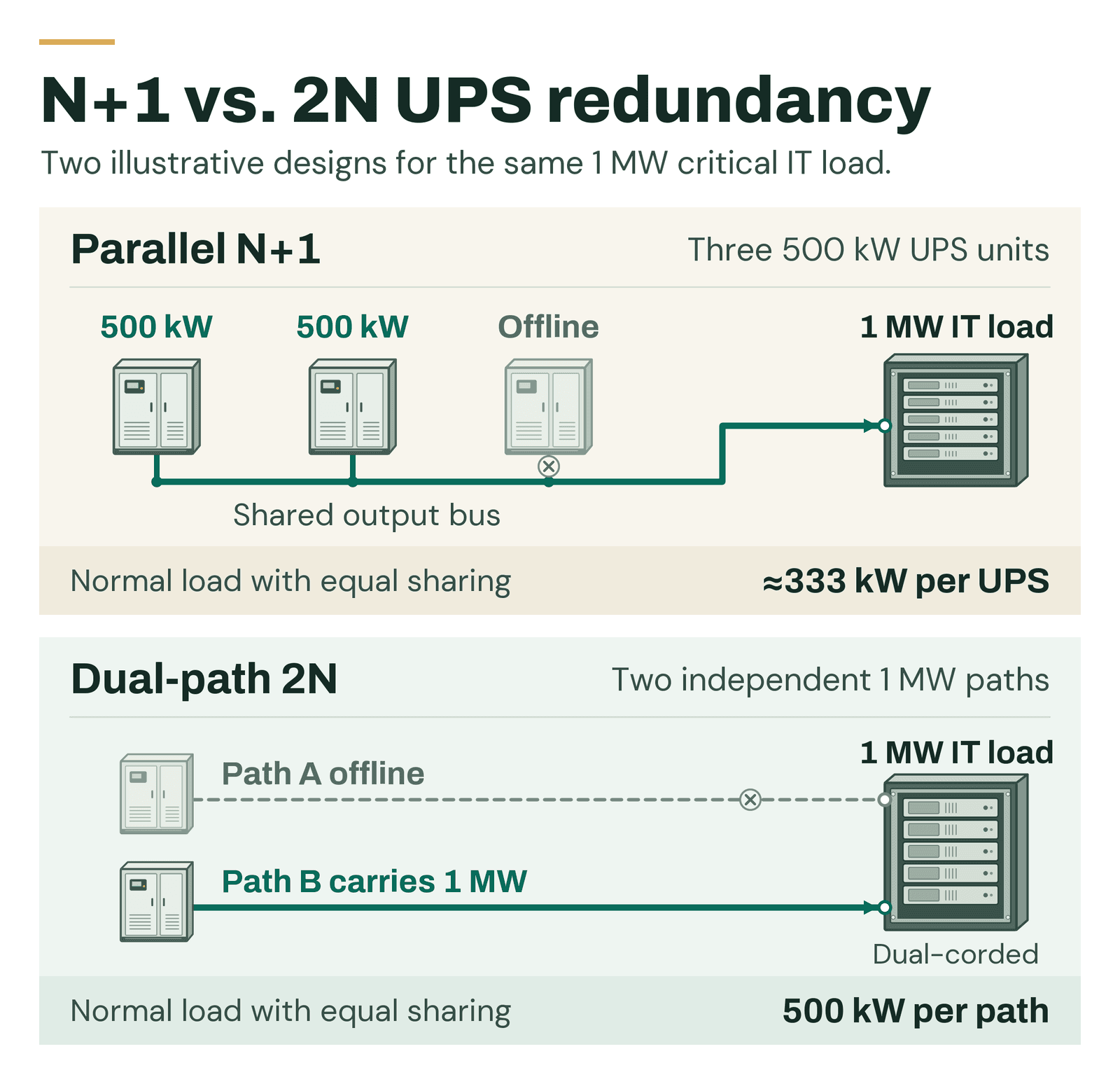
Redundancy multiplies the count. N+1 adds one unit of capacity beyond the number needed to carry the load. A 2N design builds two independent paths that can each carry the full load, so in normal operation each UPS may run at half load or less.
2. Low Voltage or Medium Voltage?
The low-voltage systems from Vertiv, Schneider, Eaton, ABB, Mitsubishi, and Toshiba all list 480 V models, and several also list 415 V or 380 to 415 V versions.
A medium-voltage UPS protects a larger distribution block with fewer units, at a voltage chosen for the design. ABB says lower currents at medium voltage mean smaller cables and lower losses. The cost is a different protection design and operators qualified for medium-voltage work, so decide this with your electrical engineer early.
3. Which Battery, and What Will the Fire Code Require?
Decide the runtime first, and ask for runtime at the end of battery life. A site with fast-start generators may need only a few minutes, and Vertiv's EnergyCore cabinets, for example, are optimized for 5 or 7 minutes of runtime. Then compare chemistries on life, footprint, warranty, and the fire protection each one requires in your jurisdiction.
4. Does the UPS Need to Work With the Grid or With AI Load Swings?
If your utility or grid operator pays for frequency regulation or demand response, a grid-interactive UPS may offset part of its cost. The backup duty comes first, so confirm the reserve, the program rules, and the battery warranty before you count the revenue.
5. Who Maintains It, and What Does the Warranty Cover?
Warranty terms differ more than the hardware does. Toshiba states three years on site. Eaton's overview says most of its warranties run one year from startup or 18 months from shipment.
For every quote, ask for the written warranty: the term, when it starts, what it covers, and whether factory startup is required to keep it. Battery warranties are separate documents with their own terms.
Every UPS needs scheduled work for its whole life. That means battery tests, the maker's replacement schedule for parts such as fans and capacitors where they are fitted, bearing service on rotary machines, and firmware updates. Transfer tests belong in a plan your engineer has approved.
"A UPS earns its keep on the worst day of the year, so prove it on the ordinary ones," says Mike Ramsey, publisher of Reliable. "Put battery tests, the maker's parts replacements, and planned transfer tests on the maintenance schedule the day it is commissioned."
6. How Should You Compare UPS Quotes?
Put every quote on the same basis: usable kW at your design temperature and voltage, the redundancy included, battery runtime at end of life, and efficiency at your expected load. Check whether switchgear, batteries, startup, acceptance testing, and the first years of service are in the price.
Also Considered
These vendors also sell data center UPS.
Legrand Keor FLEX: A modular UPS up to 1.2 MW built from 100 kW hot-swap modules. Legrand's technical sheet lists 380, 400, and 415 V output, so ask about UL-listed 480 V models.
Socomec MODULYS XL: A modular UPS built from 200 kW power modules, up to 1,200 kW per unit. US buyers should confirm which models are UL listed.
Delta Modulon DPH: A modular UPS that Delta lists for North America at 50 to 500 kW and 480 V.
Fuji Electric UPS7400WX-T3U: A 480 V UPS from 225 to 1,000 kVA built from UPS modules, with UL 1778 fifth edition named on its data sheet.
GE Vernova MV-UPS: A medium-voltage UPS platform announced in August 2026. GE Vernova's page gives a rated power of 175 MW and 200 MVA, a 34.5 kV input, and 98.5% converter efficiency, and shows no order or delivery dates.
Riello UPS Master HP UL: A UL-listed double-conversion UPS with a galvanically isolated output. Ask Riello for the current 480 V sizes and US service coverage.
How We Evaluated
Independent editorial analysis based on publicly available vendor documentation, product and pricing pages, datasheets, dated press releases, dealer price pages, and standards-body pages, reviewed in November 2026.
Reliable does not sell uninterruptible power supplies, batteries, installation services, or consulting and has no commercial interest in routing readers toward any particular vendor. Reliable does not accept payment for rankings. Vendors may sponsor enhanced listings with additional detail, but editorial rankings are independent. Read our editorial policy.
Six criteria shaped the ranking:
Use-case fit: the job each vendor's own pages put first.
Current availability: whether the vendor's US catalog lists the product as current.
Capacity and architecture: ratings, module sizes, and voltage as each vendor states them.
Efficiency: the figure and the operating mode it belongs to, as each vendor states it.
Energy storage: the battery chemistries or kinetic storage each vendor names, and the certifications it cites.
Pricing, warranty, and service: whether a US price is published, where, and the stated warranty term.
No analyst reports or review-site ratings were used. The ranking is by use case, and the number beside each entry only sets the order.
Honest Limitations
Specifications are vendor-stated. Ratings, efficiency, footprint, and feature claims come from each vendor's product pages, manuals, brochures, and releases as of November 2026. Each efficiency figure belongs to a specific mode and load level, so ask for the full curve for the model and voltage you are quoted.
Prices are thin. The vendor pages behind this guide show no price for megawatt-class systems. The two prices shown are dated reseller MSRP examples for much smaller systems, without batteries or installation. Selling prices and stock change, and a project quote will differ.
Announcements do not confirm availability. Vertiv expects its PowerNexus MV UPS to ship from mid-2027, and ABB announced its 34.5 kV HiPerGuard in April 2026. Confirm order, delivery, and certification status for anything newly announced.
Documents vary by region and date. This guide follows US pages where they exist, so confirm each figure against the current data sheet for your model.
Codes and certifications are summarized. Adopted editions of NFPA 855 and related codes vary by jurisdiction, and the authority having jurisdiction decides what applies. A test report or certificate for one configuration does not cover every voltage, battery, or site.
This is a buying guide. Sizing, redundancy design, protection coordination, and battery room design for a specific site belong with a licensed electrical engineer and the manufacturer.
Frequently Asked Questions
What is the best UPS system for a data center?
It depends on scale and architecture. For AI campuses adding power in blocks of 1.5 MW or more, Vertiv's Trinergy is the closest fit. For high power density where floor space is tight, look at Schneider's Galaxy VXL, and for grid programs, Eaton's 9395XC. For protection at medium voltage, look at ABB's HiPerGuard.
With respect to future-ready features such as lithium-ion options, advanced monitoring, DCIM integration, and grid-interactive capabilities, how do Schneider Electric, Eaton, Siemens, and Vertiv rank as modular UPS vendors?
Each leads on a different feature, so Reliable gives no single order. The modular platforms to compare are Schneider's Galaxy VXL, Eaton's 9395XR, and Vertiv's PowerUPS 9000, and all three list lithium-ion options. In the offering Siemens announced with Delta, Delta supplies the UPS.
On grid programs, Eaton is the most specific through EnergyAware, which it describes as native to the monolithic 9395XC. A vendor's own monitoring software is no proof of third-party DCIM integration, so ask which interfaces the exact model supports.
Which supplier provides the best value for money for modular UPS in data centers: Schneider Electric, Eaton, Siemens, or Vertiv?
Megawatt-class systems are sold by quote, so value has to be worked out from the quotes you receive. Compare ten-year cost: purchase and startup, efficiency at your real load, battery replacements, and the service contract.
As dated price examples for two much smaller systems, SHI listed a 20 kW Schneider Galaxy VS at an MSRP of $32,830.00 and a 60 kW Eaton 93PM at an MSRP of $96,595.00 in late November 2026. Both exclude batteries, and the two are different configurations, so treat neither as a quote for a ranked model.
Should a data center UPS use lithium-ion or VRLA batteries?
Lithium-ion can last longer and take less space, and it often costs more up front. Vertiv gives its EnergyCore lithium-ion cabinets 10 to 15 years of performance and a ten-year warranty on battery modules. Ask the authority having jurisdiction which fire and electrical code provisions apply to the chemistry and quantity you plan to install.
What is a medium-voltage UPS, and who needs one?
A medium-voltage UPS protects a large distribution block at medium voltage, upstream of the low-voltage switchgear. ABB's HiPerGuard comes in 2.5 MW units that parallel up to 25 MW. It suits large campuses, and smaller projects are usually served by low-voltage UPS.
Does a UPS replace a backup generator?
A conventional UPS is a bridge to longer-duration backup power. Vertiv's EnergyCore cabinets are optimized for 5 or 7 minutes, and Active Power lists 15 seconds at rated load for its CleanSource HD flywheel. Longer outages need generators or long-duration storage.
Related Guides
Explore our data center infrastructure resource center for independent buyer’s guides, engineering tools and technical resources covering infrastructure management, power distribution, cooling technologies and environmental monitoring.
Sources
Vertiv: Vertiv Trinergy UPS (US product page; brochure, PowerUPS 9000, battery, and PowerNexus pages linked in the Vertiv entry)
Schneider Electric: Galaxy VXL (US product range page; installation manual, Galaxy range page, and reseller listing linked in the Schneider entry)
Eaton: 9395XC UPS (US product page; EnergyAware, 9395XR, 93PM, warranty overview, and reseller listing linked in the Eaton entry)
ABB: HiPerGuard technical specifications (technical data page; April 2026 release, UL Solutions release, and US pages linked in the ABB entry)
Mitsubishi Electric: 9900D Three Phase UPS (US product page; SUMMIT Series, product overview, and ENERGY STAR listing linked in the Mitsubishi entry)
Toshiba: G9000 Series (US product page; G9400, SCiB, and 3000 TP pages linked in the Toshiba entry)
Piller: UB-V Series for Data Centres (product page; Active Power data sheet linked in the Piller entry)
Last updated November 28, 2026: first edition. This guide is editorial analysis by Reliable.