Best Data Center Cooling Optimization Software in 2026
Last updated November 27, 2026.
Data Center Cooling Optimization Software Comparison Table
| Product | Best for | How it acts on cooling | What it covers, as the vendor states it | Published price |
|---|---|---|---|---|
| Vigilent | Autonomous control of data hall and chiller plant cooling | Closed-loop control; sends commands to cooling systems in real time | Chillers, CDUs, fan walls, air handling units, and economizers; air-cooled and liquid-cooled halls | Quoted |
| Phaidra | Liquid-cooled AI factories | Closed-loop control of CDU setpoints; its Prism product is read-only | CDUs in liquid-cooled halls; chiller staging and grid-response agents are also listed | Quoted |
| EkkoSense EkkoSoft Critical | Teams that want operators to approve every change | Advisory; a person signs off each change | Air-cooled, liquid-cooled, and hybrid rooms, through wireless sensors and a 3D digital twin | Quoted; priced by the number of monitored elements |
| Cadence Reality Digital Twin Platform | CFD simulation before a design or layout change | Simulation and planning | Airflow, chilled water distribution, and liquid cooling models; connects to live data | Quoted; trial on request |
| Schneider Electric EcoStruxure IT | Cooling planning inside a DCIM platform | Simulation, monitoring, and an optional closed-loop control module | White space airflow, computer room cooling units, and liquid cooling monitoring through Motivair | No list price on Schneider's pages; U.S. reseller ITO Solutions lists the one-year CFD subscription at about $12,381, and SHI shows an MSRP of $19,290 |
| etalytics etaONE | Chilled water plant optimization | Recommendations first, then automated control within set limits | Pumps, chillers, valves, and cooling towers | Quoted; free feasibility study |
| Vertiv Liebert iCOM-S | Rooms cooled mainly by Liebert units | Supervisory monitoring and control of the room's cooling units | Vertiv thermal units and wireless sensors natively; third-party devices need confirming; integrates with a third-party BMS | Quoted |
"Decide first whether you want software that changes setpoints or software that tells your team what to change," says Mike Ramsey, publisher of Reliable. "That one answer sorts this list faster than any feature comparison, and it tells you who needs to be in the room when you buy."
7 Best Data Center Cooling Optimization Software Platforms in 2026, Ranked by Use Case
The seven are ranked by use case. The first three work from a live facility's data, the next two center on simulation and planning, and the last two serve a specific plant or equipment base. Each "Not the best fit for" line is Reliable's editorial judgment, drawn from the vendor's published pages.
1. Vigilent: Best for Autonomous Control of Data Hall and Chiller Plant Cooling
Vigilent is AI cooling control software best suited to operators that want data hall and chiller plant cooling adjusted automatically to match IT load. The Oakland, California company, established in 2008, reports more than 1,500 facilities served in 37 countries.
How it works. Vigilent Synergy, the control product, learns how each cooling asset affects temperatures across the facility and issues commands to cooling systems in real time. Staff set the thermal conditions they want, and the software checks results against its predictions and refines its model. Vigilent Vision, the companion product, covers monitoring and analytics across a portfolio of sites.
What it covers. Vigilent lists integrations with chillers, CDUs, fan walls, air handling units, and economizers. It says data hall control supports air-cooled and liquid-cooled applications, and that chiller plant and data hall cooling can be optimized as a whole. Many deployments are software-only, and Vigilent supplies its own wireless sensors and controllers on request.
Safeguards. Vigilent says its supervisory control leaves unit controls and safety interlocks in place. It lists fail-safes at the cooling unit for network failures, a Guard Mode for temperature exceedances, alarms, and manual overrides.
Deployment and security. The system can run entirely inside the customer's firewall. Vigilent lists encrypted communications, weekly vulnerability scanning, and regular third-party testing.
Other routes to buy. Siemens sells the technology as White Space Cooling Optimization, which it says is powered by Vigilent, and pairs it with the Desigo CC building management system (BMS). Schneider Electric's Cooling Optimize module also builds on Vigilent technology. Supported equipment, software versions, and terms can differ between those offers and Vigilent's own, so compare them line by line.
Pricing. Vigilent's site lists no price. It offers a benefits calculator and a remote copilot service delivered by human experts.
Not the best fit for: teams that want advice only, with staff making each change by hand. Vigilent's pages center on autonomous control, and they list no price.
2. Phaidra: Best for Liquid-Cooled AI Factories
Phaidra is AI control software best suited to operators of liquid-cooled AI data centers that need coolant temperatures held steady through fast swings in GPU load. The Seattle company's Liquid Cooling Agent adjusts CDU setpoints within seconds of a change in rack power.
How it works. Phaidra says temperature-feedback control loops react only after coolant temperature changes. Its agent reads real-time rack power as a leading indicator and moves CDU setpoints before the temperature rise registers in the coolant. Phaidra describes the agent as self-learning, adapting to workloads, hardware drift, and site conditions.
Published results. On March 16, 2026, Phaidra announced A/B test results from production environments, an NVIDIA DGX SuperPOD and CoreWeave's GB200 NVL72 clusters, in work that included Applied Digital. It reported thermal overshoot cut by 75% to 80% against tuned PID controllers during load ramps, with spikes of 5 to 6°C reduced to about 1°C. The figures are vendor-reported and describe temperature stability, with no energy saving attached. Phaidra says it is scaling the agents across CoreWeave's liquid-cooled fleet.
The wider product line. Phaidra Prism is an observability product that prioritizes alarms and supports root cause analysis in plain language. Phaidra's site also lists a Chiller Staging Agent and a Flex Agent, which adjusts a site's power draw in response to grid conditions.
Security. Phaidra lists a SOC 2 Type II audit and ISO/IEC 27001:2022 certification. Prism is read-only, with no write path into control systems, and each agent is scoped to one control problem. Data leaves the site over a single outbound connection, and the customer's team reviews and deploys updates.
Pricing. Phaidra's site lists no price and routes buyers to a contact or demo request.
Not the best fit for: air-cooled rooms, as far as the Liquid Cooling Agent goes, since that agent acts on CDUs. Phaidra's wider product line may suit other plant, so ask which agents are available today. Ask too which CDU models and control systems each one supports, since the product pages name none.
3. EkkoSense EkkoSoft Critical: Best for Teams That Want Operators to Approve Every Change
EkkoSense EkkoSoft Critical is cooling optimization software best suited to teams that want AI recommendations while a person approves each physical change. EkkoSense says the software advises and leaves control with the operator, who gets approval workflows, rollback options, and an audit trail.
How it works. Wireless sensors on the racks feed a 3D digital twin of the room. The Cooling Advisor module ranks recommended actions, such as setpoint changes, fan speed adjustments, floor grille moves, and putting units into standby.
Air and liquid. A liquid cooling module tracks temperatures and flow rates across direct-to-chip, rear-door heat exchanger, and hybrid deployments. In March 2026 EkkoSense added automatic detection of airflow faults and chilled water flow anomalies, covering CDUs and chillers, to help teams spot developing cooling problems earlier. It also lists EkkoChill, an optimization engine for chillers and pumps.
Savings claim. EkkoSense reports cooling energy savings of 10% to 40%, depending on whether an engagement is software alone or software plus optimization services. It reports an average of 30% across hundreds of customer projects.
Deployment. EkkoSense's FAQ describes EkkoSoft Critical as cloud software hosted on Amazon Web Services, with no on-premises version. It connects to third-party devices over Modbus, SNMP, and oBIX. EkkoSense holds ISO 27001 and Cyber Essentials accreditations.
Pricing. The subscription price depends on the number of elements monitored, and the price per element falls as the count rises. The license includes all updates, with no modular pricing. EkkoSense's FAQ says the typical cost of software and hardware is often a few dollars per rack per year. Treat that as a vendor estimate and get a quote for your own site, since a billed element and a rack are different units.
Not the best fit for: sites that require software to run inside their own network, since EkkoSense's FAQ describes a cloud-only product. Buyers who need native closed-loop control should look at the control products in this guide. EkkoSense says equipment adjustments stay with the BMS and control systems, so ask whether any separately integrated automation would write the setpoints.
4. Cadence Reality Digital Twin Platform: Best for CFD Simulation Before a Design or Layout Change
Cadence Reality Digital Twin Platform is data center simulation software best suited to engineers who need to test a cooling design, a rack deployment, or a failure scenario before it happens in the hall. It pairs a 3D model of the facility with a CFD solver.
Products. Reality DC Design supports engineering design. Reality DC Insight supports capacity planning and IT placement at an operating site, and its Reality DC Digital Twin module adds calibrated CFD modeling. DC Design comes in Essential, Advanced, and Pro packages, from eight-core solving up to 32-core solving with CAD and BIM integration.
What it models. Cadence lists raised and non-raised floors, fan walls, direct and indirect evaporative cooling, and liquid cooling. A built-in flow network simulates chilled water distribution and liquid cooling loops. Transient simulations show how a room behaves over time and in failure scenarios.
Live data. Cadence says the Digital Twin product is calibrated to the physical site. It can connect to live data from BMS and DCIM systems, and Cadence lists integrations with environmental monitoring systems, ticketing software, and more than 15 DCIM tools.
AI factory models. The model library includes NVIDIA GB200 NVL72 and GB300 NVL72 rack systems.
Pricing. Cadence's pages list no price and offer a trial on request.
Not the best fit for: teams that want software to adjust cooling equipment. Cadence's pages describe modeling, simulation, and planning, and they name no control of cooling units. A calibrated model also needs someone to build it and keep it current.
5. Schneider Electric EcoStruxure IT: Best for Cooling Planning Inside a DCIM Platform
Schneider Electric EcoStruxure IT is DCIM software best suited to teams that want airflow simulation, thermal monitoring, and optional automated cooling control in the platform they already use for assets and capacity. EcoStruxure IT Advisor is the planning product, sold as an on-premises or hosted subscription.
Simulation. EcoStruxure IT Design CFD is browser-based CFD software that runs its calculations on cloud GPUs. Schneider says users can test changes to load, row layout, and cooling unit placement before racks are installed.
Automated control. IT Advisor's Cooling Optimize module is a closed-loop system in which rack temperature sensors feed a purpose-built appliance and control commands go to the cooling units. Schneider's help center files the module under on-premises deployments. A September 2023 help article lists the Vigilent system versions it works with, and the help center says installation is part of a service deal. Confirm current versions and deployment options with Schneider.
Monitoring. EcoStruxure IT Expert, a cloud service, and Data Center Expert, which runs on premises, provide infrastructure monitoring. Schneider says both gained liquid cooling monitoring in 2025 through its Motivair integration, and that IT Advisor's digital twin now represents Motivair equipment.
Pricing. Schneider's product pages show no price and say IT Design CFD can be bought through a self-service portal, a partner, or Schneider sales. ITO Solutions, a U.S. reseller, lists the one-year subscription, Schneider part SFTWCFD, at $12,381.26, and SHI shows an MSRP of $19,290 for the same part.
SHI also lists a separate three-month license, part SFTWCFDUNLIMITED, at $6,615. These are reseller listings as of late November 2026 for the CFD software alone, separate from the cost of the wider EcoStruxure IT platform and of implementation.
Not the best fit for: teams that want closed-loop control from a hosted service, going by Schneider's help center, which files Cooling Optimize under on-premises only in articles dated 2023. The CFD, planning, monitoring, and control products are separate offers, so price each one.
6. etalytics etaONE: Best for Chilled Water Plant Optimization
etalytics etaONE is energy optimization software best suited to operators that want pumps, chillers, valves, and cooling towers run as one coordinated system. The German company builds a digital twin of the cooling plant and recalculates setpoints every few minutes as IT load and weather change.
Control in stages. etalytics describes three stages. The software first suggests changes for staff to approve, then runs partial automation within guardrails, then runs full automation that staff can reverse at any time. It lists fallback to conventional control and manual override.
Integration. etaONE connects to existing BMS, SCADA, and PLC systems over standard protocols such as Modbus and OPC UA. etalytics says no hardware replacement is needed.
Published results. etalytics says clients typically save 20% to 40% of cooling energy. NTT Global Data Centers reported in November 2025 that chillers at its Bonn, Germany site used 19.1% less energy in the first few months, within the range of outdoor temperatures seen in that period. That is a customer-published figure for chiller energy, and it covers less than a full year. NTT says the etalytics server sits in the data center, so the optimization runs on site.
Company. etalytics is based in Darmstadt, Germany. It extended its Series A round to €16 million in October 2025 with an investment from Microsoft's M12 fund, and in April 2026 it announced a San Francisco Bay Area office opening that May. The company lists ISO 27001 certification.
Pricing. etalytics says price depends on scope, assets, and integration work. It offers a free feasibility study before any contract.
Not the best fit for: operators whose problem is airflow in the white space. The etalytics data center pages center on the chilled water plant. The U.S. operation is new, and the named data center results on its site, NTT in Bonn and Telehouse in Frankfurt, come from Germany, so U.S. buyers should ask about local delivery and support.
7. Vertiv Liebert iCOM-S: Best for Rooms Cooled Mainly by Liebert Units
Vertiv Liebert iCOM-S is thermal monitoring and control software best suited to data centers that cool their rooms mainly with Vertiv Liebert units and want them managed as one system. Vertiv describes it as a single point for managing the cooling infrastructure, with diagnostics and trending.
Editions. Vertiv sells a Monitor version and an Optimize version. The Optimize version adds the automation and optimization features, and a site can upgrade from Monitor later. The software runs on a customer-provided server or on a Vertiv appliance.
What it does. The feature list includes thermal system optimization and control, device groups for separate environments, hot spot protection, and automatic discovery of devices. One interface covers Vertiv thermal units and wireless sensors. Wizards handle integration with a third-party BMS.
Vendor claims. Vertiv cites up to 35% thermal energy reduction and says a typical installation pays back in about one year.
Pricing. Vertiv's page lists no price. Its user manual describes a one-time license fee that depends on the deployment mode and on the number and types of connected devices. A recurring basic service contract, covering software updates and remote support, is selected by default on the order.
Not the best fit for: buyers who need one system to control cooling units from several makers. Vertiv's page describes a single interface for Vertiv thermal and wireless devices, and its 2026 user manual says only Vertiv units should be integrated into the unit network. A 2020 Vertiv white paper describes one site where iCOM-S managed third-party devices as well, so ask which devices can be monitored and which controlled.
Which Platforms Help When Thermal Limits Cap Capacity Before Power Does?
Operators reach this point when racks are installed and power is contracted, yet the cooling system cannot carry the peak heat load. Three kinds of software address it.
Control. Vigilent says its data hall control unlocks stranded capacity, and an anonymous customer testimonial on its site reports 10% more power for IT. Phaidra says steadier coolant temperatures let a site run warmer water and reclaim power that overcooling used.
Advice. EkkoSense says its customers see savings from released capacity as well as lower cooling energy.
Simulation. Cadence and Schneider's CFD tools predict whether a planned deployment will overheat, under the assumptions built into the model, before the hardware arrives.
Thermal headroom and electrical headroom are separate limits. Lower cooling power frees electrical capacity for IT only where the supply limit, the redundancy rules, and rack-level cooling all allow it.
"Cooling that runs harder than the load needs can tie up capacity you have already paid for," says Reliable publisher Mike Ramsey. "Ask each vendor how it will measure the headroom it frees up, and get that baseline in writing before the pilot starts."
Top Providers of Thermal Simulation Tools for AI Data Center Cooling Design
Cadence. Reality DC Design and Reality DC Digital Twin model airflow, chilled water, and liquid cooling, with library models for current NVIDIA rack systems. Cadence suits whole-facility models and complex failure scenarios.
Schneider Electric. Schneider positions EcoStruxure IT Design CFD for users without CFD training who need fast answers on a white space layout.
EkkoSense and Ansys. EkkoSense sells EkkoSim, which it describes as digital twin software built on first-principles physics models for testing what-if scenarios. Ansys, now part of Synopsys, sells general-purpose CFD software that engineering teams use to design cooling equipment and whole cooling systems.
A design-stage model starts from design assumptions, so ask each vendor how the model is checked against measured temperatures once the site is running.
Liquid Cooling: Which Software Controls It and Which Monitors It
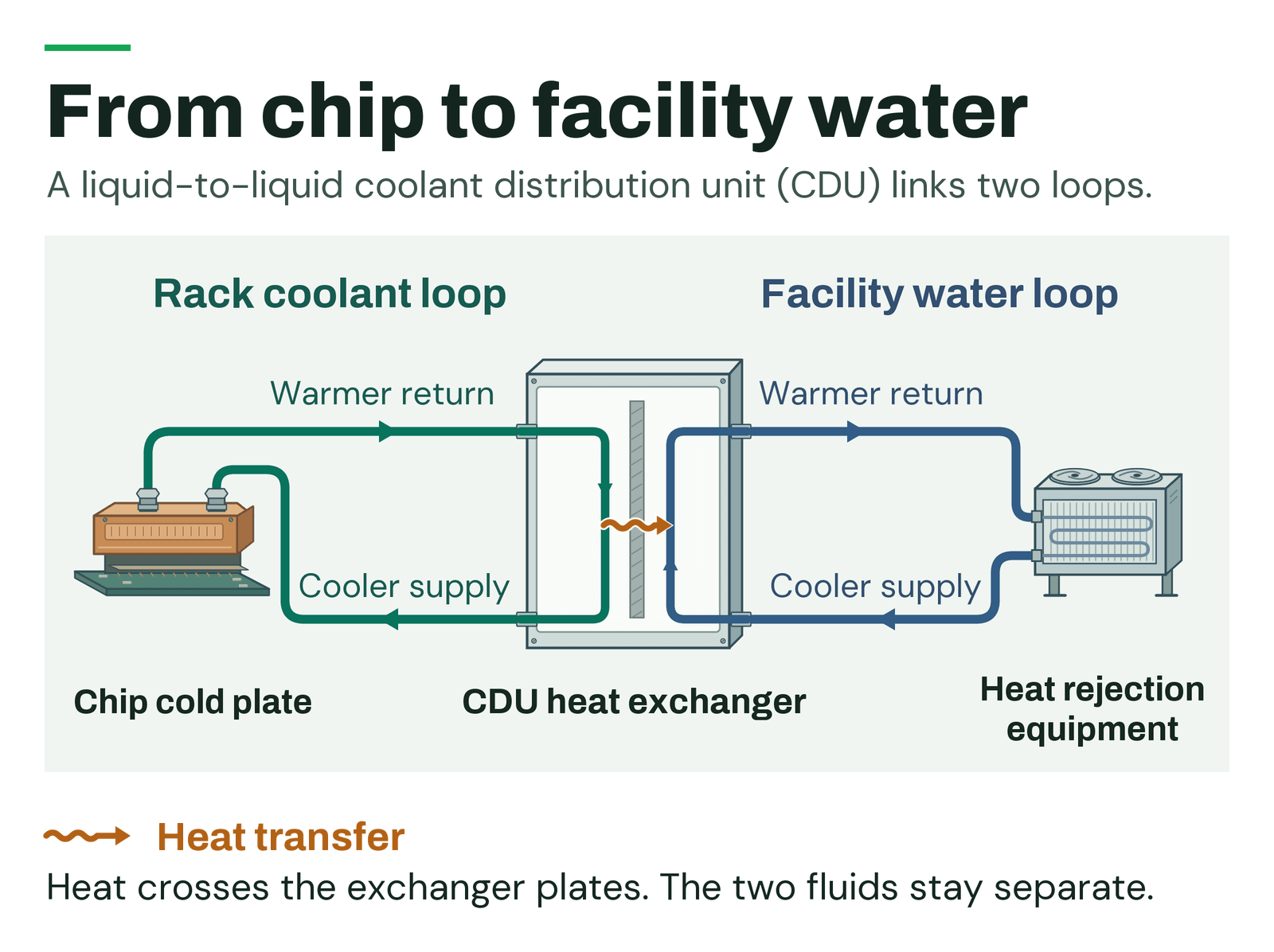
In a common liquid-to-liquid design, the technology cooling system (TCS) circulates coolant between the IT equipment and the CDU. The CDU passes the heat to the facility water system (FWS), which carries it toward the site's heat rejection plant. Other designs use liquid-to-air CDUs, which reject heat into the room, or different loop arrangements.
Control. Phaidra's Liquid Cooling Agent adjusts CDU setpoints. Vigilent lists CDU integration.
Monitoring. EkkoSense tracks temperatures and flow rates across direct-to-chip and rear-door heat exchanger deployments. Schneider's IT Expert and Data Center Expert monitor liquid cooling through the Motivair integration.
Modeling. Cadence simulates liquid cooling loops with its flow network, and Schneider's IT Advisor digital twin represents Motivair equipment.
Ask every vendor three questions. Which CDU makes and models are supported? Does the software write CDU setpoints or only read data, and does it also coordinate the facility side? What does the cooling system do when the software loses its connection?
Control, Advice, and Simulation: What Each Kind of Software Does
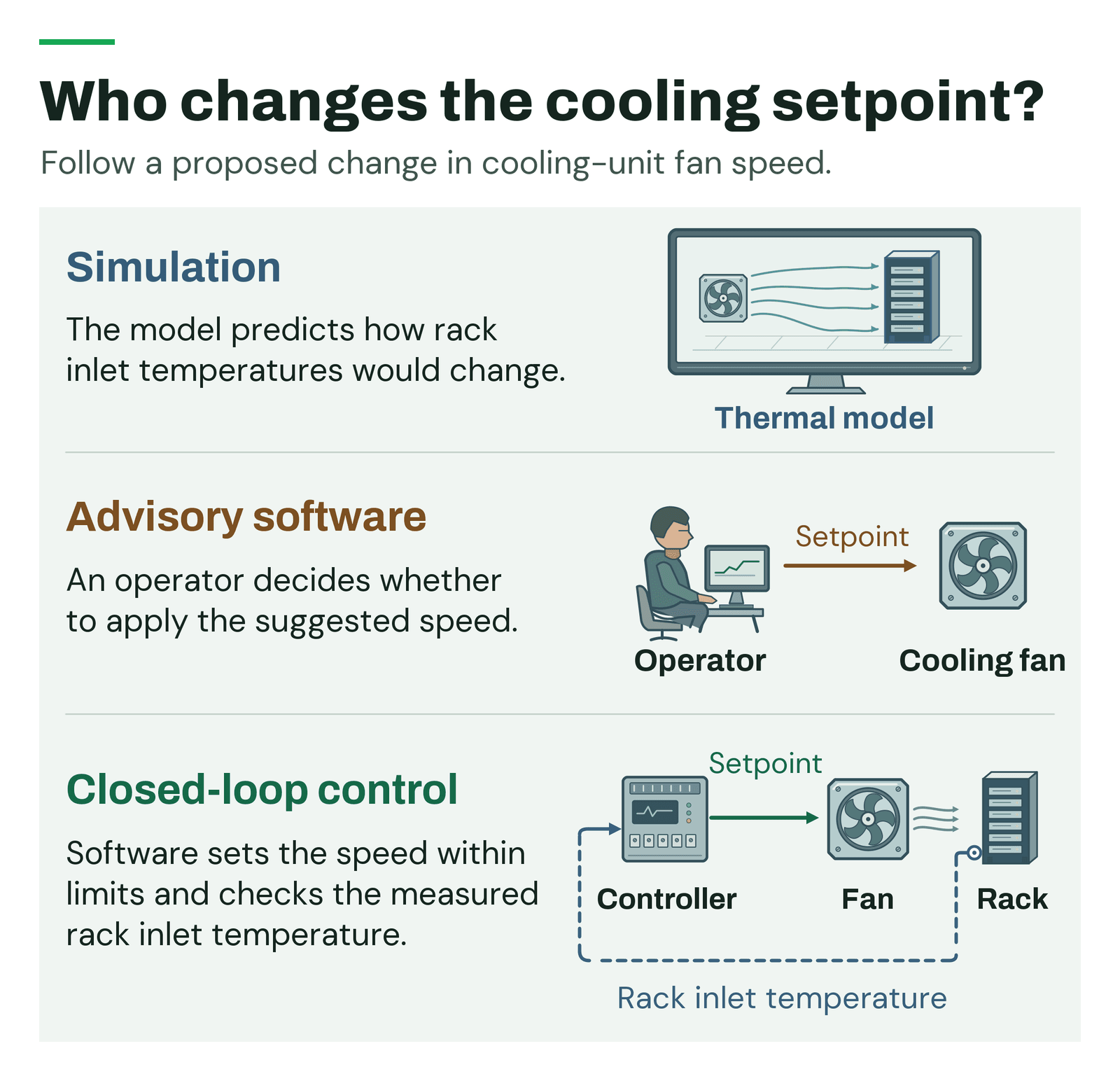
Closed-loop control. The software reads data, decides on a change, and writes the command itself. It works as supervisory automation and can combine feedback from sensors with predictive inputs such as IT load. Vigilent Synergy, Phaidra's Liquid Cooling Agent, Schneider's Cooling Optimize, and the Optimize version of Liebert iCOM-S are sold this way, and etalytics reaches it in stages.
Advisory software. The software analyzes the same data and gives staff a ranked list of changes. EkkoSense EkkoSoft Critical works this way, and so does etalytics in its first stage.
Simulation. CFD software calculates airflow and temperature for a layout that may not exist yet. Cadence and Schneider's IT Design CFD belong here.
Where the BMS fits. A BMS monitors and controls the mechanical plant, and the control logic itself often runs in chiller controllers, PLCs, and unit controls. An optimizer can sit above the BMS, be built into it, or connect to the equipment controllers, so ask each vendor which. Control products adjust setpoints within limits the operator sets, and advisory products leave the changes to staff.
PUE. Power usage effectiveness divides total facility energy by IT equipment energy over the same period. Uptime Institute's 2026 Global Data Center Survey put the industry average annual PUE at 1.52 per facility, or 1.36 when larger sites are weighted by capacity. At 1.52, a site uses 0.52 units of overhead energy for every unit that reaches IT equipment. PUE counts all overhead, cooling included, so a change in PUE reflects more than cooling.
PUE reporting in the European Union. Under Commission Delegated Regulation (EU) 2024/1364, operators of data centers in the European Union with an installed IT power demand of at least 500 kW report specified information and key performance indicators for the preceding calendar year. Reports are due May 15 each year, through a national reporting scheme where a member state has one. PUE is among the indicators calculated from that data.
What Changed in Data Center Cooling Optimization in 2026
AI-driven liquid cooling control was demonstrated in production. Phaidra published its production test results in March, the same month it launched Prism.
Advisory tools added early warning. EkkoSense added automatic cooling anomaly detection in March, and Lucend, formerly Coolgradient, took its new name in January.
Simulation moved closer to operations. Cadence announced an expanded collaboration with HPE in June on digital twins for data center modernization.
How to Choose Data Center Cooling Optimization Software
1. Should the software change setpoints, or tell your team what to change?
Closed-loop control responds at any hour without waiting for staff. It needs agreed control limits, a tested fallback, and an operations team that trusts it.
Advisory software keeps a person in every decision, and its value depends on someone working through the list. etalytics offers a path from one to the other, and Vertiv lets a site start on the Monitor version of iCOM-S and upgrade.
Ask each control vendor which points the software writes to, what limits apply, and what happens when communication drops.
2. Where is the constraint: the data hall, the chiller plant, or the liquid loop?
For airflow in the data hall, look at Vigilent, EkkoSense, Schneider's Cooling Optimize, and Vertiv Liebert iCOM-S on Liebert units. For the chilled water plant, look at etalytics and Vigilent's chiller plant control. For the liquid loop, look at Phaidra.
3. Who looks after the sensors and the model?
Live control and monitoring products depend on trustworthy telemetry. Follow each instrument maker's instructions for inspection, verification, and battery replacement, and keep the site model current when equipment, layouts, or operating conditions change.
Hosting and the contract shape who tests, approves, and deploys updates. EkkoSense runs its software in the cloud, Vigilent can run inside the customer's firewall, and Phaidra says the customer's team deploys its updates.
"An optimizer is only as good as the data feeding it," says Mike Ramsey, publisher of Reliable. "Put sensor checks and a review of every manual override on the maintenance schedule, or the savings fade without anyone noticing."
4. How will you prove the savings?
Vendor-reported figures in this guide run from 10% to 40% of cooling energy, and NTT's customer-published figure is 19.1% of chiller energy over a few months. Siemens cites 40% average cooling energy savings across more than 500 installations of its Vigilent-based product, along with a 5% to 10% PUE improvement.
These figures measure different things against different baselines. Before a pilot, agree on the baseline period, the meters, and how weather and IT load will be normalized. Ask for the result as energy in kilowatt-hours as well as a percentage.
Also Considered
Seven more products are worth evaluating for particular control, simulation, and integration needs.
Siemens White Space Cooling Optimization. Vigilent's control technology sold and integrated by Siemens. Its U.S. product page lists monitoring and control of air-cooled chiller plants, with rack temperature sensors and a physical or virtual server among the prerequisites.
Lucend. Advisory software, formerly Coolgradient, that analyzes a site's existing sensor data and recommends changes for operators to accept or decline. Lucend says it needs no new hardware, and it is a direct alternative for teams weighing EkkoSense.
Airedale by Modine Cooling AI. A predictive layer that works alongside Airedale's cooling controls, with a fan predictor that forecasts pressure and temperature one minute ahead. Airedale says it runs entirely on premises.
Johnson Controls OpenBlue Central Utility Plant Optimization. Central plant software whose Plant Optimizer stages equipment and selects setpoints automatically, with a Plant Simulator for comparing plant designs. It is a substantive alternative for chilled water plants.
Carrier QuantumLeap. Carrier's data center offer, which combines chillers and a CDU with Automated Logic building controls and Nlyte DCIM software. Carrier said in February 2025 that Nlyte ran in more than 300 data centers.
Stulz CyberHub ECO.DC. On-premises monitoring software from the cooling maker Stulz, with 3D thermal images and heat maps for finding hot spots. Its page describes monitoring and analysis, and Stulz offers energy consulting alongside it.
Ansys. General-purpose CFD and multiphysics software, now part of Synopsys. It suits equipment designers and engineering teams with CFD specialists.
How We Evaluated
Independent editorial analysis based on public vendor documentation, vendor pricing pages, dated press releases, and vendor support and security pages. Pages were reviewed in November 2026.
Reliable does not sell data center cooling optimization software, implementation services, or consulting and has no commercial interest in routing readers toward any particular vendor. Reliable does not accept payment for rankings. Vendors may sponsor enhanced listings with additional detail, but editorial rankings are independent. Read our editorial policy.
Each product was assessed on six criteria: how the software acts on cooling, the cooling systems it covers, air and liquid cooling support, deployment options, published evidence of results, and pricing transparency. No analyst rankings or review-site ratings were used to rank products.
Savings figures are vendor-reported unless a customer is named. A price cell marked quoted means the vendor's product pages show no public list price and route buyers to sales, and reseller prices are labeled as reseller prices.
Honest Limitations
Savings figures come from the vendors unless a customer is named. Each vendor uses its own baseline, some figures include services as well as software, and several measure different things, so the percentages cannot be ranked against each other.
Prices are those published in late November 2026. The Schneider figures are U.S. reseller listings for the CFD software alone. The vendors' own product pages show no manufacturer list price.
Control software changes how a cooling plant runs. Control limits, failure modes, and commissioning belong with a qualified mechanical or controls engineer and the equipment makers.
Coverage is as each vendor states it. Ask for the list of supported cooling units, CDUs, and control systems, and test on your own equipment before you sign.
Results depend on the site. Climate, plant design, load profile, and how well the room was already tuned all change what software can save.
The field is wider than seven products. BMS vendors, chiller makers, and independent integrators also deliver cooling optimization, and this guide does not rank them.
Frequently Asked Questions
What is the best data center cooling optimization software?
It depends on what you want the software to do. Vigilent fits autonomous control of data halls and chiller plants, Phaidra fits liquid-cooled AI factories, and EkkoSense fits teams that want recommendations a person approves. Cadence and Schneider Electric fit simulation and planning, etalytics fits chilled water plants, and Vertiv Liebert iCOM-S fits rooms cooled mainly by Liebert units. Reliable did not find an independent head-to-head test of these products.
Which vendor's predictive analytics best prevent AI cooling failures?
Reliable did not find an independent test that compares them, so judge each on what it watches. Phaidra's Liquid Cooling Agent reads rack power to act before coolant temperature rises, and its Prism product flags drift and instability. EkkoSense added automatic cooling anomaly detection in 2026, and Vigilent reports diagnostic data on compressors, pumps, and free cooling in the chiller plant. Ask each vendor for a failure it caught at a site like yours.
What platforms provide real-time power and cooling orchestration?
Phaidra describes its agents as coordinating compute, power, and cooling, and its site lists a Flex Agent that adjusts power draw to grid conditions and a Chiller Staging Agent. Vigilent says it optimizes chiller plant and data hall cooling as a whole. Vertiv Unify and ABB Ability Data Center Automation bring power and thermal systems into one monitoring and control platform, which is a different job from coordinating workloads with cooling.
How much energy can cooling optimization software save?
Vendors named in this guide report savings of 10% to 40% of cooling energy, and some of those figures include optimization services as well as software. NTT Global Data Centers published a figure of 19.1% for chiller energy at one site in Germany over its first few months. Treat these as examples, with no guaranteed floor, since results depend on how well the site ran before.
Is AI cooling control safe to run in a live data center?
It can be used in live facilities, and safety depends on the controls architecture, validated operating limits, equipment compatibility, redundancy, and commissioning. The integration should preserve local protective controls and safety interlocks, which must keep their equipment-protection functions. Vigilent lists unit-level fail-safes and manual overrides, and NTT says suggestions at its Bonn site are not executed if communication fails or setpoint ranges are exceeded. Test degraded telemetry, lost communication, fallback, and manual override under approved site procedures before go-live.
How much does data center cooling optimization software cost?
The ranked vendors' product pages show no manufacturer list price. EkkoSense prices by the number of elements monitored, with a lower price per element as the count rises. ITO Solutions, a U.S. reseller, lists Schneider's one-year IT Design CFD subscription at about $12,381, and SHI shows an MSRP of $19,290. Budget for sensors, integration, and commissioning on top of the software.
Related Guides
Sources
Vigilent: What We Do (platform, value, and company pages)
Phaidra: Liquid Cooling Agent (product pages and March 16, 2026 announcement)
EkkoSense: EkkoSense Frequently Asked Questions (FAQ, Cooling Advisor, liquid cooling, and EkkoSim pages, and March 24, 2026 release)
Cadence: Cadence Reality Digital Twin Platform (platform page and Reality DC Digital Twin datasheet)
Schneider Electric: EcoStruxure IT Advisor (product pages, EcoStruxure IT help center, 2026 EcoStruxure IT posts, and U.S. reseller listings from ITO Solutions and SHI)
etalytics: Data Centers (data center, FAQ, and company pages, October 2025 funding release, and April 2026 U.S. office post)
Vertiv: Liebert iCOM-S (product page, 2026 user manual, and 2020 government data centers white paper)
Last updated November 27, 2026. This guide is editorial analysis by Reliable.