Best Infrared Inspection Windows in 2026
Last updated November 26, 2026.
Infrared Inspection Window Comparison Table
| Maker and lines | Best for | Optic | Nominal sizes | Enclosure rating as stated | Published US price |
|---|---|---|---|---|---|
| IRISS: CAP-ENV, CAP-CT, VPT, VPFC, FlexIR | Large-format polymer windows and custom panels | Polymer; crystal on the VPFC | Round 2 to 4 in; rectangular 4 to 24 in; custom | IP67 and NEMA 6 on the CAP-ENV and VPT | $152 to $1,101 on iriss.com |
| Fluke: CV Series, CLKT | Fast single-hole retrofits with a crystal optic | Crystal | Round 50, 75, and 95 or 100 mm | CV: Type 4/12 and IP67; CLKT: Type 3/12 and IP65 | $359.99 to $899.99 on fluke.com |
| Teledyne FLIR: IRW, IRW-xPC and xPS, IRP-1 | Stainless steel enclosures and a low-cost port for FLIR cameras | Crystal; polymer on large format; no optic in the IRP-1 port | Round 2 to 4 in; rectangular 6 to 24 in; 12.5 mm port | IRW: Type 4/12; xPC: IP65 and NEMA 4X; xPS: IP67 and NEMA 6; IRP-1: Type 1 indoor, IP67 as listed | Windows $259 to $1,199 on flir.com; the port is $134 |
| Exiscan: XIR, XDV, XLF | Infrared, visual, and optional ultrasound inspection through one panel | Polymer, with a polycarbonate viewing pane on the XDV and XLF | Apertures of 4 by 4 in; 10 to 20 in wide on the XLF | XIR and XDV: NEMA 4X and IP66; XLF: Type 3R or Type 1 | No price on its site; a US dealer advertises $399.00 to $1,299.00 |
| ViPIRS: IW Series, Blastdown | Tagged windows on route-based inspection programs | Crystal, mesh, or polymer composite | Round 2 to 4 in; panes 4 to 20 in | Type 4/12; IW Series IP54 or IP65, depending on the document; Blastdown IP55 | No price on its site; a US dealer advertises the 4-inch IW4000 at $420.00 |
Ratings and prices are as each maker or dealer published them in November 2026. Sizes are nominal unless the cell says aperture. Nominal size, clear viewing aperture, and mounting cutout can all differ, so check the three for the exact model. A rating applies to the stated model, installed as the maker instructs with its cover closed, and a matching rating does not by itself show that modified equipment keeps its own.
"An infrared window lets you get the scan done with the covers on," says Mike Ramsey, publisher of Reliable. "Decide what you need to see behind each panel first, because the targets and the camera lens set the size of the window and how many you need."
5 Best Infrared Inspection Windows for 2026, Ranked by Use Case
1. IRISS: Best for Large-Format Polymer Windows and Custom Panels
IRISS is the best infrared inspection window maker for plants that need large rectangular polymer windows or custom panels on switchgear, transformers, and bus duct. The Bradenton, Florida, company builds most of its range around a reinforced polymer optic, which it sells in sizes well beyond its crystal line.
The outdoor CAP-ENV line runs from a nominal 4 to 24 inches wide in a stainless steel body rated IP67 and NEMA 6. IRISS's store lists it from $419 for the 4-inch model to $1,101 for the 24-inch, whose clear viewing aperture is 21.2 inches wide. The round VPT polymer window costs $152, $232, or $347 with a viewing aperture of 2, 3, or 4 inches.
The CAP-ENV page names a UL listing under file E491496, the impact and load test in IEEE C37.20.2, IEEE C37.20.7 Type 2B, and IEC 62271-200. It also names marine approvals from Lloyd's Register, ABS, and DNV. IRISS lists an unconditional lifetime warranty in the CAP-ENV and VPT specifications and a limited lifetime warranty in the table for its VPFC crystal line. Confirm the written terms for the exact model.
The CAP-CT is the indoor version, and the VPFC line is a coated crystal option in 2 to 4 inches. CAP-ENV-PDS models add a built-in ultrasonic transducer with a jack for IRISS's ultrasound and partial discharge test instruments. FlexIR covers custom shapes and replacement panels with the windows fitted at the factory.
Not the best fit for: Locations where a polymer window would run hotter than its rating. The CAP-ENV and VPT pages give an operating range of -40°C to 110°C. IRISS rates the housing of its crystal VPFC to 273°C and sells a sapphire series for furnaces and ovens.
2. Fluke: Best for Fast Single-Hole Retrofits With a Crystal Optic
Fluke is the best infrared inspection window maker for maintenance teams that want a round crystal window they can fit through one punched hole in a few minutes.
Fluke says one technician can install and ground a CV Series window in five minutes or less, through a single hole made with a standard Greenlee punch and with the panel door left on. A feature Fluke calls AutoGround bonds the window to the metal enclosure. The series is rated Type 4/12 and IP67 for indoor and outdoor use.
That figure is Fluke's time for fitting the window, and the retrofit around it is electrical work. Qualified people have to establish and verify an electrically safe work condition before cutting or drilling. They also have to follow lockout and tagout procedures and the equipment maker's instructions, and keep metal debris out of the gear.
The CV400 page cites an arc test at KEMA to IEEE C37.20.7, at 63 kA for 30 cycles at 60 Hz, and says the window "Maintains panel arc test ratings up to 63kA when properly installed." The figure describes a tested assembly, so ask for the report before relying on it. The page also lists UL 50, 50E, 50V, and UL 1558, and lifetime replacement against manufacturing defects.
Fluke's US store shows a price for each window in both lines. The CV Series costs $449.99 for the 50 mm CV200, $639.99 for the 75 mm CV300 and CV301, and $899.99 for the 95 mm CV400 and CV401. The CV301 and CV401 open with a security key.
The CLKT line costs less, at $359.99, $549.99, and $699.99 for 50, 75, and 100 mm. Fluke's 100 CLKT page cites a KEMA test at 50 kA for 30 cycles at 60 Hz, and it lists separate tests at lower currents to other standards. Fluke rates the line Type 3/12 and IP65. The same caution applies to each figure.
Not the best fit for: Compartments that need one wide opening. Fluke's US catalog stops at round windows of about four inches and has no rectangular or polymer model.
3. Teledyne FLIR: Best for Stainless Steel Enclosures and a Low-Cost Port for FLIR Cameras
Teledyne FLIR is the best infrared inspection window maker for plants with stainless steel enclosures and for FLIR camera users who want a low-cost inspection port. It sells two kinds of window and a lens-specific port, each with a US price on its product page.
The IRW series is a round crystal window in 2, 3, and 4-inch sizes that mounts through one punched hole. The 4-inch model has a 95 mm crystal and an 89 mm clear viewing aperture. Anodized aluminum models cost $259, $379, and $519. Stainless steel models cost $319, $459, and $579, and FLIR offers them to prevent mixed-metal problems on stainless cabinets.
FLIR rates the IRW series Type 4/12 and lists UL 50V. It cites an arc flash test at KEMA to IEC 62271-200, at 5 kV and 63 kA for 30 cycles at 60 Hz, and that figure describes the assembly tested. The warranty is a limited lifetime warranty against manufacturer defects.
The IRW-xPC and IRW-xPS large-format windows use a polymer optic behind a reinforcing grill, from $569 to $1,199. The aluminum xPC comes in nominal 6, 12, and 24-inch sizes and the stainless xPS in 12 and 24. The clear aperture is 20.9 inches wide on the 24-inch models.
The xPC is rated IP65 and NEMA 4X, and FLIR's page lists outdoor use as not applicable for it. The xPS is rated IP67 and NEMA 6. FLIR lists IEEE C37.20.7 Type 2B and IEC 62271-200 for the xPS only.
The IRP-1 is a $134 inspection port, a different product from an optical window. It is a small covered opening with a 12.5 mm aperture and no optic, so FLIR says there is no window transmission to correct. FLIR's support page says the port is intended exclusively for its 80° lens on compatible Exx, T5xx, and T8xx cameras, and for enclosures classified as Type 1, for indoor use.
FLIR's data sheet lists Environment Type 1, IP67, and UL 50V for the port, and FLIR says the cover must be secured whenever the port is not in use. Read those ratings with the cover closed, and assess the open port as part of the task, including whether energized parts are exposed behind it.
Not the best fit for: Sites with mixed camera brands that want the lowest-priced opening. FLIR limits the IRP-1 to its own 80° lens and to Type 1 indoor enclosures, with a stated maximum operating temperature of 100°C. Its optical windows start at $259, and its crystal windows stop at a nominal four inches.
4. Exiscan: Best for Infrared, Visual, and Optional Ultrasound Inspection Through One Panel
Exiscan is the best infrared inspection window maker for teams that want infrared and visual inspection through a single panel on each compartment, with ultrasound ports as an option. The Rochester, New York, company builds square and rectangular polymer windows in machined aluminum frames.
The XLF series puts a large infrared window and a clear polycarbonate viewing window in one frame, with ultrasound ports as an option. Its 2019 data sheet lists infrared apertures 4, 10, 15, and 20 inches wide, an operating range of -40°C to 150°C, and an infrared transmission of 57%. Exiscan's current comparison page shows the 10, 15, and 20-inch widths. Full-cover models are rated NEMA Type 3R, and partial-cover models are Type 1.
The smaller XIR is an infrared-only window with a 4 by 4 inch aperture, and the XDV adds a viewing pane of about 1.75 by 4 inches beside it. Exiscan rates both NEMA 4X and IP66. Its data sheets list UL 50V, UL 746C, and the IEEE C37.20.2 impact test. The warranty covers materials and workmanship for life, without conditions, when the window is used for its intended purpose.
Exiscan shows no prices on its site. Solutions Direct, a US dealer, advertises Exiscan windows with prices. The XIR with a 4 by 4 inch aperture is $399.00, and XLF models with 10, 15, and 20-inch apertures are $899.00, $999.00, and $1,299.00. Some of the dealer's enclosure ratings differ from Exiscan's, so take ratings from Exiscan's own documents.
Not the best fit for: Buyers who need a published arc test. The Exiscan data sheets cited here name none.
5. ViPIRS: Best for Tagged Windows on Route-Based Inspection Programs
ViPIRS is the best infrared inspection window maker for route-based inspection programs that want every window identified electronically. The Scarborough, England, company builds an RFID tag into each window.
On its IW Series pages, ViPIRS says a thermographer can scan the tag with the NFC reader in a phone to record which window a fault was found through. The round IW Series comes in 2, 3, and 4-inch sizes with crystal, mesh, or polymer composite optics. Its pages list ABS certification and a Type 4/12 rating.
The larger Blastdown viewing panes come in nominal sizes from 4 to 20 inches, with a polymer optic that has a single mesh embedded in it. ViPIRS says vents in the base of the frame relieve the pressure of an arc flash. That is the maker's description of its design, so ask for the test evidence and the clearances the vents need.
The IW Series data sheet, which gives specifications for the IW2000, IW3000, and IW4000 crystal models, reports an arc flash test against a 50 kA short circuit for one second at 11 kV. It names no tested model, assembly, or test standard, so ask for the report and check that it covers the exact window.
The UL certificate ViPIRS posts, dated October 2020, covers the five Blastdown models as infrared viewport components under UL 50V. It does not name the round IW Series. The IW4000 page cites the certificate's file, E516454, and the IW3000 pictured on the data sheet is marked E352489. Ask for the record that covers the model you are buying.
ViPIRS's documents also differ on warranty and ingress rating. The home page promotes an unconditional lifetime warranty, and the data sheet gives lifetime replacement against manufacturing defects. The IW4000 page lists IP54 and the data sheet lists IP65, so confirm the figures for the exact model.
Its site shows no prices. The IW Series was sold under the CorDEX Instruments name, and some dealers still list it that way. Global Test Supply, a US dealer, advertises the ViPIRS IW4000 at $420.00 and gives a lead time of three to four weeks.
Not the best fit for: Hot locations and buyers who need a documented US support office from the maker. The IW4000 and Blastdown pages give an overall temperature range of -10°C to 50°C, and ViPIRS's contact page gives a UK address and phone number.
Crystal or Polymer: Which Infrared Window Optic Fits?
Two kinds of optic cover nearly every window. The crystal models ranked here are round, in nominal sizes of about two to four inches. The polymer models are reinforced with a grill or a mesh and reach a nominal 24 inches wide.
The makers disagree about crystal. IRISS, which sells mostly polymer, says calcium fluoride crystal absorbs moisture and that readings taken through it drift as the window ages. FLIR, which sells both, says its calcium fluoride does not absorb moisture, and IRISS sells a coated crystal line of its own.
Treat each statement as a maker's case for its own product. Neither tells you how a finished, coated window holds its transmission under one site's humidity, cleaning, and contamination.
Stated temperature limits belong to each model. The operating range of the assembled window tops out at 110°C on IRISS's CAP-ENV, 150°C on Exiscan's windows, 200°C or 273°C on FLIR's large-format polymer models, and 260°C on FLIR's crystal IRW. Those figures describe the window, and the target behind it can be hotter.
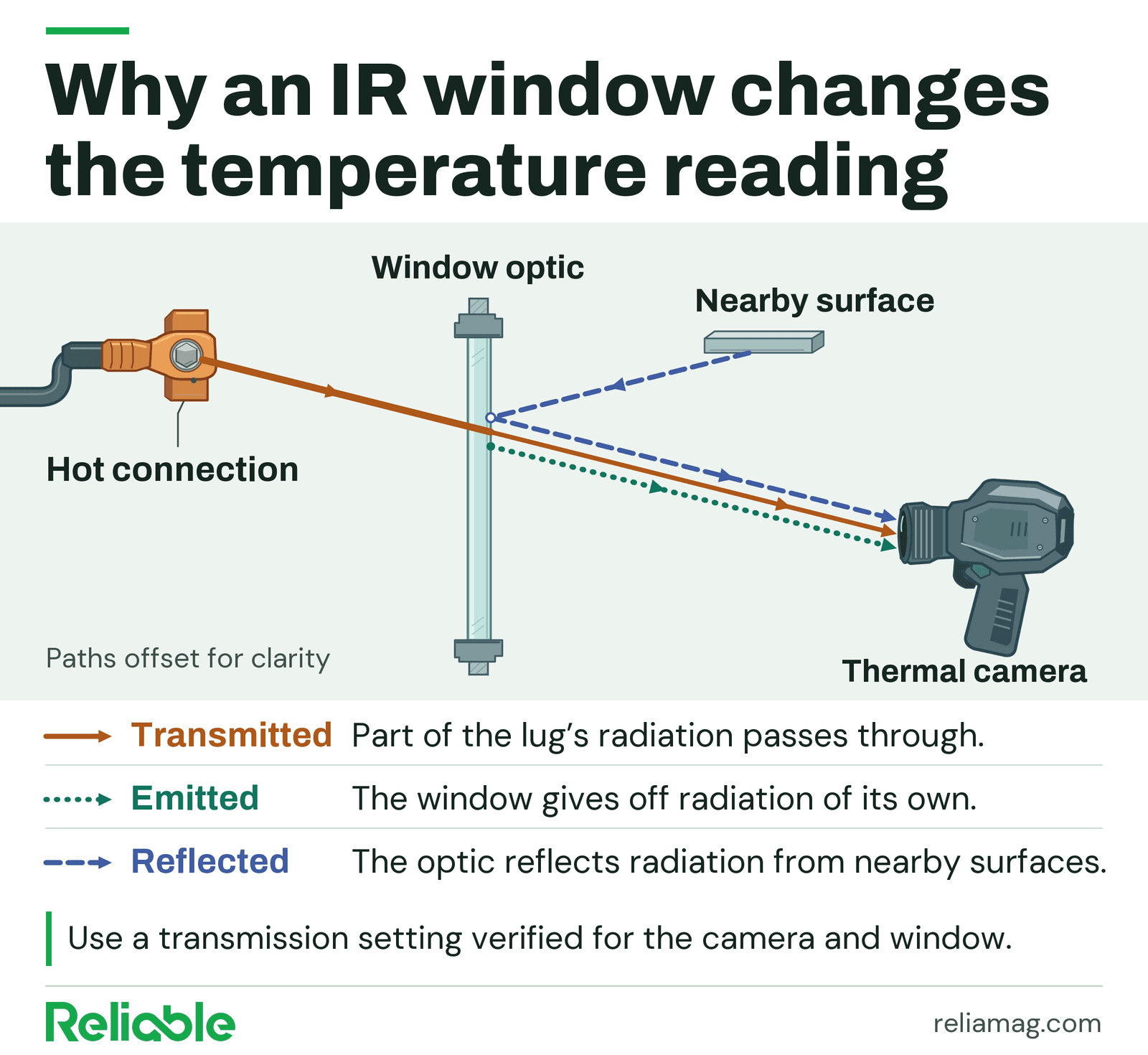
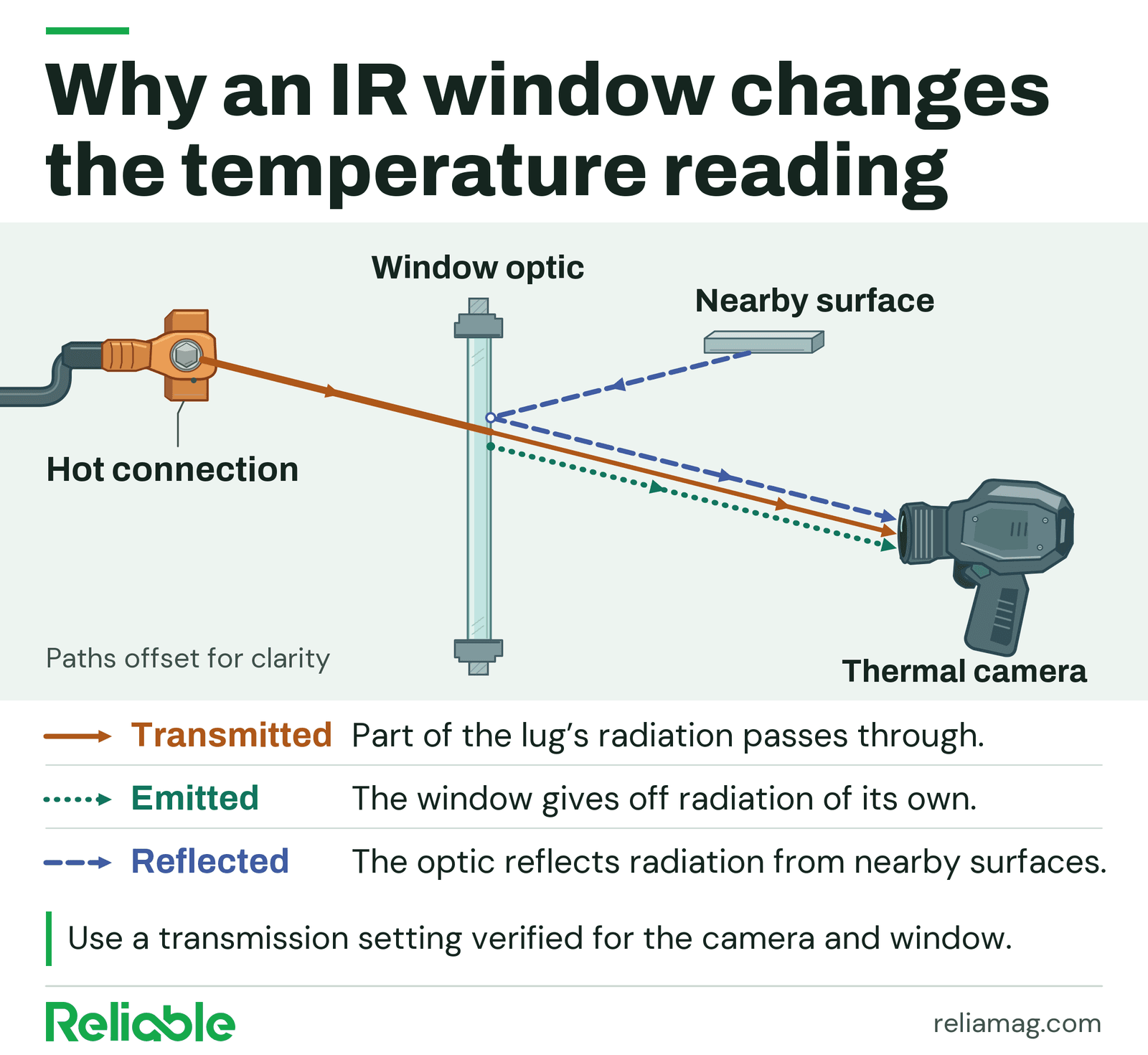
A window changes the reading. The optic attenuates the target's radiation, so an uncorrected reading of a hot connection is usually low, and the window also emits and reflects some radiation of its own. FLIR's support notes say the measured transmission of its window depends on the camera and on the temperature of the object. Exiscan's 57% is its published figure, to be checked with your own camera.
ASTM E1897 is the standard practice for measuring and compensating for that attenuation. Have a qualified thermographer establish the correction under safe, representative conditions, and never open energized equipment just to compare readings. Set the camera by its maker's procedure, and account for emissivity, reflected temperature, and window temperature where the camera allows.
Are Infrared Windows Arc Rated?
An arc test result describes the equipment assembly that was tested. Arc-resistant switchgear earns its rating as a complete assembly, and a window fitted to it was one part of that test. A window's own certification, such as UL 50V, is a separate matter and gives the equipment no arc-resistant rating.
An IRISS vice president of engineering services put it plainly in a 2018 article: "No IR Viewing Pane or individual component can ever be Arc Rated." The tests available for a window by itself, he wrote, cover load, impact, and flammability.
Fluke says its CV window maintains a panel's arc test rating when properly installed. FLIR cites a KEMA test to IEC 62271-200 at 63 kA, and IRISS lists IEEE C37.20.7 Type 2B and IEC 62271-200. ViPIRS reports a 50 kA test at 11 kV in its IW Series crystal window data sheet, and the Exiscan data sheets cited here name no arc test.
These figures cannot be set side by side. A kiloamp figure means little without the voltage, the duration, the assembly, and the test standard. Confirm whether each test was run with the window's cover open or secured. The ViPIRS IW3000 pictured on its data sheet is marked as incomplete without its cover secured, so do not assume a test result applies during a scan with the cover open.
"Read every arc figure on a window data sheet as a test of one assembly," says Reliable publisher Mike Ramsey. "Ask which equipment the window was tested in, to which standard, and whether its cover was open or closed."
Ask the maker for the test report before relying on any figure. A window does not by itself reduce the available fault current, shorten a protective device's clearing time, or set a new incident energy value. Any change to an enclosure's arc behavior has to be assessed for the installed equipment. The value of a window is that routine scans happen with the doors and covers in place.
What Do OSHA, NFPA 70E, and NFPA 70B Say About Infrared Windows?
OSHA's rule on electrical work practices, 29 CFR 1910.333, generally requires live parts to which an employee may be exposed to be deenergized before the employee works on or near them. The exceptions are cases where the employer can show that deenergizing adds hazards or is infeasible, and the rule's notes give testing that can only be done on an energized circuit as an example.
Electrical thermography that looks for load-related heating normally needs the equipment energized and carrying a representative load. Where exposure remains, the rule's safeguards for energized work and its qualified-person requirement still apply.
NFPA 70E is the consensus Standard for Electrical Safety in the Workplace, and its 2027 edition took effect on May 6, 2026. NFPA's second revision record for that edition lists infrared thermography and other noncontact inspections outside the restricted approach boundary in Table 130.5(C)(3). The table gives the likelihood of an arc flash for that task as "No", which its note defines as not likely, under any equipment condition, and the entry excludes opening doors or covers.
That record precedes the issued text, so confirm the wording in the published edition. The rating still leaves the hazard and the PPE question open, because the table's note says likelihood has to be combined with severity. The employer's shock and arc flash risk assessments for the whole task, including opening a window's cover, decide the work practices and the PPE.
NFPA 70B, the electrical equipment maintenance standard, is in its 2026 edition. NFPA's first revision record for Section 7.4.2 keeps the requirement to remove accessible and necessary covers so the camera has a clear line of sight. The same record proposes annex guidance that infrared windows can give that line of sight with the covers on. Annex material is explanatory, the record precedes the final text, and a window helps only where it shows the target clearly.
Eaton's summary of the published edition says Section 7.4.5 lets permanently installed, continuously monitoring temperature measurement devices satisfy Sections 7.4.1 through 7.4.4. Eaton sells such sensors. Read that as reaching the points those devices actually monitor, with the rest of the maintenance program still in place. Reliable's NFPA 70B compliance guide explains when the standard applies to a facility.
Two documents appear on most data sheets. UL 50V is UL's outline of investigation for infrared viewports, in its third edition since September 2023. Its scope covers factory installation in enclosures in ordinary, non-hazardous locations, and it excludes field installation on equipment already in service. Meeting the outline does not establish a viewport's suitability in a given end product, and UL says products rated over 600 V may need additional investigation.
A retrofit therefore rests on the equipment maker and the authority having jurisdiction, and a window's certificate does not approve the modified assembly. IRISS calls its UL file a listing, and Fluke and ViPIRS describe theirs as recognized components. Exiscan's 2019 XLF sheet shows a Recognized Component mark and a Listed mark, each with its own file number. Those are different categories, so check the category, the file, and the conditions of acceptability for the exact model.
The impact and load test for viewing panes sits in IEEE C37.20.2, the standard for metal-clad switchgear, whose current edition is dated 2025. A maker's reference to that test leaves open which edition was used and which switchgear the window suits, so ask.
Which Infrared Window Fits Which Equipment?
The examples below come from the ranked makers' own product pages, and each assumes the equipment maker allows the window.
| Equipment or situation | Window type that fits | What to check | Examples from the ranked makers |
|---|---|---|---|
| Small enclosures and tight doors | Small round window, or a lens-specific port | The lens field of view against the size of the target; a wider lens puts fewer pixels on each target | FLIR IRW-2C; IRISS VP-12-IR; Fluke CV200; FLIR IRP-1 (Type 1 indoor enclosures, FLIR 80° lens only) |
| Switchgear compartments with many connections | Large-format rectangular polymer window | Internal barriers, and how much the clear aperture covers | IRISS CAP-CT and CAP-ENV; FLIR IRW-xPC; Exiscan XLF; ViPIRS Blastdown |
| Outdoor enclosures | Window with a stated outdoor rating | The Type rating the enclosure needs against the window's; Type and IP ratings measure different things | IRISS CAP-ENV; FLIR IRW-xPS; Fluke CV Series; Exiscan XIR |
| Stainless steel enclosures | Stainless steel frame | Mixed-metal contact at the cutout | FLIR IRW-2S, 3S, and 4S; IRISS CAP-ENV; Exiscan's stainless option |
| Locations where the window itself runs hot | A model whose operating range covers the location | The assembled window's operating range, the optic's range, and the camera's band | FLIR IRW (260°C); FLIR IRW-xPS (273°C); Fluke CV Series (232°C continuous) |
| Programs that add ultrasound or partial discharge checks | Window with an ultrasound port or sensor | Where the port sits relative to the components | IRISS CAP-ENV-PDS; Exiscan XLF with ultrasound ports; ViPIRS Ultrasonic Inspection Point |
Does Continuous Thermal Monitoring Replace an Infrared Window?
A window still needs a person and a camera on a schedule. Permanently installed temperature sensors and radiometric cameras can monitor defined points or fields of view continuously. Where NFPA 70B's 2026 edition applies, Section 7.4.5, as Eaton summarizes it, lets such devices satisfy the thermography requirements of Sections 7.4.1 through 7.4.4 at the points they adequately monitor.
A window gives a thermographer a view of everything in the line of sight, at a published price of $152 to $1,299 per optical window. A contact sensor reads the point it is attached to, and a fixed camera sees its own field of view. Reliable's guide to fixed thermal imaging cameras compares that equipment.
Several companies sell both, and IRISS offers its E Sentry wireless sensors beside its windows. Some sites use windows for accessible points that are inspected periodically and continuous monitoring for selected points that are critical or cannot be seen.
What Does an Infrared Window Cost?
Among the models in this guide, published US prices in November 2026 start at $152 for IRISS's 2-inch VPT, the lowest-priced optical window. FLIR's IRP-1 port, a different product for one FLIR lens, is $134. Four-inch round crystal windows run from $420.00 for the ViPIRS IW4000 at a dealer to $519 from FLIR and $899.99 for Fluke's CV400.
Large-format windows cost more per opening and can do the work of several round ones. A nominal 12-inch window is $799 or $909 from FLIR and $825 for IRISS's CAP-ENV. A nominal 24-inch window is $999 or $1,199 from FLIR and $1,101 from IRISS, and a dealer advertises Exiscan's 20-inch XLF at $1,299.00.
Cutting openings in existing gear takes an outage and qualified labor, and the makers' pages cited here give no installed price. As a hypothetical, 20 switchgear sections with one $825 window each come to $16,500 in windows before installation.
How to Choose an Infrared Inspection Window
1. What Do You Need to See Behind Each Panel?
List the connections that matter in each compartment, then confirm that each has a clear line of sight from the door or cover. Internal barriers block infrared as surely as steel does. Schneider Electric's Power-Zone 4 switchgear catalog, for example, offers up to two windows per section on some configurations and leaves out the main breaker's line side because barriers block the view.
Work from the clear viewing aperture, which can be smaller than the nominal size: 21.2 inches on IRISS's 24-inch CAP-ENV and 89 mm on FLIR's 4-inch IRW. The cutout is a third dimension, given in the maker's template. At the same distance and resolution, a wider lens covers more area and puts fewer pixels on each target, so check the camera's minimum spot size too. Reliable's guide to thermal imaging cameras compares the cameras themselves.
2. Crystal or Polymer for This Location?
Start with each model's stated operating range, which runs from 50°C to 273°C among the ranked makers. Then check that the optic passes the band your camera uses. Crystal suits small round openings, and polymer suits large openings and places where a window may take a knock.
3. Does the Window Match the Enclosure's Rating?
An enclosure is only as tight as its weakest opening. Match the window's stated rating to the protection the enclosure is required to have. NEMA Type and IP ratings classify different things, so one cannot stand in for the other, and a matching rating on the window does not by itself show that the modified enclosure keeps its own.
4. Who Has to Approve a Cutout in This Equipment?
Ask the equipment maker before cutting. Schneider Electric, for one, says infrared viewing windows are not an option for its panelboards and can be installed in switchboard-class equipment. Ask in writing what a retrofit does to the listing, the warranty, and any arc-resistant rating.
UL's guidance for code authorities says the authority having jurisdiction judges whether a field modification is acceptable. It adds that only a field evaluation can determine whether modified equipment still meets UL's requirements. Ask the authority early whether it will want one on listed gear.
5. How Will Readings Stay Comparable From Year to Year?
A fixed viewport helps make surveys repeatable. The thermographer still has to reproduce the camera position, the angle, the lens, and the measurement settings. Record the window ID, the transmission and emissivity settings, the load, and the ambient conditions with each image. Fluke ships an identification plate on each window, and ViPIRS builds in an RFID tag.
"A window pays off when this year's reading can be set beside last year's," says Mike Ramsey, publisher of Reliable. "Label every window, write down its transmission setting, and file the images under the asset, so the next thermographer starts from your baseline."
Also Considered
These companies fit windows at the factory or sell an alternative to a window.
Schneider Electric (Square D): Sells H.VIR Comet infrared viewing windows in 2, 3, and 4-inch sizes through distributors and its field services group. Its Power-Zone 4 catalog uses IRISS VPT windows on NEMA Type 1 enclosures and H.VIR windows on Type 3R and arc-resistant enclosures.
ABB: Offers ReliaGear XFMR low-voltage dry-type transformers with IRISS windows installed at the factory. It suits buyers ordering new transformers who want the windows built in.
Eaton: Offers an infrared joint cover for its Pow-R-Way III busway, which IRISS manufactures. It also sells Exertherm continuous thermal monitoring and publishes a comparison of that system with windows and manual thermography.
Legrand (Starline): Offers IR windows with a polymer viewing pane on the end feeds and plug-in units of its Track Busway. It presents them as part of a busway maintenance plan.
Grace Technologies: Sells the GraceSense Hot Spot Monitor, a permanently installed temperature monitor, and the HSM 600 for equipment at or below 600 VAC. It is an alternative for connections that no camera can see.
How We Evaluated
Independent editorial analysis based on publicly available vendor documentation, product and pricing pages, datasheets, dated press releases, and standards-body and regulator pages, reviewed in November 2026.
Reliable does not sell infrared windows, inspection services, or consulting and has no commercial interest in routing readers toward any particular vendor. Reliable does not accept payment for rankings. Vendors may sponsor enhanced listings with additional detail, but editorial rankings are independent. Read our editorial policy.
Six criteria shaped the ranking:
Use-case fit: the inspection job each maker's own pages put first.
Optic: crystal, polymer, or open port, and the sizes each allows.
Enclosure rating: Type and IP ratings as each maker states them.
Certifications and tests: UL, CSA, IEEE, IEC, and arc test statements as each maker states them.
Warranty: terms as each maker states them.
Pricing transparency: whether a US price is published and where.
No analyst reports or review-site ratings were used. The ranking is by use case, and the number beside each entry only sets the order.
Honest Limitations
Specifications are maker-stated. Ratings, temperature limits, transmission figures, and test results come from each maker's product pages and data sheets as of November 2026.
Prices are those published in late November 2026. The ranges cover the models named here, the Exiscan and ViPIRS figures are dealer prices, and the makers' pages give no installed cost.
Certifications are as the makers state them. A standard named on a data sheet, a certificate, and a current listing record are three different things. Ask for the certificate, the UL file, and the test report before you specify a window, and check that they cover the model and size you are buying.
Standards are summarized here. The NFPA 70B points follow NFPA's first revision record and Eaton's summary of the 2026 edition. The NFPA 70E points follow NFPA's second revision record for the 2027 edition. Both records precede the issued text, so read the published editions before relying on either.
Selection and placement for a specific site belong with a qualified engineer and the manufacturer. A window is one control within an electrical safety program. Fitting one is electrical work for qualified people, and the employer's risk assessment decides the work practices and PPE.
The field is wider than five. Switchgear, transformer, and busway makers fit windows at the factory, and this guide ranks the makers that publish US product pages for windows sold separately.
Frequently Asked Questions
What is an infrared inspection window?
An infrared inspection window is a viewport fitted in the door or cover of electrical equipment, so a thermal camera can inspect energized components with the door or panel left in place. Most use an optic that passes the longwave infrared most electrical thermography cameras use, which steel and ordinary glass block. A lens-specific inspection port, an opening with no optic, is a related but different product. Most have a cover that is opened only for the scan.
Do infrared windows work with any thermal camera?
Not automatically. Check the optic's wavelength band against the camera's, the usable transmission, the lens geometry, and whether the camera can apply a window correction. IRISS and ViPIRS say their windows work with any infrared camera, and Exiscan states its polymer for midwave and longwave cameras from 3 to 13.5 µm. FLIR limits its IRP-1 port to its own 80° lens on compatible FLIR cameras.
Do you still need PPE to scan through an infrared window?
The employer's shock and arc flash risk assessments for the whole task decide that. A window keeps the equipment's doors and covers in place, and opening the window's cover or an inspection port still has to be assessed, including whether energized parts are exposed behind it. A window does not by itself justify changing the incident energy on the equipment label or reducing PPE. Have any enclosure modification assessed, and follow the site's electrical safety program.
How many infrared windows does a switchgear section need?
Enough to give a line of sight to every connection you intend to scan. That depends on the depth of the compartment, the internal barriers, the clear viewing aperture, and the camera lens.
Can infrared windows be installed on existing equipment?
Often, where the equipment maker and the authority having jurisdiction allow it. All five ranked makers sell windows for retrofit. Fluke's CV Series and FLIR's round IRW are designed for a single punched hole, and larger rectangular windows need a cutout. The work calls for qualified people, an electrically safe work condition, and a plan for the listing and the warranty.
How long does an infrared window last?
A warranty is not a measure of service life. Each ranked maker states a lifetime warranty, and the terms differ by maker and model, from unconditional cover to manufacturing defects only. How long an optic holds its transmission depends on the material, the coating, and the environment, and the documents cited here include no independent test of that.
Related Guides
Best Thermal Imaging Cameras for Industrial Use: An Independent Comparison
Best Fixed Thermal Imaging Cameras for Continuous Monitoring
NFPA 70B Compliance: What Changed and When It Actually Applies
Arc Flash Statistics: Incident Frequency, Injury Data, and Costs
Sources
IRISS: CAP-ENV Series (models, prices, apertures, certifications, and warranty; also the VPT, VPFC, and CAP-ENV-PDS pages, the high-temperature series page, and the crystal and polymer comparison)
Fluke: Fluke CV400 95 mm (4 in) Infrared Window (installation, arc test, ratings, and warranty; also the IR windows store page and the CLKT pages)
Teledyne FLIR: IR Windows (IRW series prices and specifications; also the IRW-xPC/xPS and IRP-1 pages, support pages on the IRP-1 and on window transmission, and a June 2026 FLIR article)
Exiscan: IR Windows: Compare (series, apertures, and NEMA ratings; also the XIR and XDV specifications and the XLF data sheet)
ViPIRS: ViPIRS infrared windows (range and warranty statement; also the IW4000 Crystal and V412BD pages, the IW Series data sheet, and the posted UL certificate)
NFPA: NFPA 70B first draft report, first revision statements (Section 7.4, infrared thermography; also the NFPA 70E document page and second revision record)
OSHA: 29 CFR 1910.333, Selection and use of work practices (deenergizing live parts, its exceptions, and work on energized parts)
Last updated November 26, 2026: first edition. This guide is editorial analysis by Reliable.