Best Intelligent Rack PDUs for Data Centers in 2026

Last updated November 27, 2026.
Intelligent Rack PDU Comparison Table
| Vendor and product | Best for | Vendor-stated metering accuracy and temperature rating | Network and protocols | Warranty | Example US price (MSRP or reseller) |
|---|---|---|---|---|---|
| Legrand Raritan PX4 and Server Technology PRO4X | Outlet-level power quality data, on outlet-metered models | ±0.5%; 60°C | Two Gigabit Ethernet ports; up to 32 PDUs cascaded on one port; SNMP v2c and v3, Modbus TCP, MQTT, JSON-RPC, Redfish | Two years standard; up to five with paid extensions | No price on either brand's site; one US reseller lists a PX4-5547-E7V2 at $3,300.99 |
| Vertiv PowerIT | Upgrading the monitoring module without replacing the PDU | 1%; 60°C on high-temperature models | Two Ethernet ports; up to 50 devices on one IP address through Vertiv Intelligence Director, with a compatible IMD in each group; SNMP v1, v2c, and v3; JSON API; Modbus TCP on documented models | Five years in current documents; older documents say three, or five with registration | No price on Vertiv's site; one US reseller lists the VP7N30AP at a sale price of $2,139.99 (regular price $2,989.00) |
| Schneider Electric APC NetShelter Rack PDU Advanced (Gen 2) | EcoStruxure IT sites and mixed plug types | 1%; 60°C at full load | Gigabit and 10/100 ports; network port sharing; web, SNMP, and command line; EcoStruxure IT | Three years | Shown on Schneider's store after a ZIP code; one US reseller lists the APDU11452SM at $6,353.00 (MSRP $8,035.00) |
| Eaton Rack PDU G4 | Universal input across regions | ±1% on Managed models; 60°C | Gigabit Network Module; 32 to 40 PDUs on one network connection, per Eaton's documents, each with its own IP address; SNMP, Modbus TCP, MQTT, RESTful API | Three years | No price on Eaton's site; one US reseller lists the EVMAGU23X at $2,651.99, input cable extra |
| Chatsworth Products eConnect | PDUs, sensors, and door locks on one IP address | ±1%; 65°C at rated input power on models with 20 A breakers and at 50% load on models with 30 A breakers | Gigabit Ethernet; 48 PDUs on one IP address, or 32 with locks; SNMP v1, v2, and v3; RESTful API; Redfish | Three years; two more optional | MSRP on Chatsworth's site; $2,555.78 for the EA-6012-C |
| nVent Enlogic Advantage Series | Long rows that share one network connection | ±1%; 60°C | Gigabit and 10/100 ports; up to 64 PDUs on one IP address; SNMP v1, v2c, and v3; JSON-RPC | Five years | No price on the Enlogic pages; quotes by contact form |
| CyberPower Switched Metered-by-Outlet | Server rooms and small data centers at a published price | ±1% on CyberPower's Taiwan site for both models; the US pages give no figure; 60°C | Ethernet and serial ports; cascading; SNMP v1 and v3 | Three years in the US | MSRP on CyberPower's US site; $1,200.00 for the PDU81001 and $3,000.00 for the PDU83105 |
Each figure is as the vendor states it for the models named in the entries, and accuracy figures are not measured under identical conditions. Reseller prices are for the part numbers named, as listed in late November 2026, and a listing is no promise of stock.

"Start with the power the rack needs and the circuit that feeds it," says Mike Ramsey, publisher of Reliable. "Metering, switching, and software only matter once the PDU can carry the load."
7 Best Intelligent Rack PDUs for Data Centers in 2026, Ranked by Use Case
1. Legrand Raritan PX4 and Server Technology PRO4X: Best for Outlet-Level Power Quality Data
Legrand's Raritan PX4 and Server Technology PRO4X are intelligent rack PDUs best suited to operators who want power quality measurements at the outlet and help tracing breaker trips, on the models equipped for outlet metering.
The two brands share one platform: Legrand's Xerus firmware and a hot-swappable controller called the iX. Raritan's PX4 data sheet states ±0.5% metering accuracy and cites IEC 62053-21 and IEC 61557-12. It lists total harmonic distortion and crest factor at the inlet and the outlets, plus voltage dips and swells at the inlet.
Outlet-level figures need an outlet-metered model. Raritan's PX 4000 series meters each outlet and the PX 5000 series meters and switches each outlet, while the PX 1000 and 2000 series meter at the inlet and branch circuits. The PX 2000 adds outlet switching without outlet metering. Server Technology's PRO4X specifications list four families, and only Smart POPS and Switched POPS sense power at each outlet.
Waveform capture is the unusual feature. Raritan says compatible PX4 models record waveforms on demand or when an event occurs and flag an outlet suspected of tripping a breaker. On models with outlet switching, a trip-cause setting can keep the suspected outlet off once the breaker is reset. Treat the result as a diagnostic aid and confirm the cause before restoring the load.
Both lines offer Legrand's HDOT Cx outlet, a hybrid that accepts C14 and C20 plugs, on selected models. Raritan lists inputs from 12 A to 100 A and a standard 60°C (140°F) rating, and both brands offer an optional universal input.
For networking, the data sheet lists two Gigabit Ethernet ports and cascading of up to 32 PDUs under one Ethernet port. It names SNMP v2c and v3, Modbus TCP, MQTT, JSON-RPC, and a Redfish API. The sensor port takes Raritan's SmartSensors, which Reliable covers in its guide to data center environmental monitoring systems.
Neither brand's site shows prices. Avendor, a US reseller, lists a PX4-5547-E7V2, a 208 V three-phase model with a 50 A plug and 24 outlets, at $3,300.99.
Not the best fit for: Buyers who want a long standard warranty. Raritan's warranty page gives two years as standard, with registration required for advanced replacement and paid extensions to five years in total. Server Technology's specifications page states the same term.
2. Vertiv PowerIT: Best for Upgrading the Monitoring Module Without Replacing the PDU
Vertiv's PowerIT rack PDUs, formerly sold under the Geist name, are intelligent rack PDUs best suited to buyers who expect their monitoring needs to change during the life of the hardware.
The monitoring electronics sit in a hot-swappable module Vertiv calls the IMD. Vertiv's product overview brochure says an IMD-5M can be bought separately to upgrade a Monitored or Switched unit, so the power strip itself stays in the rack. The same brochure gives 1% accuracy to ANSI and IEC standards and a 60°C rating on high-temperature models.
Monitored units report at the input, and Switched units add on, off, and reboot at each outlet. Outlet-level monitoring is an option on both. Vertiv's combination outlets accept C14 and C20 plugs, and its US page says up to 16 external sensors connect to a Switched unit.
For networking, the brochure allows up to 50 devices on one IP address through Vertiv Intelligence Director, the array feature in the monitoring module. One unit in each group must carry an IMD-03E, IMD-03E-S, IMD-3E, IMD-3E-S, or IMD-5M module. Vertiv's model data sheets list SNMP v1, v2c, and v3, Modbus TCP, a JSON API, and LDAP, RADIUS, and TACACS+ authentication.
Vertiv's PowerIT warranty document, dated July 2025, gives five years from shipment, and its US product page states a standard five-year limited warranty. That page says each unit is tested for UL, RoHS, and TAA compliance.
Vertiv's site shows no prices. Avendor lists the 208 V switched VP7N30AP, with a 30 A plug and 24 combination outlets, at a sale price of $2,139.99 (regular price $2,989.00).
Not the best fit for: Buyers who want every answer from one document. Older Geist-era data sheets give three years of warranty, or five with registration within 120 days, where its current documents give five, so confirm the term on the quote. Protocol support depends on the IMD and its firmware. Confirm it if your integration needs Redfish or a particular Modbus register map.
3. Schneider Electric APC NetShelter Rack PDU Advanced: Best for EcoStruxure IT Sites and Mixed Plug Types
Schneider Electric's APC NetShelter Rack PDU Advanced is an intelligent rack PDU best suited to data centers that already run EcoStruxure IT and want one outlet that takes four plug types.
The line is now in its second generation. Schneider's US site marks the first-generation APDU10450SM as discontinued and names the Gen 2 APDU11450SM as its replacement. Check that a quote carries the newer APDU11 part numbers.
The 4-in-1 outlet works as a C13, C15, C19, or C21, and Gen 2 models pair these with C13/C15 outlets. APC's brochure for the Gen 2 series gives up to 48 outlets, 1% metering accuracy, and operation at 60°C. Its largest listed model is rated 43.5 kW at 400 V and 63 A, or 34.6 kW at 415 V and 60 A. The North American 208 V models run from 5.0 kW to 17.3 kW.
Each PDU carries a Network Management Card 3 that can be swapped live. Schneider's product page for the 17.3 kW model lists EcoStruxure IT compatibility and one free year of its Secure NMC System subscription. Schneider's Gen 2 data sheets show a 36-month warranty and UL 62368-1.
Schneider's store shows prices after a ZIP code is entered. SHI, a US reseller, lists the 17.3 kW switched, metered-by-outlet APDU11452SM at $6,353.00 against an MSRP of $8,035.00.
Not the best fit for: Buyers who need ongoing access to current NMC3 firmware without a subscription. Schneider's firmware FAQ says NMC3 firmware 3.0 and higher for rack PDUs is delivered only through its Secure NMC System tool, which needs a valid subscription. Confirm the supported update procedure and any service requirements for your model. APC's brochures also give different counts for network port sharing, so confirm how many Gen 2 PDUs can share one port.
4. Eaton Rack PDU G4: Best for Universal Input Across Regions
Eaton's Rack PDU G4 is an intelligent rack PDU best suited to organizations that want one universal-input chassis across regions and a vendor that publishes its cybersecurity certificates.
The universal input version, the UPDU, takes detachable input cables. Eaton lists 17 cables with 15 plug types, and it rates the 42-outlet EVMAGU23X from 5 kW to 23 kW depending on the cable. C39 outlets accept both C14 and C20 plugs. Legrand, Vertiv, and Chatsworth also sell universal-input models, so compare the cable ranges.
Eaton lists UL 2900-1 and IEC 62443-4-2 for the G4's Gigabit Network Module and publishes a certificate for each. The UL 2900-1 certificate was issued on April 30, 2024, shows an expiration date of April 30, 2025, and names software version 2.4.6. The IEC 62443-4-2 certificate, dated May 2024, covers firmware version 2.4.2 and lists the requirements assessed. Ask Eaton for a current certificate that covers the hardware and firmware you will deploy.
Eaton's G4 page also describes a user-configurable firewall and zero-touch provisioning. Eaton's brochure says firmware updates are free and need no support contract.
The line comes in Basic, Metered Input, Metered Outlet, and Managed versions, and Managed adds outlet switching. Eaton's brochure gives ±1% accuracy on Managed models and operation to 60°C (140°F) with no power derating. Eaton's documents name SNMP, Modbus TCP, MQTT, and a RESTful API, and the list varies by document, so check your model.
Eaton's G4 page says up to 40 PDUs can share one network connection, each keeping its own IP address, while its February 2026 brochure and some model pages say 32. Confirm the limit for the model you are quoted.
Eaton's site shows no prices. Zones, a US reseller, lists the managed universal-input EVMAGU23X at $2,651.99 with a three-year manufacturer warranty, and the input cable is sold separately.
Not the best fit for: Buyers who need a current UL 2900-1 certificate in hand. The certificate Eaton publishes states an April 30, 2025 expiration date, so request an updated one. The universal-input model also tops out at 23 kW, and Eaton lists a separate HDX version of the G4, rated up to 46 kW, for GPU-dense racks.
5. Chatsworth Products eConnect: Best for PDUs, Sensors, and Door Locks on One IP Address
Chatsworth Products' eConnect is an intelligent rack PDU line best suited to operators who want power, environmental sensors, and electronic cabinet locks managed together.
Chatsworth, known as CPI, calls its networking feature Secure Array. Its Switched Pro data sheet says one IP address serves up to 48 linked PDUs, or 32 when the PDUs also run electronic locks, with a second connection for failover. CPI sells an RFID lock kit with locks, card readers, and door sensors that reports through the PDU.
CPI's quick reference guide lists six levels, from Basic to Switched Pro, which meters and switches individual outlets. On models with 5-20 convenience outlets, the data sheet says those outlets are neither monitored nor switched. It states ±1% accuracy, which CPI calls billing grade, bistable latching relays, and inputs to 100 A.
CPI lists UL 489 hydraulic-magnetic breakers as available on single-phase and three-phase models with 30 A or higher input. The data sheet also lists SNMP v1, v2, and v3, a RESTful API, Redfish, 802.1X, and zero-touch provisioning.
CPI's data sheet describes the Switched Pro line as made in the United States, TAA compliant, and NEMKO certified to UL and IEC 62368. Confirm TAA status for the exact part number. The warranty is three years with advanced replacement, and two more years are optional.
CPI publishes list prices on its own site. The 208 V single-phase Switched Pro EA-6012-C, built for a 30 A circuit with 24 outlets, shows an MSRP of $2,555.78.
Not the best fit for: Buyers who need full nameplate load at CPI's top temperature. The data sheet ties the 65°C (149°F) rating to conditions: rated input power on models with 20 A internal breakers and 50% load on models with 30 A internal breakers. Sites with no plans for electronic cabinet locks also get less from the line's main advantage.
6. nVent Enlogic: Best for Long Rows That Share One Network Connection
nVent's Enlogic Advantage Series is an intelligent rack PDU line best suited to large halls where network ports for PDUs are scarce and a long warranty matters.
nVent's EN6 series page says up to 64 PDUs cascade over Ethernet on one connection and IP address. nVent says each PDU's Gigabit and 10/100 ports allow redundant network communication. Each PDU can also supply DC power for network management electronics, a feature nVent calls DC power sharing.
The family runs from input-metered EN1 units to EN6 units that meter and switch each outlet. nVent describes the metering as billing grade, and its spec sheet for the EN6883 gives ±1% accuracy and an operating range of -5°C to 60°C. The network controller is hot-swappable and supports up to 10 digital sensors for environmental monitoring, electronic locks, or both.
nVent states that the line is UL 2900-1 certified for cybersecurity and IEC 62368 listed. It warrants Enlogic equipment to the original purchaser for five years from the invoice date. Catalog models reach 100 A input, derated to 80 A in North America.
Not the best fit for: Buyers who want to see a price before talking to sales. nVent's Enlogic pages show no prices and route buyers to a contact form. The EN6 spec sheet lists SNMP v1, v2c, and v3 and JSON-RPC, so confirm support if your software needs Modbus or Redfish.
7. CyberPower: Best for Server Rooms and Small Data Centers That Want a Published Price
CyberPower's Switched Metered-by-Outlet PDUs are intelligent rack PDUs best suited to server rooms, labs, and small data centers that want outlet-level control at a price they can see.
CyberPower shows an MSRP on its US product pages. Its site lists $1,200.00 for the 1U PDU81001, which has eight outlets and a 15 A plug derated to 12 A. It lists $3,000.00 for the three-phase PDU83105, which has 30 outlets and a 30 A plug derated to 24 A. The line meters at the input, each circuit, and each outlet, and it switches each outlet.
The PDU83105 page gives an operating range up to 60°C (140°F). It lists SNMP v1 and v3, HTTPS, SSH, LDAP, and RADIUS, cascading through an RJ45 port, and an optional environmental sensor.
CyberPower warrants the PDUs for three years in the US and sells an extension. The same page lists UL 60950-1 and UL 62368-1 under safety certifications. CyberPower's Taiwan site gives ±1% measurement accuracy for the PDU81001 and the PDU83105, a figure the US pages leave out.
Not the best fit for: High-density racks. The three-phase models on CyberPower's US Switched Metered-by-Outlet list stop at a 60 A nominal input, below the 100 A nominal units other makers sell for AI racks. The US product pages give no accuracy figure or test standard, so confirm both for US stock.
Which Rack PDU Vendors Provide the Best Integration?
Integration comes down to two things: the protocols the exact model speaks and the software already tested against it.
SNMP is the common ground, and every vendor in this guide lists it. SNMP v3 supports authenticated and encrypted traffic when it is set to its authPriv level. Use that mode where the PDU offers it, and restrict access to the management network.
Beyond SNMP, the lists differ by vendor and by model. Legrand names Modbus TCP, MQTT, JSON-RPC, and Redfish, and Chatsworth names a RESTful API and Redfish. Eaton's documents name Modbus TCP, MQTT, and a RESTful API. Vertiv's model data sheets name Modbus TCP and a JSON API, and nVent names JSON-RPC.
A shared protocol is a starting point. Ask the software vendor whether it discovers the model automatically, which readings and alarms it collects, and whether it can switch outlets or push firmware.
Each large vendor also sells its own software. Schneider's PDUs report to EcoStruxure IT, and Eaton's report to its Brightlayer Data Centers suite. Vertiv Intelligence Director manages arrays of compatible Vertiv PDUs and UPS units, and Vertiv offers a separate cloud platform. Reliable's guides to data center power monitoring software and DCIM software cover the platforms above the rack.
For mixed fleets, Sunbird's Power IQ monitors rack PDUs from many makers. Sunbird's product page lists centralized firmware updates and bulk configuration for supported Raritan, Server Technology, and Chatsworth models.
"Ask every vendor the same question: which protocols does this exact model speak, and which software has already been tested against it," says Reliable publisher Mike Ramsey. "A PDU your monitoring software cannot read is a basic PDU with a higher price."
Metered, Monitored, and Switched: What the PDU Types Mean
A rack PDU is hardware that distributes power inside the rack, and an intelligent one also reports on that power over the network. A data center UPS maintains power to connected critical loads through short supply interruptions, within the limits of its stored energy. An electrical power monitoring system (EPMS) watches the electrical distribution upstream, and DCIM software tracks capacity and assets across the facility.
Vendors use different names for the same steps up in capability, so the terms below describe functions. Some vendors use metered for a networked product, so read the feature list.
A basic PDU only distributes power. A metered PDU adds a local display. A monitored or input-metered PDU adds a network connection and reports power for the whole unit and usually each branch circuit.
An outlet-metered PDU reports individual outlet readings. A switched PDU controls designated outlets remotely, and the top tier does both at each controlled outlet. Server Technology calls that tier Switched POPS, Chatsworth calls it Switched Pro, Eaton calls it Managed, and APC calls it Switched Metered-by-Outlet. Check for convenience outlets that sit outside both functions.
Which PDU Type Fits Which Job?
The table below matches each PDU type to the work it does.
| PDU type | What it adds | Where it fits | What to ask the vendor |
|---|---|---|---|
| Input-metered or monitored | Remote readings for the whole PDU and each branch circuit | Capacity planning and overload alarms at the rack | Stated accuracy and the protocols the exact model speaks |
| Outlet-metered | Readings for individual metered outlets | Chargeback by device, finding idle servers, and per-device capacity planning | Whether the accuracy figure applies at the outlet as well as the input |
| Switched | Remote on, off, and reboot at controlled outlets, typically with input metering | Remote sites and labs where a reboot would otherwise need a visit | Relay type, power-on sequencing, and the outlet state after a power loss |
| Switched with outlet metering | Metering and control at supported outlets; check for convenience-outlet exceptions | Colocation cages and high-density rows | Temperature rating at full load and the price step over a switched unit |
| Universal input (an input option on any tier) | One chassis with detachable input cables | Operators who standardize across regions or expect circuits to change | Which input cables are certified for the chassis and whether they are sold separately |
| Basic PDU with separate metering | Readings from an upstream or in-line meter | Rooms that keep working basic PDUs | Where the meter sits and what it cannot see at the outlet |
How Much Power Can a Rack PDU Deliver to a High-Density or AI Rack?
In the common North American case, a PDU carries less than its circuit rating. Vertiv's rack PDU FAQ explains that its cord-connected rack PDUs carry a nameplate current of 80% of the branch circuit rating, a requirement it traces to UL 62368-1 and the National Electrical Code. On that basis a 30 A circuit supplies 24 A.
For single-phase power, kVA is volts times amps divided by 1,000. For balanced three-phase power, it is 1.732 times line-to-line volts times line amps divided by 1,000. Real power in kW is kVA times the power factor of the load.
The figures below assume the 80% limit and a balanced load:
208 V single-phase, 30 A circuit (24 A): 5.0 kVA
208 V three-phase, 30 A circuit (24 A): 8.6 kVA
208 V three-phase, 60 A circuit (48 A): 17.3 kVA
415 V three-phase, 30 A circuit (24 A): 17.3 kVA
415 V three-phase, 60 A circuit (48 A): 34.5 kVA
415 V three-phase, 100 A circuit (80 A): 57.5 kVA
Vendor ratings for the same circuits differ slightly, such as 34.6 kW and 57.6 kW, where the vendor calculates from 240 V line to neutral. At a power factor of 0.95, a 17.3 kVA supply delivers about 16.4 kW.
These are illustrative capacities. The lowest limit in the chain governs: the PDU nameplate, the circuit, the plug, the outlet, the internal breaker, the phase loading, and the temperature. Where a nameplate current already includes the maker's derating, do not derate it again.
At the same line current, a 415 V three-phase circuit carries about twice the apparent power of a 208 V one, where the equipment supports it.
Vendors now build for the top of that range. Vertiv's high-density brochure rates its largest PowerIT units at up to 66.4 kW, Chatsworth's quick reference guide lists eConnect configurations up to 57.5 kW, and nVent's catalog reaches 100 A input.
Intelligent Rack PDU Capacity Calculator
Estimate usable rack power capacity, check planned electrical demand and see whether a surviving PDU could carry the full rack load after an A/B feed failure.
Enter your rack power requirements
Replace the illustrative starting values with your own electrical ratings and expected maximum rack demand. Ratings apply to each identical feed separately. Results update automatically.
Your estimated rack capacity
Bars show utilization relative to the estimated usable capacity per feed, not the nominal input rating. Values above 100% exceed the modeled limit.
Calculation methodology and assumptions
Single-phase theoretical apparent power (kVA) = input voltage × rated current ÷ 1,000. Balanced three-phase theoretical apparent power (kVA) = √3 × line-to-line voltage × rated line current ÷ 1,000.
Estimated continuous apparent capacity = theoretical apparent power × permitted loading percentage ÷ 100, limited to the optional confirmed continuous kVA rating if lower. Estimated usable real power (kW) = continuous apparent capacity × true power factor.
For single-feed architecture, the feed carries the entire rack load. For redundant A/B architecture with equal load sharing, each feed carries half during normal operation; one surviving feed must carry the entire rack load after failure. Redundant capacity is not the sum of both feeds. Worst-case utilization (%) = full rack demand ÷ usable real power per feed × 100. Headroom (kW) = usable real power per feed − full rack demand.
Technical references: Schneider Electric rack PDU load calculations, Raritan iPDU Handbook, section 4.2, and Raritan rack PDU power-quality metrics.
Preliminary planning only, not an electrical design or compliance determination. Confirm the specific PDU's continuous ratings, input voltage, connectors, upstream circuit limits, outlet and breaker-bank limits, phase and neutral currents, temperature derating, inrush and load transfer behavior with the manufacturer and qualified electrical personnel. Uneven phase loading or unequal feeds can reduce practical capacity; use separate engineering checks for each line, branch and power path. The calculator does not establish that redundant feeds are independent or that connected equipment can transfer. Use measured or conservatively estimated maximum demand, not average demand. Do not exceed applicable equipment or circuit limits.
Safety Listings and Cybersecurity Certifications
Two kinds of certification apply to an intelligent PDU, electrical safety and network security, and neither stands in for the other.
For safety, a common North American standard for IT rack PDUs is UL 62368-1, which superseded UL 60950-1 for the equipment it covers. UL Solutions lists the fourth edition of CSA/UL 62368-1 as published on July 31, 2025. That date does not say which edition a given PDU is certified to. Ask for the certification mark, the listing or file number, and the edition for the exact model.
Schneider, Eaton, Vertiv, and CyberPower name UL 62368-1 for the products in this guide, and Chatsworth, nVent, and Legrand cite UL or IEC 62368. A statement of IEC compliance is a different thing from a North American listing, so check the mark.
The branch circuits inside the PDU need protection too. Server Technology's product pages say its PDUs meet the UL and IEC 62368 requirement for branch circuit protection with UL 489 breakers or UL 248 fuses. Those are component ratings, and the listing for the whole PDU is a separate question.
For security, two standards come up. UL 2900-1 covers software cybersecurity for network-connectable products, and IEC 62443-4-2 covers security requirements for industrial control system components. Neither is a guarantee against compromise.
Eaton and nVent state UL 2900-1 for their PDU network modules, and Vertiv describes the intelligence in its rack PDUs as UL 2900-1 certified. Eaton and Schneider state IEC 62443-4-2. Eaton publishes its certificates, and the UL certificate on its site shows an April 2025 expiration date.
A certificate applies to the product and version it names. Check its validity, any expiration date, and whether the hardware and firmware you will deploy fall inside its scope.
How to Choose an Intelligent Rack PDU
1. How Much Power Does the Rack Need, and What Circuit Feeds It?
Add up the nameplate or measured draw of the equipment, then choose the input that covers it with room to grow. Where the design calls for full redundancy across A and B feeds, each PDU has to carry the whole rack alone if the other feed fails. Check each phase and outlet group in that failure state as well as the rack total.
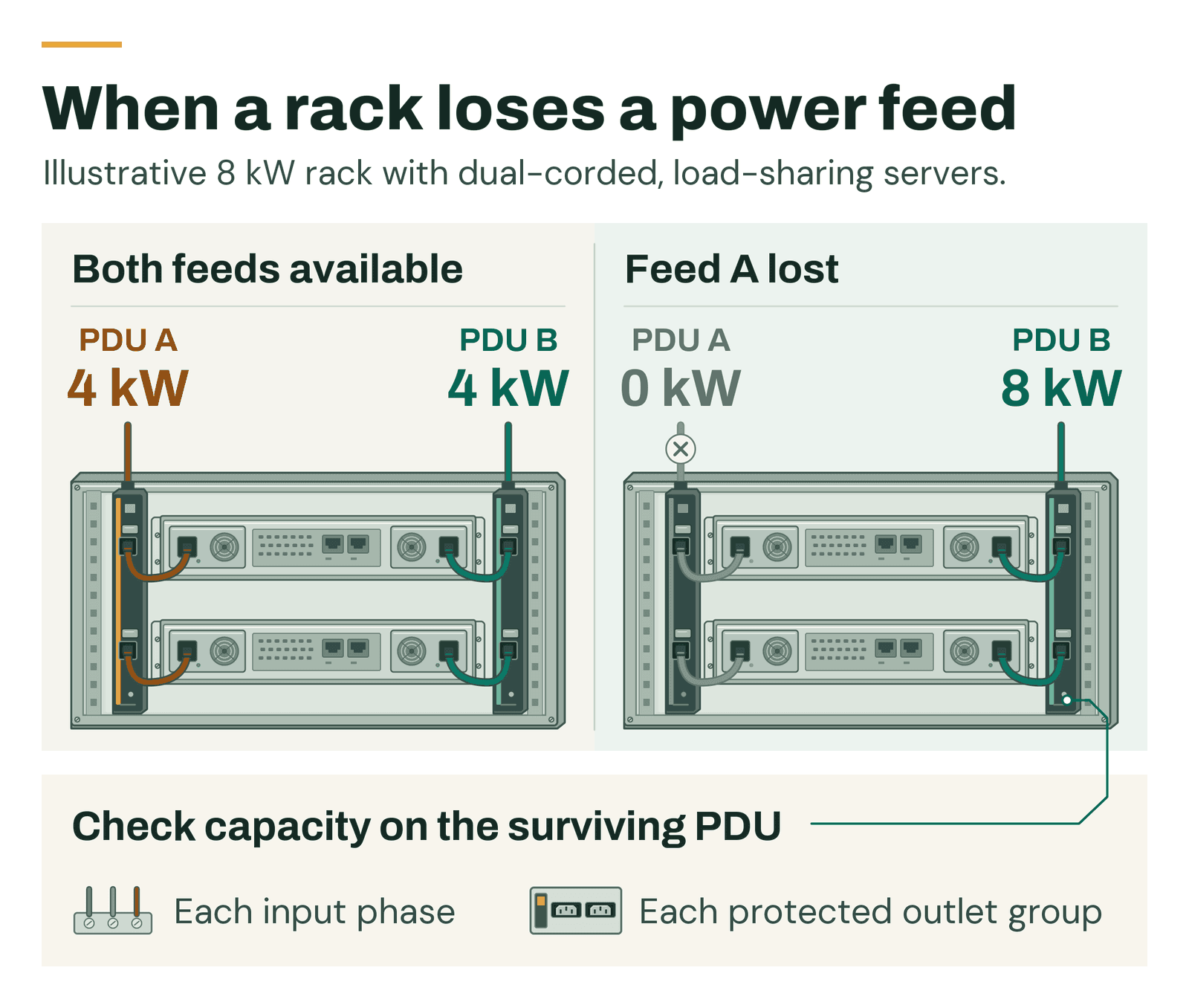
Then match the hardware to the rack: plug type, voltage and phase, 0U or 1U form factor, and the current rating of each outlet. Three-phase PDUs also need their loads balanced across the phases.
2. Do You Need to Meter or Switch Each Outlet?
Input metering answers the capacity question for the rack. Outlet metering answers it for each device, which matters for chargeback and for finding idle servers. Switching earns its cost where a reboot would otherwise need a site visit. Decide who is allowed to switch an outlet, because a remote off command can take down a server as easily as it can reboot one.
3. Which Software Will Read the PDUs?
Start from the monitoring or DCIM platform you run and ask which PDU models it supports natively. Then check the protocol list for the exact model. If chargeback or billing depends on the readings, ask for the accuracy standard behind the stated figure. If rack power measurements will also feed data center cooling optimization software, confirm that the metering source and reporting frequency meet the software's requirements.
4. How Will the PDUs Connect to the Network?
Two PDUs per rack across a hall add up to hundreds of switch ports and IP addresses. Cascading cuts the switch ports, and the vendors here state limits from 32 to 64 PDUs per connection. Some designs give each PDU its own IP address, and others put the whole chain behind one. Ask what happens to the chain when one PDU loses power, and keep PDUs on a segmented management network.
5. Who Keeps the Firmware Current and Tests the Alarms?
A networked PDU needs firmware updates for as long as it is in service. Ask whether updates are free, how they are delivered, and whether the controller can be replaced without dropping the load. Change default credentials before the PDU joins the management network, and test that an overload alarm reaches a person.
"A networked PDU is a small computer bolted to every rack, and it needs the same care as any other one," says Mike Ramsey, publisher of Reliable. "Put firmware updates, password changes, and a test of each alarm on the maintenance schedule the day the PDUs go in."
Also Considered
These vendors also sell intelligent rack PDUs.
Panduit: EL2P and ES2P intelligent PDUs. Panduit publishes a UL 2900-1 certificate for EL2P model E2V016A0 with software v1.4.1, and it shows an expiration date of January 30, 2027.
Eaton Tripp Lite series: Monitored and switched PDUs with Eaton's LX Platform network interface.
ATEN: Outlet-metered and switched eco PDUs in 0U and 1U sizes, with support for environmental sensors.
Austin Hughes: InfraPower W-series intelligent PDUs in monitored and switched versions, each with or without outlet measurement. Austin Hughes says daisy-chained PDUs share one IP dongle.
Rittal: Five PDU variants, from Basic to Managed, with the Managed version measuring and switching each output.
Synaccess: SynLink switched and monitored PDUs with an HTTP API and a three-year standard warranty, sold through Synaccess's own online store.
How We Evaluated
Independent editorial analysis based on publicly available vendor documentation, product and pricing pages, datasheets, dated press releases, dealer price pages, and standards-body pages, reviewed in November 2026.
Reliable does not sell rack power distribution units, installation services, or consulting and has no commercial interest in routing readers toward any particular vendor. Reliable does not accept payment for rankings. Vendors may sponsor enhanced listings with additional detail, but editorial rankings are independent. Read our editorial policy.
Six criteria shaped the ranking:
Use-case fit: the job each vendor's own pages put first.
Current availability: whether the vendor lists the product as current.
Metering and control: the measurements, accuracy, and outlet switching each vendor states.
Network and integration: ports, cascading limits, protocols, and software each vendor names.
Safety and security: the listings and certificates each vendor publishes.
Pricing and warranty: whether a US price is published, where, and the stated warranty term.
No analyst reports or review-site ratings were used. The ranking is by use case, and the number beside each entry only sets the order.
Honest Limitations
Specifications are vendor-stated. Accuracy, temperature ratings, cascading limits, and power ratings come from each vendor's product pages, data sheets, and brochures as of November 2026. A figure given for a product family may not apply to every model in it, and documents differ by region and date, so confirm each figure against the current data sheet for the model you are quoted.
Prices are examples. CyberPower's and Chatsworth's MSRPs are from their own sites in late November 2026, and the Raritan, Vertiv, APC, and Eaton figures are reseller listings for the part numbers named. The models differ in power, outlets, and metering, and a project quote will differ.
Accuracy figures carry conditions. A figure such as ±1% depends on the quantity measured, the load, and the test standard, and it may not meet the legal metering rules for tenant billing.
Products get renamed and replaced. Vertiv's Geist line became PowerIT, and APC's first-generation Advanced models gave way to Gen 2. Confirm that any model you are quoted is current and still receives firmware.
Standards are summarized here. The points on UL 62368-1, UL 2900-1, IEC 62443-4-2, and the 80% rule follow vendor and UL Solutions pages. The standards themselves carry more detail.
This is a buying guide. Circuit sizing, breaker coordination, and installation for a specific site belong with a licensed electrician or qualified engineer and the manufacturer.
Frequently Asked Questions
What is the best intelligent rack PDU for a data center?
It depends on the job. Legrand's PX4 and PRO4X fit outlet-level power quality work on outlet-metered models, Vertiv PowerIT fits upgradeable monitoring, and Eaton's G4 fits buyers who want a universal-input chassis. APC fits EcoStruxure IT sites, Chatsworth fits cabinets with electronic locks, nVent fits long cascaded rows, and CyberPower fits buyers who want a published price.
How well do Schneider Electric's rack PDUs integrate with existing data center management software?
Schneider's APC NetShelter Rack PDU Advanced reports to Schneider's own EcoStruxure IT software through its Network Management Card 3. APC describes access by web, SNMP, and command line, so monitoring tools that read SNMP can collect its data, though discovery and outlet control depend on the software. Sunbird lists APC among the vendors its Power IQ software supports out of the box. The Gen 2 models carry new part numbers, so confirm support for them with your software vendor.
Is a smart PDU the same as an intelligent PDU?
Yes. Vendors use smart, intelligent, networked, and managed for a rack PDU with a network connection. The words that change what you get are metered, monitored, and switched, and whether they apply to the whole unit or to each outlet.
How much does an intelligent rack PDU cost?
Example prices in this guide include a $1,200.00 MSRP for a CyberPower 1U single-phase unit and a $2,555.78 MSRP for a Chatsworth Switched Pro built for a 30 A circuit. Resellers list a managed Eaton G4 at $2,651.99 before its input cable and a 17.3 kW APC switched, metered-by-outlet unit at $6,353.00, against an MSRP of $8,035.00. The models differ in power, outlet count, and metering, so treat them as examples.
How accurate is the metering on an intelligent rack PDU?
Most vendors in this guide state 1% accuracy. Legrand states ±0.5% for the PX4 and PRO4X, and CyberPower gives ±1% on its Taiwan site for both models named here. If tenants are billed from the readings, ask which standard applies and whether the meter satisfies the legal metering rules where you operate.
Can an intelligent rack PDU run in a hot aisle?
Yes, within its rating. Legrand, Vertiv, Schneider, Eaton, nVent, and CyberPower state 60°C (140°F) for the models in this guide, and Chatsworth states 65°C (149°F) with load conditions. Vertiv applies the figure to its high-temperature models, so check the rating for the exact part number.
Related Guides
Explore our data center infrastructure resource center for independent buyer’s guides, engineering tools and technical resources covering infrastructure management, power distribution, cooling technologies and environmental monitoring.
Sources
Legrand: Raritan PX4 Rack PDUs data sheet (2026; Raritan technical specifications and warranty page, Server Technology PRO4X specifications, and reseller listing linked in the Legrand entry)
Vertiv: PowerIT Switched Rack PDU (US product page; brochures, model data sheet, warranty document, FAQ, and reseller listing linked in the Vertiv entry and later sections)
Schneider Electric: APC NetShelter Advanced Rack PDUs (US range page; product pages, firmware FAQ, and reseller listing linked in the APC entry)
Eaton: Rack PDU G4 (US product page; certificates and reseller listing linked in the Eaton entry)
Chatsworth Products: Switched Pro eConnect PDU data sheet (November 2026 revision; product page with MSRP linked in the Chatsworth entry)
nVent: Enlogic iPDU, Outlet Switched and Metered, EN6 Series (US product page; EN6883 spec sheet linked in the nVent entry)
CyberPower: PDU83105 Switched Metered-by-Outlet PDU (US product page with MSRP; PDU81001 page and Taiwan-site pages linked in the CyberPower entry)
Last updated November 27, 2026: first edition. This guide is editorial analysis by Reliable.