Best Data Center Battery Monitoring Systems in 2027
Last updated November 28, 2026.
Data Center Battery Monitoring System Comparison Table
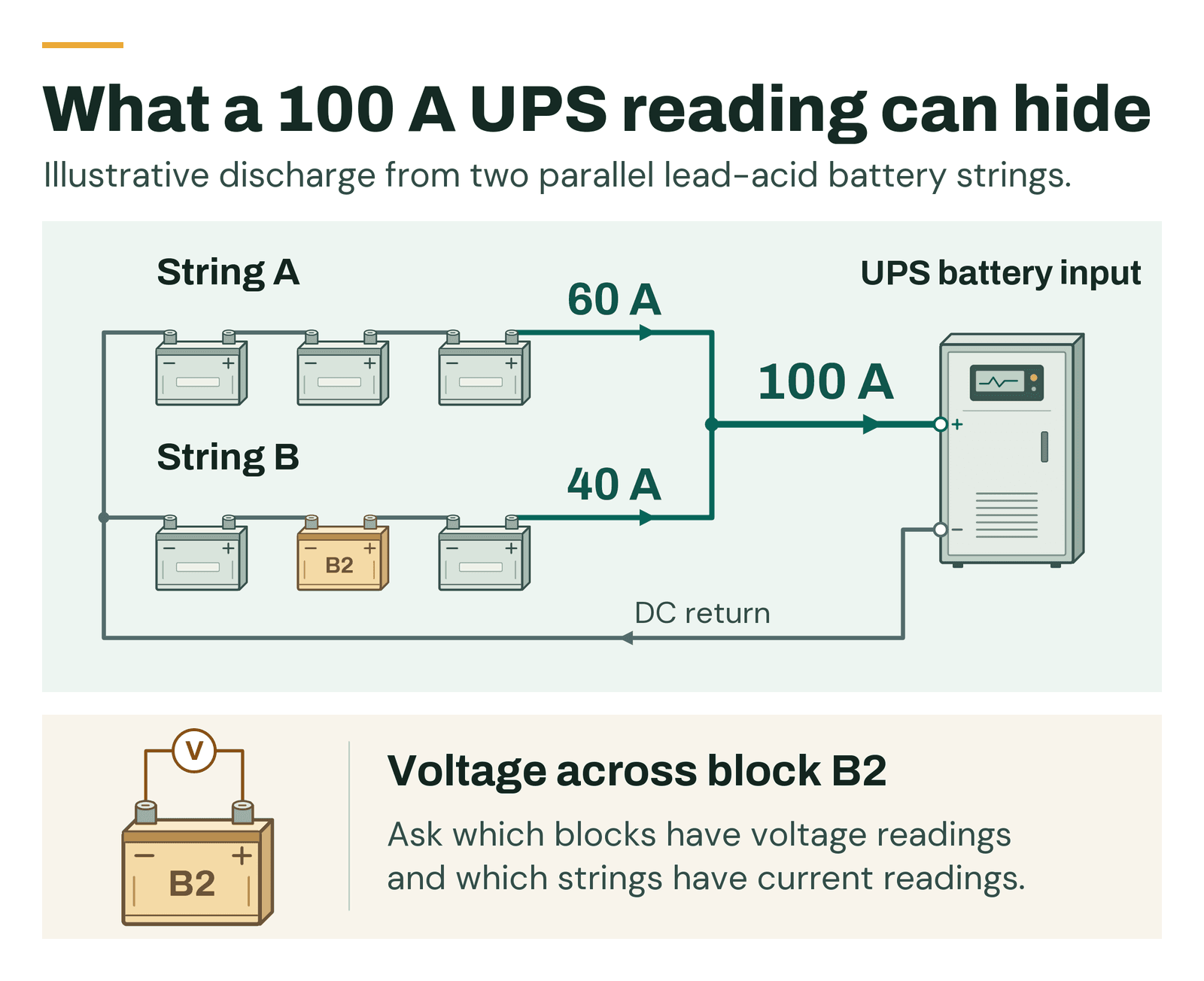
“Ask the vendor to show you which battery units are monitored, which strings are covered, and exactly what your team will see when a battery starts to deteriorate,” says Mike Ramsey, publisher of Reliable.
These are manufacturer-stated features and configuration limits, subject to model selection. A cell, a battery jar, a string, and a controller represent different purchasing units. Obtain a bill of materials sized for the actual battery plant, including sensor accessories, data integration, installation and commissioning.
6 Best Data Center Battery Monitoring Systems, Ranked by Use Case
1. NDSL Cellwatch: Best for Large Modular UPS Battery Installations
NDSL Cellwatch is a stationary UPS battery monitoring system best suited to large data centers that favor a modular architecture with electrically isolated fiber-optic communications between battery data collection modules. NDSL, which supplies Cellwatch, merged with RLE Technologies to form a new platform called Parameter.
The Cellwatch system manual, version 6.0 describes Data Collection Modules (DCMs) that acquire voltage and ohmic readings from four monitored points. Fiber links connect the DCMs to a control unit or thermal runaway controller. The controller communicates with an integrated Battery Monitoring Unit (iBMU) running Cellwatch software.
That architecture is particularly relevant to long battery rows where the installer must account for communications routing and electrical isolation. A buyer should have the integrator show the layout for each string, the proposed DCM types, the placement of controllers, and the consequences of a communications interruption. The battery connections and module power arrangements still require safe engineering.
Cellwatch can monitor individual unit voltage, ohmic value and temperature, depending on configuration. The system manual also describes discharge and recharge records, total string voltage, current and temperature monitoring. Ask which temperature channels are actually included on the quoted bill of materials, including whether each jar or a representative location is monitored.
For a large colocation or hyperscale estate, Cellwatch Central aggregates battery data across installations. NDSL also offers remote monitoring services with expert analysis, alerts and reporting. Buyers should distinguish the monitoring service agreement from field maintenance and emergency response obligations.
Not the best fit for: Operators whose IT security policy prohibits the Windows-based iBMU architecture described in the version 6.0 manual unless NDSL can supply an approved alternative. Confirm the supported operating system, patching arrangement, local and enterprise licensing, and remote access requirements before specifying it.
2. Vertiv Albér: Best for Liebert Cabinet Integration and Large VLA Strings
Vertiv Albér battery monitoring systems are best suited to data centers buying compatible Liebert UPS battery cabinets or maintaining large vented lead-acid (VLA) battery strings. Vertiv's data center battery monitoring portfolio also includes battery testing equipment and enterprise battery analysis software.
The Albér BDSUi and BDSU-50 brochure identifies two different installation options. BDSUi is designed for factory integration with compatible Liebert external battery cabinets, while BDSU-50 is a universal cabinet or open-rack installation for series-connected sealed battery modules. Both address 12 V and 16 V sealed batteries. The brochure dates from 2020 and names older Liebert UPS families, so confirm that the UPS and battery cabinet on the current order still offer factory-installed BDSUi.
The BDSU family performs scheduled DC resistance measurements alongside voltage, current and temperature monitoring. Its documentation also identifies connection-resistance monitoring, including selected inter-row connections and mid-string disconnects. This can be useful where a bad electrical connection would otherwise be investigated separately from deteriorating battery units.
For an existing flooded battery installation, Vertiv's BDS-256XL supports battery units from 2 V to 16 V and is optimized for 2 V VLA cells. Its published application limit is up to 256 cells per string. Compare that limit with the battery room schedule, including multiple strings and any sections separated by switching devices.
Vertiv lists Battery Xplorer and optional Battery Xplorer Enterprise for BDSU. The brochure also identifies network protocols, including Modbus, SNMP and BACnet. Specify the interface required by the facility's alarm platform and confirm the exact communication card, gateway and software entitlement.
Not the best fit for: Buyers intending to monitor an open-rack battery plant through the factory-integrated BDSUi model. Its specified mounting arrangement is inside compatible Liebert cabinets. Select BDSU-50, BDS-256XL or another appropriately engineered monitor for the actual installation.
3. PowerShield: Best for Mixed-Chemistry and Multi-Site Battery Estates
PowerShield8 is an enterprise stationary battery monitoring platform best suited to data center operators consolidating lead-acid, nickel-cadmium and compatible lithium-ion battery assets across facilities. The distinction between its direct lead-acid monitoring and lithium-ion integration is central to selecting the right system.
For lead-acid and Ni-Cd, the PowerShield8 hardware architecture uses battery-level mSensors, string-level Hubs and a controller. The sensors measure electrical and thermal properties at monitored blocks; the Hubs collect string measurements such as current and environmental data. Sensor models must be matched to battery type and voltage.
PowerShield lists up to 200 blocks for MX and up to 512 for LX and LX+ in its lead-acid hardware range. Those are controller limits rather than whole-campus limits. The earlier published lead-acid data sheet also identifies an important exception: its single 1 V Ni-Cd mSensor does not perform an ohmic measurement. Ask for the current sensor data sheet before specifying Ni-Cd monitoring.
For lithium-ion batteries, PowerShield8 for Lithium retrieves measurements and states from the battery's own BMS. PowerShield's controller stores and analyzes that data, including information associated with battery alarms. Integration depends on the battery BMS and the interface it exposes; confirm the proposed cabinet and model rather than assuming universal compatibility.
The software range includes Assure, a cloud platform for remote portfolio visibility, Link, Windows-based on-premises software, and a controller-level browser interface. These options give operators a choice between centralized supervision and local access. Require the vendor to identify which functions and retention policies apply to each software edition and service contract.
Not the best fit for: A lithium-ion UPS procurement that still needs the battery's primary protective BMS. PowerShield's lithium architecture relies on that upstream system for measurements. The monitoring layer should be specified alongside the battery maker's approved protection architecture.
4. BTECH: Best for Multiple Parallel Battery Strings
BTECH S5 is a stationary battery monitoring system best suited to data centers with multiple parallel lead-acid or nickel-cadmium battery strings that want individual-unit diagnostics and string-current monitoring within a common system.
The S5 technical brochure specifies support for up to 480 monitored units across eight strings per system. It covers compatible VLA, VRLA and Ni-Cd batteries, including 16 V VRLA units. S5 monitors unit and string voltages, impedance, current and selected temperatures under the configurations described in that brochure. The vendor's separate S5 product page describes comparison of impedance readings against baseline values.
Parallel strings deserve special attention because the condition of each current path matters. A common UPS measurement may provide an aggregate reading while a string's individual behavior remains obscured. Require each relevant string's current to be identifiable in the historian, including during charge and discharge. Check whether the proposed current transducers cover the installation's full operating range.
BTECH's brochure describes discharge event logging, Modbus TCP and SNMP. It also names the Windows-based BVM software and optional programmable relay-based charger or breaker control. Any proposed relay control needs a separate approved protection and operating philosophy, particularly where an automatic isolation would reduce the backup capacity available to critical loads.
The S5's scale makes it a candidate for consolidating monitoring equipment across a substantial battery room. A purchasing specification should require a schedule showing how the 480-unit and eight-string constraints are applied together. Include sensor modules, temperature coverage, field wiring and the BVM software configuration in the bid comparison.
Not the best fit for: A project that requires native lithium-ion pack supervision using this model. BTECH's S5 technical brochure identifies lead-acid and Ni-Cd as its target chemistries. Evaluate the lithium cabinet maker's interface and a specifically supported monitoring platform instead.
5. Eagle Eye Power Solutions: Best for Local UPS Diagnostics With Optional Browser Access
Eagle Eye PowerEye is a modular UPS battery monitoring system best suited to data center operators seeking local diagnostics with optional browser access and industrial communications for facility monitoring.
The PowerEye UPS BMS brochure specifies four strings per control module, with one string module and up to 120 battery monitoring units per string, for 480 units in total. It names VRLA, VLA and Ni-Cd battery types. The control unit records incoming data, and the brochure lists an embedded web server for browser access as an option.
The current product page lists a 1.2 to 12 V battery support range for the controller and a 1 to 16 V measurement range for the battery module. Its FAQ also mentions lithium-ion compatibility, beyond the chemistries in its technical specification. Obtain written confirmation of the exact battery voltage and chemistry before ordering, particularly for 16 V or lithium-ion units.
The system measures battery voltage, internal resistance and temperature, plus string-level and ambient measurements. Its product specifications describe a battery-mounted module and separate control and string monitoring modules. The distinction matters for installation: identify what must be installed on each monitored unit, what is shared by a string, and what is supplied at the controller level.
The PowerEye brochure lists Modbus RTU, SNMP, optional Modbus TCP/IP, PDF or Excel reporting and email alerts. The same brochure describes detailed charge and discharge records and a string voltage-balancing feature on the battery modules. Name the web server and any other optional features explicitly in the procurement specification, and verify the manufacturer's approved use of voltage balancing with the selected battery model.
For a facility with a small critical-power team, the optional browser interface can be a useful commissioning and troubleshooting tool. Central alerting and retention still need to be planned. Ask whether the control module stores the amount of history required by the operator and how that history is recovered following controller replacement.
Not the best fit for: Buyers requiring more than four monitored strings on a single controller or more than 120 monitored units on one string module. The PowerEye brochure limits each control module to four strings and each string module to 120 monitoring units. Request an engineered alternative for longer strings or a multi-controller quote for more strings, including how alarms and history are combined.
6. Franklin Electric: Best for Wireless Lead-Acid Battery Sensor Communications
Franklin Electric's CELLGUARD Wireless is a stationary battery monitoring system best suited to lead-acid UPS installations that want to reduce communications cabling between the individual battery sensors and a central receiver.
The CELLGUARD Wireless data sheet lists voltage, temperature, conductance measurements and strap resistance on supported sensor models. The same data sheet distinguishes sensor models with and without strap-resistance measurement. The sensor attaches to, and receives operating power from, the battery being monitored. The base coordinator collects sensor data and supports Modbus TCP/IP integration with the building infrastructure.
Franklin specifies support for up to 600 sensors per base coordinator, with up to 16 strings and 300 sensors per string. The total sensor limit still applies. The ordering notes allow one base coordinator for up to 16 strings on open racks in the same room, but call for one per enclosed cabinet.
The 2.4 GHz wireless sensor communications have a stated unobstructed range of 30 meters (98.4 feet). Metal cabinet doors, rack placement and interference make a site-specific signal test important.
The CELLGUARD Wireless data sheet identifies a built-in CONVERGE web interface and communication with UNITE battery asset management software. Buyers comparing new wireless equipment with existing Franklin systems should clarify the software edition, legacy hardware compatibility and migration support. Request current wired alternatives where the site requires hardwired communications.
For string measurements, the data sheet lists an optional voltage, temperature and current (VTC) unit. The data sheet also gives battery voltage-test intervals of 1 to 24 hours and conductance-test intervals of 1 to 30 days for the base coordinator. Confirm whether those intervals meet the required diagnostic coverage.
Wireless communications can simplify selected retrofit layouts. Local sensor connections remain necessary, and the sensor power draw must be appropriate for the battery and charging regime. Require the vendor to explain how loss of sensor communications is identified, how missed measurements are handled, and how a failed sensor is safely serviced.
Not the best fit for: Facilities with a policy requiring hardwired battery sensor communications or with cabinets that fail the wireless coverage acceptance test. The CELLGUARD Wireless design depends on a radio link. Request a compatible wired alternative and obtain a configuration-specific quote.
What Does a Data Center Battery Monitoring System Measure?
A data center battery monitoring system collects condition measurements from the stationary batteries that support uninterruptible power supplies (UPSs). For the power equipment itself, see Reliable's data center UPS comparison. The hardware typically includes sensors or measurement modules, a controller and a local or networked interface. For example, the PowerShield8 lead-acid architecture separates block-level measurements from string-level measurements and controller-level processing.
The purpose is to identify developing abnormalities between maintenance visits, preserve records of actual discharge behavior and help prioritize further investigation. A UPS alarm remains important, but the diagnostic question is more specific: which battery unit or string needs attention, what changed, and how quickly should someone respond?
The term battery can be ambiguous in a proposal. A cell is an electrochemical unit. A monobloc or jar may contain several cells within one container. A string is a series-connected set of cells or battery units, and a battery plant can have multiple parallel strings.
Drawings and sensor counts should consistently identify the actual monitored unit.
For each UPS, obtain the battery schedule and identify where the monitor will measure individual units, string voltage and string current. Then define the data required at each operating level. A system can have excellent individual-unit measurements and still omit information important to a facility's particular arrangement.
Match Monitoring Coverage to the Battery Installation
| Battery installation or purchasing requirement | Monitoring approach to consider | Confirm before ordering |
|---|---|---|
| Cabinet-mounted VRLA, new compatible Liebert UPS | Vertiv Albér BDSUi factory integration | BDSUi offered for the current UPS and cabinet model, approved battery modules, sensors included, commissioning ownership |
| Existing sealed lead-acid cabinets across several UPS brands | Cellwatch modular monitoring, BDSU-50, or compatible direct-monitoring alternatives | Unit voltage, access, wiring, protected controller supply, warranty approval |
| Large flooded VLA strings | Vertiv BDS-256XL, BTECH S5, or another compatible VLA monitor | Cell count, connection resistance, electrolyte-level needs, battery room conditions |
| Multiple parallel strings | BTECH S5 or another monitor sized by both string and sensor count | Individual current readings, discharge history, common-controller failure impact |
| Mixed lead-acid and lithium-ion estate | PowerShield8 with direct monitoring for compatible lead-acid units and BMS integration for lithium | Exact lithium cabinet protocol, accessible cell data, OEM protection retained |
| Battery rooms where communications cabling is difficult | Franklin CELLGUARD Wireless for compatible lead-acid batteries | RF acceptance with doors closed, coordinator per enclosed cabinet, power draw, stale-data alarm, security policy |
| Existing monitors from multiple suppliers | CPG Insight for Batteries or a validated enterprise aggregation layer | Compatible hardware, data rights, analyst response scope, retained local alarms |
The table is a starting point for a request for proposal. The battery supplier and electrical engineer should approve the final measurement, protection and installation design.
Battery Voltage, Resistance, Impedance and Conductance
Voltage is a useful measurement for detecting departures from the expected charging or discharge behavior of a battery unit. The overall string voltage provides context, but aggregate voltage alone can obscure variation between units. Ask the supplier for a trend of individual-unit voltages and a way to compare all units within the same string.
Resistance, impedance and conductance are related electrical measurements with different test methods. Some monitors apply a test to determine DC resistance; other systems measure impedance or conductance. Vertiv uses scheduled internal DC resistance testing, BTECH specifies impedance measurements, and Franklin's wireless system specifies conductance.
Treat results from different devices as separate measurement series until the battery supplier and instrument manufacturers establish comparability. The method, applied signal, test conditions and calibration can influence the result. A threshold defined using one instrument should be validated before being transferred to another instrument.
For practical maintenance, the buyer needs an appropriate baseline, repeatable measurements and an exception report. Require the monitor to preserve the historical identity of each battery position and the associated dates of replacement, inspection and testing. A replacement unit may need a new baseline even though its physical position remains the same. The BTECH S5 product description describes comparing each unit's internal impedance with baseline values.
Temperature is another important trend. A battery room's ambient temperature describes the local environment, while a battery-terminal measurement describes a different condition. Ask whether the system measures every monitored unit, selected pilot locations or only room temperature. Specify that distinction in the acceptance criteria.
Connection-resistance monitoring addresses a related failure mode. It can help draw attention to deteriorating electrical connections rather than the internal condition of a jar alone. Ask whether the monitoring system measures the exact connections of interest or requires supplemental equipment and periodic testing. Document how those results are associated with physical locations in the battery room.
Ripple measurements are worth discussing where the battery manufacturer or UPS supplier identifies excessive AC ripple as a concern. The PowerShield lead-acid architecture describes block ripple voltage and string ripple current measurements. Establish the relevant manufacturer limits and measurement method for the installed equipment before setting alarms.
Lead-Acid vs. Lithium-Ion UPS Battery Monitoring
For a valve-regulated lead-acid (VRLA) battery system, a permanently installed monitor commonly collects electrical and temperature readings at the jar or block level. The buyer should define unit-voltage coverage, battery temperature points, ohmic trending and string current. A trend-based maintenance process then determines which abnormalities warrant additional tests or inspection.
Thin plate pure lead (TPPL) technology also belongs within the lead-acid evaluation when the installed product is a lead-acid battery. EnerSys's DataSafe HX530T and HX600T announcement describes TPPL technology in its high-rate UPS battery range. Obtain the charging requirements and approved measurement methods for the exact battery model before choosing a monitor or transferring alarm settings from another lead-acid product.
Vented lead-acid batteries may introduce additional inspection and measurement needs. Confirm whether electrolyte-level sensors and connection monitoring are required and how those functions are supplied. Vertiv's stationary monitoring portfolio identifies an electrolyte-level sensor alongside its battery monitors. The engineer and battery maker should define the maintenance and monitoring scope for the particular plant.
For lithium-ion UPS batteries, the battery management system performs a different role. IEEE 2686-2024 describes a BMS in stationary energy storage as a component that includes active functions to protect the battery. The exact architecture, protection functions and communication interfaces depend on the battery cabinet and its intended application.
An external supervisory monitor can collect information from the battery maker's BMS, as described in PowerShield8 for Lithium. The lithium-ion battery's approved protective controls remain part of the primary battery system. Do not specify an external lead-acid resistance-monitoring system as a replacement for those functions.
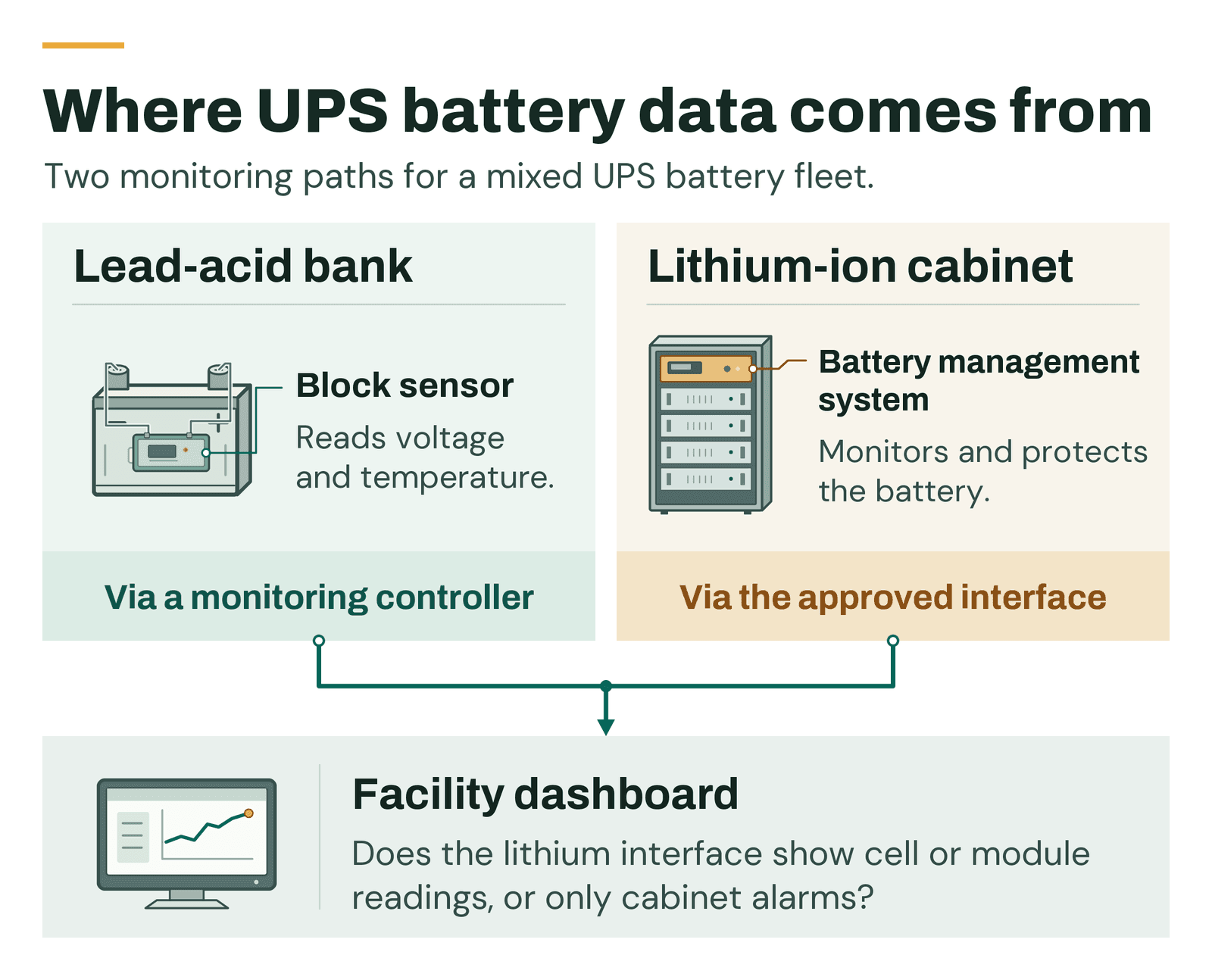
Ask the lithium battery vendor for the communication specification, the list of accessible measurements, alarms and status codes, and the interface approval. Some supervisory projects may only need cabinet-level alarms, while others require module-level or cell-level information. The external platform can present only the data that the upstream system makes available through the agreed interface.
The same approach applies to a mixed fleet that includes other chemistries, such as nickel-zinc. Require explicit approval for the battery chemistry, model and monitoring method. A product description that uses the phrase battery management system is insufficient evidence of compatibility with every stationary battery.
Can Battery Monitoring Replace Capacity Testing?
Permanent UPS battery monitoring and capacity testing serve complementary purposes. Monitoring supplies trends and event records between service visits. Capacity testing evaluates delivered battery output under defined test conditions. Megger's technical support discussion of stationary battery testing distinguishes the estimates obtained from impedance tests from discharge tests that measure actual string performance.
A state-of-health (SOH) indicator generated from ohmic readings is useful for prioritizing inspection. Its accuracy as an estimate of available capacity depends on the measurement method, battery characteristics and the algorithm. Ask the vendor to explain what its SOH score represents and whether the battery manufacturer supports that interpretation.
State of charge (SOC) addresses the estimated amount of charge available relative to an applicable reference. SOH addresses condition or degradation relative to a defined reference. Require the vendor to define both metrics and the underlying assumptions. A dashboard showing a healthy battery state still needs an agreed method of demonstrating that the UPS can carry the specified critical load for the required duration.
Discharge event recording can reveal differences in unit or string behavior during an actual outage or a planned test. Compare the voltage and current history with the conditions of the event. An incidental short outage may be valuable diagnostic evidence while providing limited evidence about the full required backup duration.
Keep battery inspections and appropriately planned capacity testing in the maintenance program. The current IEEE 1188-2025 recommended practice covers maintenance, testing and replacement of stationary VRLA batteries. The electrical engineer, battery maker and qualified service team should establish the procedures and any permitted changes to inspection or testing frequency for the specific installation.
“Battery monitoring gives you a reason to investigate a problem earlier. A planned testing program is still how you establish whether the battery system can do the job you bought it to do,” says Mike Ramsey, publisher of Reliable.
Integrating Battery Monitoring With EPMS, DCIM and the Building Management System
A dedicated battery monitor supplies the detailed condition information used by the critical-power maintenance team. An electrical power monitoring system (EPMS) provides facility-level electrical visibility, and a data center infrastructure management (DCIM) platform brings together broader physical infrastructure and capacity information. The data center power monitoring software guide compares products for those electrical monitoring responsibilities.
The battery monitor's controller should remain a useful source of local diagnostic information if an enterprise dashboard becomes unavailable. Define which system is responsible for detecting the alarm, storing the original event, notifying operators and recording the corrective action. Assign responsibility for monitoring the health of the monitoring system itself.
The acronym BMS also creates confusion in data center projects. It can refer to the building management system or the battery management system. Use the full name of each system in specifications and drawings, especially where a lithium-ion battery cabinet, building automation controls and EPMS coexist.
Specify the required data by name rather than simply asking for Modbus, SNMP or BACnet support. For example, PowerEye publishes Modbus RTU, SNMP and optional Modbus TCP/IP communications. An integrator still needs the supported register map or MIB, correct scaling, alarm meanings and configuration details for the exact model.
A useful interface should distinguish an alarm from a sensor reading that is unavailable or no longer current. Require a timestamp, units, equipment identity and data-quality status wherever the architecture supports them. Define a fallback alarm when the connection to a battery monitor or its controller is lost.
For multi-site operators, plan consistent naming across the battery monitoring system, the EPMS and the DCIM software. A maintenance technician should be able to move from an enterprise alarm to the exact battery cabinet, string and unit without translating between unrelated naming conventions. Preserve those identifiers when batteries are replaced or monitored positions are reassigned.
Battery Monitoring System Costs and Total Cost of Ownership
The relevant price is the installed cost of monitoring the specified battery plant, including the continuing costs of the system's operation. The ranked systems are engineered configurations. Request a US project quote from each supplier with the same battery schedule and coverage requirements. A price for one sensor or controller provides limited guidance on the cost of a complete installation.
Ask vendors to separate battery-level measurement modules, string sensors, controllers, cables, power supplies, mounts, network equipment and software. Include the labor needed for planning, approved installation, commissioning, integration and training. Require a schedule for future expansion so the price of adding a string or battery cabinet can be understood before construction begins.
Recurring costs may include software support, cloud services, remote monitoring, calibration or verification, field service, spare sensors and replacements for obsolete controllers. Request an itemized service agreement and a breakdown of which functions continue to operate if a subscription expires. Include the customer's own labor for managing alarms and maintaining the monitoring system.
A meaningful economic evaluation starts with the site's current maintenance costs and replacement policy. Estimate the work that monitoring could help redirect or schedule more effectively, subject to the approved maintenance program. Document the evidence needed to change battery replacement timing. Avoid budgeting for savings from eliminated tests until those changes are approved.
For colocation and enterprise operators, compare whether the proposed program offers enough visibility to plan replacement expenditure across facilities. Include the cost of retaining spare monitoring hardware and the effect of controller or sensor obsolescence. Request a process for retrieving historical data before migrating away from the system.
Standards, Safety and Commissioning Requirements
The appropriate technical guidance depends on battery chemistry and application. IEEE 1188-2025 is the active recommended practice for maintenance, testing and replacement of stationary VRLA batteries; IEEE identifies its publication date as October 19, 2026. IEEE 450-2020 addresses those activities for stationary vented lead-acid batteries.
The monitoring-specific IEEE 1491-2012 guide is listed as inactive-reserved by IEEE. The P1491 project is developing a recommended practice for monitoring stationary VRLA, VLA and Ni-Cd systems. IEEE's project scope places newer chemistries that use active management systems outside that proposed practice.
For stationary battery management systems used in energy storage applications, IEEE 2686-2024 addresses protective BMS design, configuration and interoperability. Confirm applicability with the engineer and equipment manufacturer. An IEEE recommended practice is technical guidance; binding requirements depend on the applicable code, contract, adopted standard and authority having jurisdiction.
Monitoring systems connect to equipment that can present serious electrical and chemical hazards. Selection of sensor isolation ratings, conductor protection, connection points, environmental suitability and safe work procedures belongs with a qualified electrical engineer and the manufacturer. Have the vendor identify the exact product safety listing and applicable conditions for each component of the quoted installation.
Treat an automatic trip or isolation function as a separately engineered decision. An alarm that leads to a human inspection and an output that disconnects a string have different consequences. The design must account for the critical load, remaining backup capacity, coordination with UPS protection and the site's approved emergency response plan.
Commissioning should demonstrate correct identification of every monitored unit and string, expected readings, alarm delivery, history retention and communications-failure detection. Plan tests with the UPS and battery service teams so they can be performed under approved conditions. Document the acceptance results and assign responsibility for correcting discrepancies before handover.
How to Choose a Data Center Battery Monitoring System
1. Which battery chemistry, unit voltage and string configuration do you have?
Begin with an accurate battery inventory. Record the manufacturer, model, chemistry, nominal unit voltage, series unit count, number of parallel strings, cabinet or open-rack arrangement, and UPS model. Include any older battery banks that must remain in service while newer equipment is installed.
Obtain written confirmation that the proposed monitoring devices support those batteries and their operating conditions. If a lithium-ion cabinet is involved, require the specific approved BMS interface. Compare the vendor's coverage against the full inventory so each installed configuration has a corresponding line in the quote.
2. How many monitored units and strings will the system need to accommodate?
Evaluate sensor counts, per-string constraints, controller limits and enterprise software capacity separately. For example, BTECH S5 supports up to eight strings and 480 units per system, while PowerEye supports four strings and 480 units per control module. The identical unit limit can conceal different controller requirements when the string count increases.
Include the anticipated expansion plan and any boundaries between independent power paths. Ask whether the hardware can expand without replacing existing modules and how the enterprise interface handles added systems. Keep an allocation of spare capacity appropriate to the site's engineering plan.
3. Can the system be installed without compromising the operating battery plant?
On a retrofit, have the electrical engineer and qualified service provider develop the installation and isolation plan. Ask the monitor vendor to supply an approved wiring and sensor layout, required access, cabinet clearances, protected controller supply and the installation sequence. Coordinate any work that affects the UPS redundancy or battery warranty with the responsible manufacturers.
Where communications wiring is difficult, compare a modular fiber-linked design with a wireless design. For wireless installations, require a coverage test under actual operating conditions. For new cabinets, investigate available factory-installed options and identify where factory responsibility ends and field commissioning begins.
4. Who will respond to battery and communications alarms?
Decide whether the site has the expertise and staffing to interpret battery trends internally. A multi-site organization may benefit from a centralized battery specialist or a service such as NDSL's remote monitoring. An operator with existing mixed monitoring hardware may instead evaluate CPG Insight for Batteries.
Specify response targets and escalation paths for warning, critical and communications-failure conditions. Define who can acknowledge alarms, modify limits or authorize work. A remote monitoring service agreement should identify the analyst's responsibilities and the party authorized to carry out electrical maintenance.
5. Which systems must receive battery data, and what security rules apply?
Write down the exact points that must appear in EPMS, DCIM or the building management system. Require an integration demonstration with the site's selected platform, including the handling of unavailable readings and loss of communication. Ask for the protocol documentation and the licensing and gateway requirements for each interface.
For security review, identify device and server operating systems, authentication, user roles, supported encryption, firmware updates, vulnerability disclosure and remote access. Establish responsibility for approving and installing updates. Compare local operation during a network interruption with the features that require a remote service or cloud connection.
6. What ongoing testing, service and lifecycle costs are included?
Ask the vendor to price the full monitored configuration and its expected support over the site's planned ownership period. Include replacement sensors, software, service, integration, future expansion and data migration. Review warranty terms, exclusions and manufacturer support arrangements for the quoted model and region.
For a small server room, compare full unit-level monitoring with UPS-provided diagnostics and an appropriate battery maintenance agreement. For a large multi-string installation, require the monitoring resolution and data history needed to investigate individual battery units. The appropriate investment depends on consequence of failure, test requirements, staffing and the actual battery plant.
Also Considered
CPG Beyond the Cloud. Insight for Batteries is a managed battery asset monitoring service that consolidates information from existing compatible monitoring hardware and includes analyst reporting. Evaluate it when the site wants ongoing specialist supervision across installed systems.
Eaton. The Brightlayer EPMS Battery Management feature is an enterprise software option for monitoring UPS battery information and organizing warranty records. Confirm the underlying sensing hardware and available points before treating it as a replacement for a dedicated monitor.
Schneider Electric. EcoStruxure IT SmartConnect provides remote operational and battery health visibility for compatible APC Smart-UPS equipment. Schneider's older US Battery Management range is listed as discontinued, so obtain a current supported hardware offer before specifying a dedicated replacement.
Megger. The BVM battery voltage monitor is designed for recording unit voltage during battery capacity testing with compatible load and test equipment. It suits periodic test programs alongside permanent battery diagnostics.
Hioki. The BT3554-50 is a portable battery tester for internal resistance and voltage measurements on lead-acid UPS batteries. It suits field maintenance and diagnostic follow-up when technicians need a handheld instrument.
EnerSys Alpha. Remote Battery Monitoring System Plus provides individual battery information for small outdoor UPS systems. Its application scope is different from the large stationary UPS installations emphasized in this ranking; consider it for compatible remote infrastructure.
How We Evaluated
Independent editorial analysis based on publicly available manufacturer product documentation, technical data sheets, user manuals and the published scope and status of relevant IEEE standards.
Reliable does not sell battery monitoring equipment, installation services, or battery monitoring consulting and has no commercial interest in routing readers toward any particular vendor. Reliable does not accept payment for rankings. Vendors may sponsor enhanced listings with additional detail, but editorial rankings are independent. Read our editorial policy.
The ranking emphasizes dedicated UPS battery monitoring hardware with documented individual-unit diagnostics. Each product was evaluated by its documented battery compatibility, measurement approach, string and sensor architecture, deployment options, integration capabilities and fit for the specified purchasing scenario. The ordering reflects use-case fit for data center operators. It does not establish a measured performance advantage in a standardized comparison test.
Supplier claims describe their own products and are commercially interested evidence. The guide uses those claims for documented functions and limits, with engineering confirmation required for the installed configuration. It excludes unsupported cost savings, battery life extension figures and failure-prediction percentages.
Honest Limitations
The vendors use different measurement methods and define battery health differently. Their published specifications cannot establish which system will predict a particular battery failure first. Obtain the relevant test method, calibration requirements and battery manufacturer guidance. No independent comparative field-performance dataset is presented here.
Published controller capacities are maximum configuration limits. Actual channel coverage, voltage constraints, equipment availability, service coverage, supported battery models and pricing require a project-specific quote. Current software and firmware versions may differ from those in earlier technical documents.
IEEE's public standard descriptions establish the scope and status of the documents. Obtain the full applicable standards and battery manufacturer procedures before changing the maintenance program. The guide does not establish the requirements of a particular jurisdiction or the compliance status of an installation.
Monitoring equipment can experience faults of its own, including failed sensors, stale data and interrupted communications. Establish a method to detect these failures and preserve appropriate maintenance and inspection procedures.
Equipment selection, sensor placement, battery connections, protection design and safe work procedures for a particular site belong with a qualified electrical engineer and the equipment manufacturers. Site-specific professional review is essential before using a monitor as part of a protective control system.
Frequently Asked Questions
What is the best UPS battery monitoring system for a data center?
The choice depends on the installation. Reliable's picks include Cellwatch for modular fiber-linked monitoring, Vertiv Albér for compatible Liebert cabinets and large VLA strings, and PowerShield8 for mixed fleets with compatible lithium-ion BMS integration. Start with the battery configuration and required monitoring coverage.
What is the difference between a battery monitoring system and a battery management system?
A battery monitoring system collects condition data, reports abnormalities and preserves trends. A battery management system may also actively protect the battery, as described in IEEE 2686-2024 for stationary energy storage. The terms overlap in vendor marketing, so specify the required measurements, protective functions and responsibilities explicitly.
Can a battery monitoring system predict UPS battery failure?
It can identify abnormal measurements and changes that may indicate deterioration. Ohmic measurements support condition assessment, but their ability to estimate performance is limited, as Megger's technical support discussion explains. Confirm diagnostic findings through the appropriate inspection and testing program.
Can I use the same monitoring system for lead-acid and lithium-ion UPS batteries?
Some platforms can supervise both using different architectures. For example, PowerShield8 uses direct lead-acid monitoring hardware and collects lithium-ion data from the battery BMS. Confirm the exact battery model and supported data interface, and retain the manufacturer's approved lithium-ion protection system.
How much does a data center battery monitoring system cost?
Request an installed project quote based on the actual number of battery units, strings, controllers, sensors and required software interfaces. Include commissioning, integration, support, expansion and ongoing service. The six ranked products are configurable systems; a controller-only price would be an incomplete purchasing comparison.
Does continuous UPS battery monitoring eliminate the need for load testing?
Continuous monitoring helps identify changes between tests. A capacity or discharge test measures battery output under defined conditions, as explained in Megger's comparison of impedance and discharge testing. Follow the battery manufacturer's procedures and applicable maintenance guidance, including IEEE 1188-2025 for stationary VRLA batteries.
Related Guides
Explore our data center infrastructure resource center for independent buyer’s guides, engineering tools and technical resources covering infrastructure management, power distribution, cooling technologies and environmental monitoring.
Sources
NDSL: Cellwatch Battery Monitoring System Installation and User Manual, Version 6.0
Vertiv: Albér BDSUi and BDSU-50 Battery Monitoring Systems brochure
PowerShield: PowerShield8 lead-acid and Ni-Cd monitoring architecture
Eagle Eye Power Solutions: PowerEye UPS BMS brochure
Franklin Electric: CELLGUARD Wireless Battery Monitoring System data sheet (FEGRID-0025)
Last updated November 28, 2026: introduces six UPS battery monitoring systems and compares monitoring architecture, battery chemistry, and integration requirements. This guide is editorial analysis by Reliable.