Best Optical Gas Imaging Cameras in 2026
Last updated November 27, 2026.
Optical Gas Imaging Camera Comparison Table
| Vendor and products | Best for | Detector and format | Target gases | Hazardous-area rating | Published price |
|---|---|---|---|---|---|
| Teledyne FLIR: G-Series (Gx320, G620, Gx620), GF77, G306, G343, G346, G304, G620a, Gx620f | One supplier from handheld LDAR to fixed monitoring | Cooled handhelds at 320 × 240 or 640 × 480; uncooled GF77; fixed and pan-tilt cameras | Hydrocarbons and VOCs; SF6, CO2, CO, and refrigerants on dedicated models | Class I, Division 2 and ATEX/IECEx Zone 2 on the Gx320 and Gx620; Zone 1 on the Gx620f and Gx620pt | No camera prices on FLIR's site; QL320 tablet $24,950.00; a US dealer lists the GF77 from $37,950.00 |
| Opgal: EyeCGas Multi, EyeCGas 2.0 Long Range (sold in the US by Thermo Fisher Scientific) | Methane, VOCs, and CO2 from one handheld | Cooled handheld, 320 × 240, with three replaceable filters | Methane, CO2, and more than 400 VOCs | Class I, Division 2 (non-incendive); ATEX and IECEx Zone 2 | No price on Opgal's or Thermo Fisher's site |
| Konica Minolta: GMP03, GMP02 | A light handheld with quantification built in | Cooled handheld, about 2.4 kg with battery | Methane and other hydrocarbons; quantifies methane, ethylene, and propane | None named on the GMP03 specification page | No price on its site |
| SLB: Aura OGI | Standardized surveys across many operators | Midwave infrared handheld, 640 × 512, with a remote tablet | Methane and other hydrocarbons | Class I, Division 2 and ATEX Zone 2 | No price on its site |
| Sensia: RedLook System with Mileva 33F and Caroline FY cameras (EPA MATM-018 and MATM-017); Mileva 33 handheld | Fixed cameras running an EPA-approved screening method | Fixed cameras, cooled Mileva 33F and uncooled Caroline FY, with detection software; cooled handheld | Methane and other hydrocarbons | Mileva 33 page says ATEX certified and shows no marking; confirm fixed models separately | No price on its site |
| Honeywell: Rebellion GCI Standard and Mini | Identifying gases across large sites | Fixed hyperspectral camera on a pan-tilt unit, listed at up to 1,700 m | 35 listed gases and mixtures; up to seven monitored at once on the Standard camera | "N/A" on the Standard and Mini data sheets; explosion-proof option on the Mini | No price on its site |
| Kuva Systems (Sensirion Connected Solutions): GCI360 (EPA MATM-016) | Daylight monitoring at unattended upstream sites | Fixed shortwave infrared camera on a mast with a wind sensor; works from sunlight | Methane and VOCs | General purpose, per Kuva's data sheet; IP65 enclosure | No price on its site |
"Buy the camera for the gas you have and the rule you answer to," says Mike Ramsey, publisher of Reliable. "A methane-band camera will not show an SF6 leak, and a camera that satisfies one regulation may fall short of the next one's test conditions."
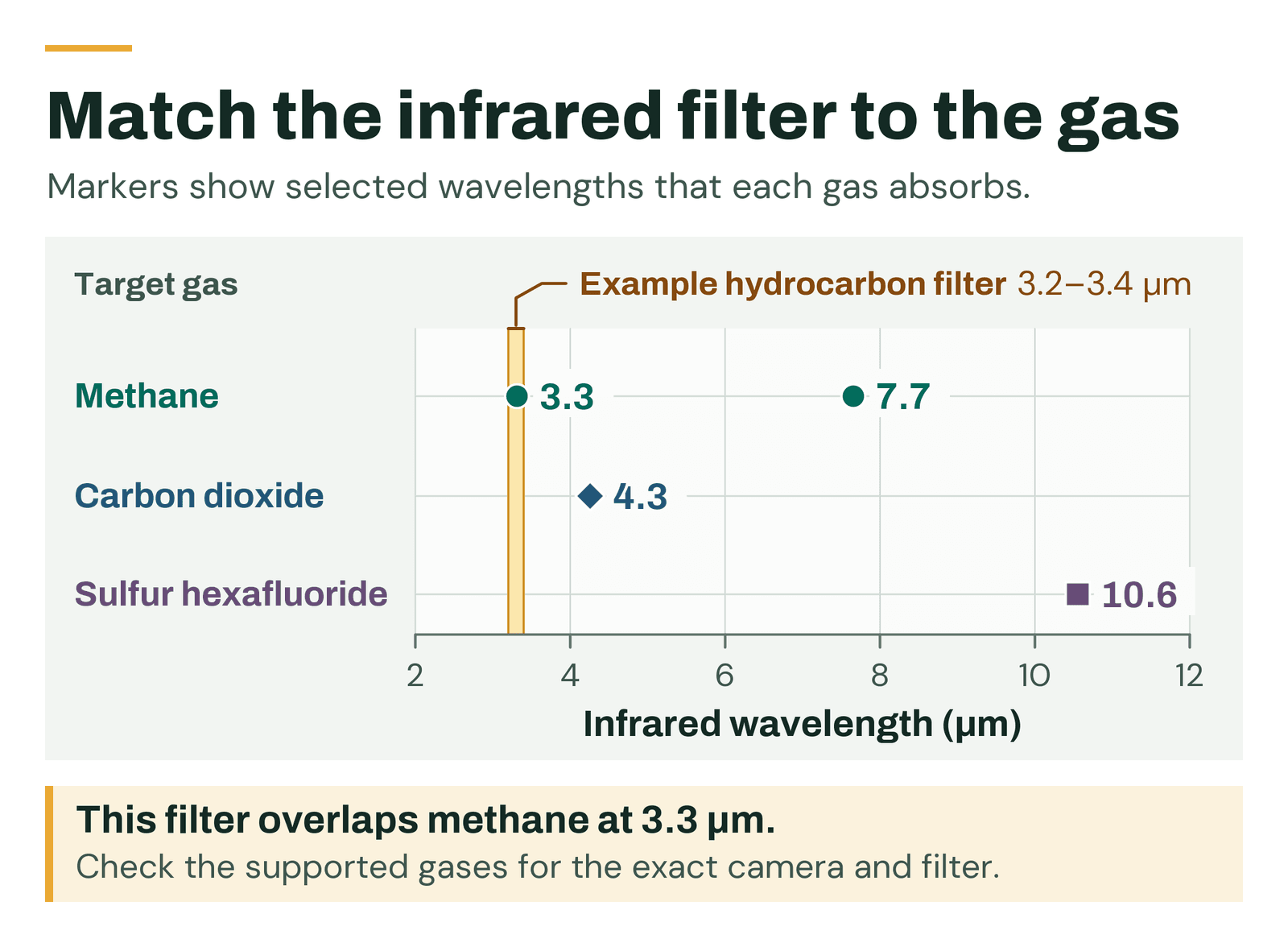
Methane absorbs near both 3.3 and 7.7 µm, so cameras with different filters can image the same gas.
7 Best Optical Gas Imaging Cameras for 2026, Ranked by Use Case
The ranking is by use case, and the number beside each entry only sets the order. Each entry is a vendor's product family. The first four are handheld cameras for leak detection and repair (LDAR) surveys, and the last three are fixed systems. Specifications, approvals, and compliance statements are as each vendor or EPA states them.
1. Teledyne FLIR: Best for LDAR Programs That Want One Supplier From Handheld to Fixed
Teledyne FLIR's G-Series is a family of cooled handheld optical gas imaging cameras best for LDAR programs that want one supplier across hydrocarbons, specialty gases, and fixed monitoring.
The Gx320, G620, and Gx620 image methane, other hydrocarbons, and VOCs in the 3.2 to 3.4 µm band. The G620 and Gx620 offer 640 × 480 resolution, and the Gx320 offers 320 × 240. FLIR lists the Gx320 and Gx620 for Class I, Division 2 and ATEX/IECEx Zone 2 areas. All three run quantification analytics inside the camera.
Dedicated models cover other gases: the G306 for SF6, the G343 for CO2, the G346 for carbon monoxide, and the G304 for refrigerants. The uncooled GF77 comes with LR or HR lenses. Its LR lens lists methane and selected refrigerants, and its HR lens lists SF6, ammonia, and ethylene. FLIR notes that the lenses require service calibration, so confirm the gas and lens combination when you order.
For fixed monitoring, FLIR sells the G620a, the hazardous-area Gx620f and Gx620pt, and the ADGiLE automated monitoring system.
A 2024 certificate linked from FLIR's optical gas imaging page names the Gx320, Gx620, G620, and fixed G620a, along with five legacy models, as independently tested against the OOOOa, OOOOb, and Appendix K sensitivity tests. The list leaves out the uncooled GF77 and the specialty-gas models. The QL320 quantification tablet, a separate accessory for the G-Series, is listed at $24,950.00.
Not the best fit for: Buyers who want to compare camera prices before a sales call, or long shifts on one battery. FLIR's site shows no prices for the cameras themselves. It lists G-Series battery life at more than 2.5 hours and a typical start-up time of 7 minutes. Its G306, G343, G346, G304, and GF77 pages name no hazardous-location rating.
2. Opgal: Best for Methane, VOCs, and CO2 From One Handheld
Opgal's EyeCGas Multi is a cooled handheld optical gas imaging camera best for teams that survey methane and VOCs and also need to image CO2 with the same instrument.
The camera has three operator-replaceable filters: a standard VOC filter, a long-range filter for heavier alkanes, and a CO2 filter. Opgal lists detection of methane, CO2, and more than 400 VOCs on a 320 × 240 cooled detector, with built-in quantification. Battery life is listed at more than 4.5 hours, and the camera weighs 2.6 kg.
In the United States the EyeCGas family is available from Thermo Fisher Scientific. The camera connects over Bluetooth to Thermo Fisher's TVA2020 analyzer for Method 21 work. The range also includes the EyeCGas 2.0 Long Range, CO and CO2 models, the EyeCGas Fly for drones, and the fixed Sentinuum24 system.
Opgal lists non-incendive certification for Class I, Division 2, plus ATEX and IECEx markings for Zone 2. Opgal states compliance with EPA OOOOa, OOOOb, OOOOc, and Appendix K and links third-party documents. The warranty is four years, with two years on the detector and cooler and one year on batteries.
Not the best fit for: Buyers who need 640-pixel resolution, or a camera rated for Division 1 or Zone 1 areas. The "intrinsically safe" label on the product pages refers to Ex ic protection for Zone 2, and the North American listing is non-incendive for Class I, Division 2. Neither Opgal nor Thermo Fisher shows a price.
3. Konica Minolta: Best for a Light Handheld With Leak Quantification Built In
Konica Minolta's GMP03 is a cooled handheld optical gas imaging camera best for crews that want leak detection and flow-rate quantification in one light unit.
Konica Minolta launched the GMP03 in the United States and Canada in October 2025. It weighs about 2.4 kg with its battery, and its technical report describes a cooled infrared sensor. Quantification runs in the camera, where the earlier GMP02 needed an external display device.
Quantification needs the distance to the leak, which a Bluetooth rangefinder can supply automatically. Standard quantifiable gases are methane, ethylene, and propane, with ethane, propylene, iso-butane, and n-butane optional.
The specification page lists detection of hydrocarbons from methane through octane, plus benzene, toluene, xylene, and methanol. The camera carries an IP54 rating, Wi-Fi and Bluetooth, and a battery life of about 2.5 hours.
The GMP02 remains in the range, along with a detection-only GMP02 Limited Edition for LDAR work. Konica Minolta describes the GMP02 as third-party tested to the NSPS OOOOa requirement and certified by Colorado as an Approved Instrument Monitoring Method.
Not the best fit for: Classified areas, or buyers who need the compliance paperwork for the newest model up front. The GMP03 specification page names no hazardous-location certification and no EPA test statement, and it shows no price. The OOOOa and Colorado statements are for the GMP02, so ask for a GMP03-specific test report.
4. SLB: Best for Standardizing Surveys Across Many Operators
SLB's Aura OGI is a handheld midwave infrared optical gas imaging camera best for companies that want every operator to run the same survey the same way.
The camera stores predetermined routes and uses RTK GNSS positioning and augmented reality targeting to steer the operator to each inspection point. A learning mode records an experienced operator's workflow and replays it on later surveys. A supervisor can watch and control the camera remotely from a tablet.
SLB lists 640 × 512 midwave infrared imaging and a gas enhancement mode. It states detection of methane leaks as small as 0.02 kg/h, a vendor figure given without test conditions. The camera is rated for Class I, Division 2 and ATEX Zone 2 areas, with IP54 protection.
ChampionX launched the Aura OGI in January 2023, and SLB now sells it alongside its drone, helicopter, and LDAR survey services.
Not the best fit for: Buyers who want temperature measurement or leak-rate quantification from the same camera. SLB describes a nonradiometric design that needs no annual calibration, and its product page names no quantification function. The page shows no price.
5. Sensia: Best for Fixed Cameras Running an EPA-Approved Screening Method
Sensia's RedLook System is a fixed optical gas imaging system best for operators that want automated leak screening under a method EPA has approved.
RedLook applies computer vision and machine learning to video from Sensia's fixed cameras. In 2026 EPA approved two configurations as methane alternative test methods for periodic screening under NSPS OOOOb: MATM-018 with the cooled Mileva 33F and MATM-017 with the uncooled Caroline FY. The Mileva approval letter, dated June 12, 2026, sets a 1 kg/hr screening threshold with component-level spatial resolution.
Operators must stay within the maximum wind speed and camera distance written into each method. The methods give detection limits at 90% probability of detection of 0.27 kg/hr for the Mileva 33F and 0.85 kg/hr for the Caroline FY. Those performance figures are separate from the 1 kg/hr regulatory threshold. Each approval covers the complete method as written, with the named camera.
Sensia also makes the handheld Mileva 33, a separate cooled 640 × 512 camera for the 3.2 to 3.4 µm hydrocarbon band with on-board flow-rate quantification. Sensia lists a minimum detectable leak rate of 0.4 g/h for pure methane, measured with a gas-to-background difference above 5°C and a quarter-inch orifice.
Not the best fit for: Continuous-monitoring compliance, or buyers who need the hazardous-area marking up front. EPA's approvals cover periodic screening. Sensia's Mileva 33 page says the camera is ATEX certified and shows no marking, certificate number, or price. Sensia is based in Leganés, Spain, and Texas-based Encino Environmental Services offers its cameras, so confirm who handles service, spares, and loaners.
6. Honeywell: Best for Identifying Gases Across Large Sites From a Fixed Camera
Honeywell's Rebellion Gas Cloud Imaging (GCI) system is a fixed hyperspectral camera best for large sites that want to know which gas is leaking as well as where.
The system uses snapshot hyperspectral imaging to identify the gas, show the plume on live video, and estimate its concentration. Honeywell's data sheet for the Standard camera lists 35 target gases and mixtures, with up to seven monitored at once. The list includes methane, ammonia, benzene, hydrogen sulfide, and sulfur dioxide.
The long-range version is listed at up to 1,700 meters and the wide-field version at up to 660 meters, on a pan-tilt unit with full rotation. Those are maximum ranges, and the reach for a given gas and leak size will be shorter. Alarms go out by email or text and over Modbus TCP/IP to a control system.
The smaller Mini GCI covers congested areas at up to 100 meters. Its data sheet lists up to three gases at once, or seven with an enhanced analyzer.
Honeywell sells the system with site mapping, installation, commissioning, training, and lifetime maintenance.
Not the best fit for: Component-level LDAR surveys, classified mounting locations, or a quick price. The Standard and Mini data sheets list hazardous-area approvals as "N/A". Honeywell offers an explosion-proof option on the Mini, so ask for the enclosure marking. EPA's list of approved methane alternative test methods had no Honeywell entry as of November 18, 2026, and Honeywell shows no price.
7. Kuva Systems: Best for Daylight Monitoring at Unattended Upstream Sites
Kuva Systems' GCI360 is a fixed shortwave infrared gas imaging camera best for unattended upstream and midstream sites that want automated methane monitoring in daylight.
The camera mounts on a mast beside a wind sensor and pairs a shortwave infrared sensor with a color camera. It images sunlight in the 2.2 to 2.4 µm band, where conventional OGI cameras rely on thermal contrast. Trained reviewers screen out false positives.
EPA approved the Kuva method, MATM-016, on October 2, 2025 for periodic screening in the 15 kg/hr category. The method reports 90% probability of detection at 15 kg/hr and 100 meters, from blind testing at Texas Tech University, with area-level spatial resolution. Screening frequency depends on site type, and the method sets monthly screening for most listed categories. The approval calls for the camera to sit within 100 meters of potential leak sources.
Kuva's data sheet reports a minimum detection limit of 0.25 kg/h and 90% probability of detection at 2.2 kg/h, from a separate blind test at the METEC facility. Cambridge, Massachusetts-based Kuva became part of Sensirion Connected Solutions in June 2025.
Not the best fit for: Sites that need detection at night, or cameras in classified areas. The approved method performs no periodic screening when shortwave infrared light is insufficient, which includes night, heavy precipitation, and thick cloud. Kuva's data sheet lists the camera as general purpose with an IP65 enclosure, and Kuva shows no price. Sites that need overnight coverage should add complementary monitoring and verify it separately.
How Does an Optical Gas Imaging Camera Work?
Optical gas imaging uses the way a gas absorbs infrared light to make an invisible plume visible. A conventional thermal OGI camera is filtered to a narrow band that the target gas absorbs. Gas between the camera and the background changes the infrared energy reaching the detector, and the plume appears on screen as moving smoke.
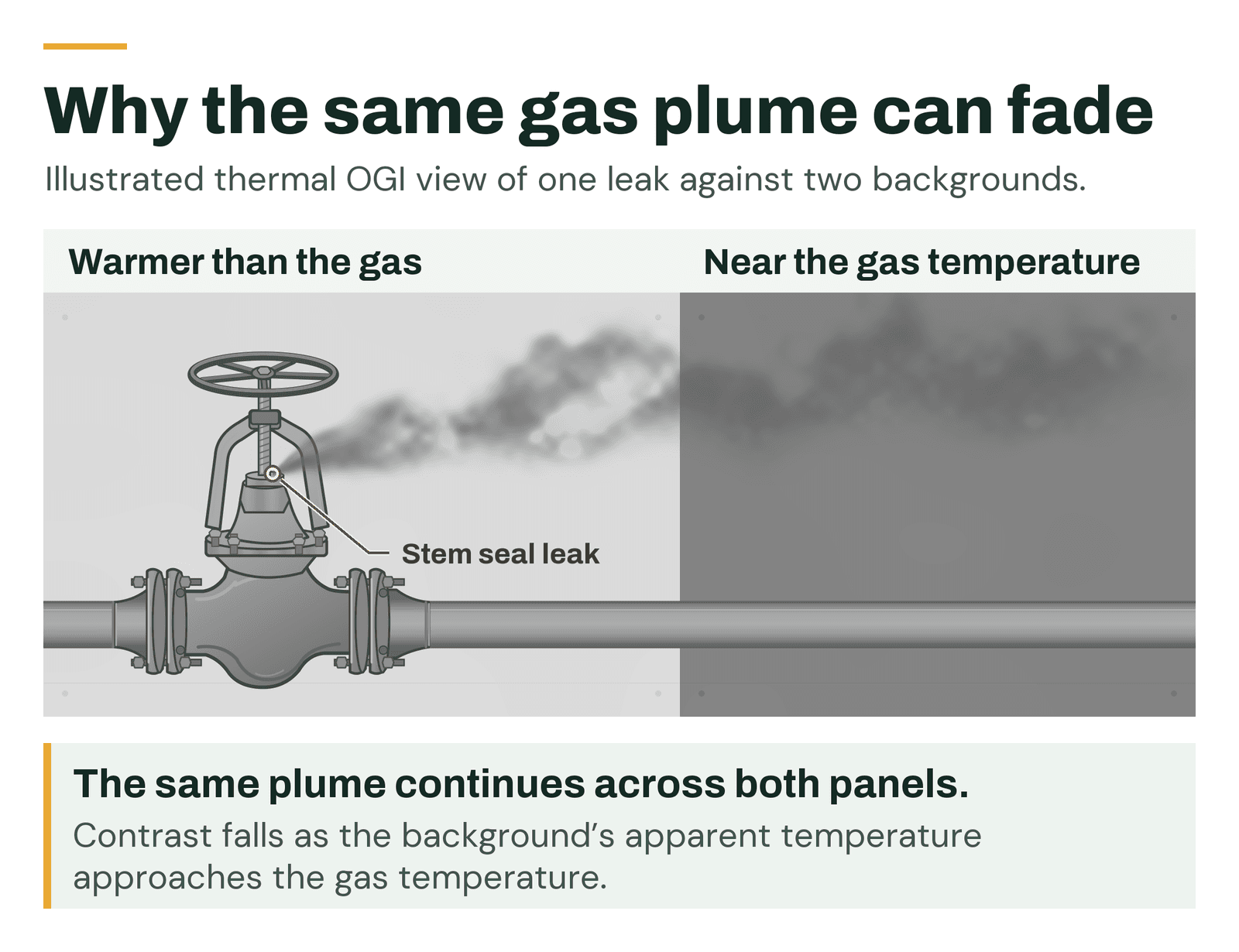
For a thermal camera, three conditions decide whether a leak shows. The gas must absorb in the camera's band. The gas and the background behind it need enough apparent temperature contrast, called delta-T. Wind and viewing distance must also stay within what the camera can handle.
Some fixed systems work differently. Kuva's camera images reflected sunlight in the shortwave infrared, and Honeywell's reads a hyperspectral signature to identify the gas.
Appendix K, EPA's OGI protocol, calls the limits on delta-T, wind, and distance the operating envelope. It also states that the protocol helps find the presence and location of leaks and is not for direct emission rate measurement.
Which Gas Needs Which Camera?
Each camera sees only the gases that absorb in its filter band, so the gas list comes first.
| Target gas | Infrared band | Cameras named in this guide | What to check |
|---|---|---|---|
| Methane and hydrocarbon VOCs | 3.2 to 3.4 µm on the FLIR and Sensia handhelds; 3.2 to 3.5 µm standard or 3.3 to 3.6 µm long-range filter on the Opgal EyeCGas Multi | FLIR Gx320, G620, and Gx620; Opgal EyeCGas Multi; Sensia Mileva 33. Konica Minolta's GMP03 and SLB's Aura OGI also image hydrocarbons, and their pages give no filter band | Which regulatory sensitivity test the model has passed, and in which configuration |
| Methane with an uncooled camera | 7 to 8.5 µm | FLIR GF77 with LR lens; GF77a and GFx77f fixed cameras | FLIR lists methane sensitivity under 100 ppm × m, well above its cooled figures, and its validation list does not name the GF77 |
| Methane by reflected sunlight | 2.2 to 2.4 µm shortwave infrared | Kuva GCI360 | Needs daylight and line of sight; no screening at night |
| Carbon dioxide | 4.2 to 4.4 µm on the FLIR G343; 4.1 to 4.4 µm on the Opgal EyeCGas Multi CO2 filter | FLIR G343; Opgal EyeCGas Multi with CO2 filter. Opgal also sells a dedicated EyeCGas CO2 | FLIR also images CO2 as a tracer gas on hydrogen-cooled generators |
| Carbon monoxide | 4.52 to 4.67 µm on the FLIR G346 | FLIR G346. Opgal also sells a dedicated EyeCGas CO | The G346 also lists nitrous oxide; the GF77 lists neither CO nor CO2 |
| SF6 and ammonia | 10.3 to 10.7 µm cooled; 9.5 to 12 µm uncooled | FLIR G306; FLIR GF77 with HR lens | Both also list ethylene. SF6 sensitivity is under 0.3 ppm × m on the G306 and under 1 ppm × m on the GF77 |
| Refrigerants | 8.0 to 8.6 µm on the G304; 7 to 8.5 µm on the GF77 LR lens | FLIR G304; FLIR GF77 with LR lens for R-134a and R-152a | Whether your refrigerant is on the camera's gas list |
Sensitivity in ppm × m is a path-integrated concentration, stated by FLIR at a delta-T of 10°C and 1 meter. It is a different measure from a leak rate.
What Do EPA Rules Require From an OGI Camera?
Federal rules test a survey camera in three ways, and a fourth provision covers automated systems. Each carries conditions and exceptions, so read the cited section for your facility.
Fugitive emissions surveys under NSPS OOOOa and OOOOb. At covered well sites and compressor stations, these surveys may use OGI or Method 21. Under 40 CFR 60.5397b, the camera must image the main compound in the expected emissions. It must also image a gas that is half methane and half propane at 10,000 ppm, at 60 g/hr or less from a quarter-inch orifice.
The operator, the manufacturer, or a third party may run that check. The monitoring plan must also cover daily verification, maximum viewing distance and wind speed, survey procedures, operator training, and camera maintenance. Under OOOOb, OGI or Method 21 surveys are at least quarterly at compressor stations and at well sites and centralized production facilities with major production and processing equipment, subject to exceptions. Other site types have their own schedules, and audio, visual, and olfactory (AVO) inspections run alongside.
Appendix K. Appendix K applies where a subpart calls for it. Under 40 CFR 60.5400b, OOOOb requires it for OGI surveys of process unit equipment at natural gas processing plants. The standard camera test uses methane at 19 g/hr and either n-butane at 29 g/hr or propane at 22 g/hr, at 2 meters with a delta-T of 5°C and wind of about 1 m/s or less.
Appendix K also limits OGI to gas mixtures the camera can image, and it sets operating envelopes, dwell times, rest breaks, operator training, and audits.
Alternative work practice. For equipment that other rules monitor with Method 21, 40 CFR 60.18 offers OGI as an option. The standard sensitivity level is 60, 85, or 100 g/hr, depending on monitoring frequency, with a daily instrument check. The equipment must still be monitored with Method 21 once a year.
Alternative test methods. Automated systems come in through 40 CFR 60.5398b, where EPA-approved methods may be used for periodic screening at a frequency set by the method's detection threshold. An annual OGI survey may still be required, and confirmed detections must be investigated and repaired. Continuous monitoring is a separate pathway in the same section, with its own requirements.
The rules are in motion. On October 29, 2026, EPA proposed giving gas processing plants under the older subparts OOOO, OOOOa, and KKK the option of surveying under Appendix K. That change is a proposal, and comments are due December 16, 2026.
"Read the vendor's compliance statement next to the rule it names," says Reliable publisher Mike Ramsey. "Ask for the third-party test report, the operating envelope, and the camera configuration it was tested in, and keep all three with your monitoring plan."
Cooled or Uncooled: Which Detector Do You Need?
Cooled cameras chill the detector with a small mechanical cooler, and in the hydrocarbon band they are usually the more sensitive choice. Uncooled cameras use a microbolometer and do best on gases they image strongly, such as SF6. The rules test performance and do not require a cooled detector, and Sensia's uncooled Caroline FY runs an EPA-approved screening method.
FLIR's own figures show the gap for methane. It lists sensitivity under 9.6 ppm × m for the cooled Gx320 and under 29 ppm × m for the G620. For the uncooled GF77 with the LR lens, the figure is under 100 ppm × m. All three are stated at a delta-T of 10°C and 1 meter.
Cooling has costs: FLIR lists a 7-minute start-up and more than 2.5 hours of battery life on the G-Series, against more than 4 hours on the GF77. A cooler is also a wearing part. Opgal warrants its detector and cooler for two years inside a four-year camera warranty. FLIR says the linear cooler in its fixed G620a supports 27,000 hours of non-stop operation.
Before you rely on any camera for a regulated survey, ask the vendor for a test report for that model and configuration. FLIR's validation list leaves out the GF77, and a FLIR webinar page from 2019 said the GF77 did not meet OOOOa requirements. Ask FLIR for its current position.
Handheld, Fixed, or Drone: Which Format Fits?
Handheld cameras do component-level work. An operator walks the unit, images each valve, connector, and seal, and records what leaks. Appendix K describes this kind of survey in detail, down to viewing each component from at least two angles.
Fixed systems monitor set views automatically and can catch intermittent releases between manual surveys. FLIR's ADGiLE, Opgal's Sentinuum24, Sensia's RedLook, Honeywell's Rebellion GCI, and Kuva's GCI360 all work this way. Coverage depends on the detection principle, line of sight, weather, and scan cycle. Thermal systems can run day and night, and Kuva's sunlight-based camera screens only in adequate daylight.
For a fixed system to stand in for periodic surveys under OOOOb, it needs an EPA-approved alternative test method. EPA's list of approved methods included Sensia's RedLook methods at a 1 kg/hr threshold and Kuva's at 15 kg/hr as of November 18, 2026. Both are approved for periodic screening. Those thresholds set screening obligations and are not directly comparable measures of the cameras' minimum detectable leak rates.
An approved method comes with duties. The operator follows the method's conditions, investigates and repairs confirmed detections, and runs an annual OGI survey where the rule's tables require one.
Drone payloads reach tank tops, flare tips, and pipe racks without scaffolding. Opgal sells the EyeCGas Fly, and SLB runs drone and helicopter OGI surveys as a service. Reliable's industrial inspection drone guide covers the aircraft.
How OGI Compares With Acoustic Imaging and Fixed Gas Detectors
The three tools answer different questions.
An OGI camera sees gas by infrared absorption. It works on low-pressure leaks and vents, provided the gas absorbs in the camera's band and the scene gives enough contrast. It shows where the gas is coming from.
An acoustic imaging camera hears the ultrasound from a turbulent, pressurized leak, whatever the gas, as long as the sound stands out from background noise. Quiet or low-pressure releases can be missed. EPA's list now includes a method built on Distran's Ultra Pro X, approved on November 17, 2026 for periodic screening below 1 kg/hr.
A fixed gas detection system measures gas concentration at a point or along a beam, and it can drive alarms and shutdowns when it is engineered for that job. It monitors continuously, and pinpointing the leaking component usually takes further investigation. An OGI camera is no substitute for required gas detection.
What Does an OGI Camera Cost?
Few prices are public. The seven vendors' own sites show no US prices for cooled cameras or fixed systems, so budgeting starts with a quote.
Two published figures give a sense of scale. FLIR lists the QL320 quantification tablet, a separate accessory for its G-Series, at $24,950.00. US dealer Global Test Supply lists the uncooled FLIR GF77 from $37,950.00 with one lens to $62,950.00 with four, as of late November 2026.
Plan for the costs around the camera as well:
Training. MFE Inspection Solutions lists a three-day OGI certification course from the Infrared Training Center at $2,500.00. A course covers the classroom side, and Appendix K adds field hours and audits.
Field hours. Appendix K requires at least 30 survey hours of field training with a senior operator, plus a final test.
Method 21 equipment. Sites that use the alternative work practice still need an analyzer for the annual Method 21 check.
Service. Ask each vendor for cooler service intervals, loaner terms, and turnaround time.
Fixed systems. Ask what the quote includes for towers, installation, software, and image review, and which fees recur.
How to Choose an Optical Gas Imaging Camera
1. Which Gases Do You Need to See?
List every gas you need to find before you look at cameras. A hydrocarbon camera filtered to 3.2 to 3.4 µm shows methane, propane, and many VOCs, and it will not show SF6, CO2, or carbon monoxide. For CO2, look at FLIR's G343 or the CO2 filter on Opgal's EyeCGas Multi, and for carbon monoxide, FLIR's G346 or Opgal's EyeCGas CO. For SF6, look at FLIR's G306 or the GF77 with its HR lens.
2. Which Rule Sets the Camera's Performance?
Name the regulation before you ask for a quote. A fugitive survey under OOOOa or OOOOb needs the 60 g/hr test, and process unit surveys at a gas processing plant under OOOOb need the Appendix K test and an operating envelope. State programs keep their own lists of approved instruments. Ask each vendor for a test report that matches your rule, model, and configuration.
3. Will the Camera Go Into a Classified Area?
Check the area classification of every unit you plan to survey. FLIR presents the Gx320 and Gx620 as its hazardous-location handhelds, and Opgal's EyeCGas Multi and SLB's Aura OGI list Class I, Division 2 and Zone 2 ratings. Konica Minolta's GMP03 page names none, and Kuva's data sheet lists general purpose. Match the exact marking, gas group, and temperature class to the site, and involve your safety department before any camera enters a classified area.
4. Do You Need a Survey Tool, a Continuous Monitor, or Both?
A handheld camera finds the leaking component. A fixed system can detect events between surveys and record when they were detected. If you want a fixed system to count toward federal monitoring, start from EPA's list of approved methods and read the threshold, screening frequency, and conditions in each approval.
5. Who Will Run the Camera, and Where Do the Findings Go?
Plan the people and the records along with the hardware. Where the applicable rule or protocol requires it, operators need training, documented practice, and periodic audits. The governing rule sets the leak records and repair deadlines, and good practice adds a work order in the CMMS and a rescan after the repair.
"The operator matters as much as the detector," says Mike Ramsey, publisher of Reliable. "Budget for training, audits, and practice hours when you budget for the camera, because a rushed survey with a good camera still misses leaks."
Also Considered
MultiSensor AI. Its Mirage HC is a cooled 640 × 512 hydrocarbon camera for fixed mounting or drones.
MFE Inspection Solutions. The MFE Detect MW is a 640 × 512 midwave handheld that also mounts on Boston Dynamics' Spot robot. MFE sells a drone payload version, the MFE OGI 640.
Sierra-Olympia Technologies. Its Ventus OGI is a 640 × 512 camera core for integrators. Freefly sells it as a gimbal payload for the Astro drone.
AerialOGI. The AerialOGI-N module moves between a handheld grip and a drone gimbal. It is built on Teledyne FLIR's Neutrino LC OGI camera core.
Fluke. Fluke's US site marks the Ti450 SF6, a thermal imager with an SF6 gas mode, as discontinued.
SLB Methane Lidar Camera. This laser-based imager is a different technology from OGI. EPA approved it as an alternative test method on August 19, 2025.
Distran. The acoustic camera maker's Ultra Pro X is the basis of an EPA-approved screening method.
How We Evaluated
Independent editorial analysis based on publicly available vendor documentation, product and pricing pages, datasheets, dated press releases, and standards-body and regulator pages, reviewed in November 2026.
Reliable does not sell optical gas imaging cameras, leak detection services, or consulting and has no commercial interest in routing readers toward any particular vendor. Reliable does not accept payment for rankings. Vendors may sponsor enhanced listings with additional detail, but editorial rankings are independent. Read our editorial policy.
Six criteria shaped the ranking:
Use-case fit: the survey or monitoring job each vendor's own pages put first.
Target gases: the gases and filter bands each vendor lists.
Detector and format: cooled or uncooled, and handheld, fixed, or drone.
Regulatory evidence: sensitivity test statements and EPA approvals as each vendor or EPA publishes them.
Hazardous-area ratings: the markings each vendor lists for each model.
Pricing transparency: whether a US price is published and where.
No analyst reports or review-site ratings were used. The ranking is by use case, and the number beside each entry only sets the order.
Honest Limitations
Specifications are vendor-stated. Sensitivity, range, resolution, and battery life come from each vendor's product pages and data sheets as of November 2026. Leak rates, detection probabilities, ppm × m figures, and regulatory thresholds are different measures, so this guide does not rank cameras on one number.
Compliance statements are the vendors' own. Third-party validation is as each vendor describes it, and a camera that passes a sensitivity test is one part of a compliant monitoring program. Ask for the test report and the operating envelope for the exact model, lens, and operating mode.
Regulations are summarized here, and they are changing. The summary covers federal rules as codified in late November 2026 and one pending proposal. Applicability depends on the facility, its equipment, and its construction date. State rules, permits, and consent decrees add requirements, and rules outside the United States are left out.
Prices are scarce. The FLIR QL320 price is from FLIR's site, and the GF77 figures are dealer listings from late November 2026. Quotes will differ.
Ratings vary by model. Hazardous-area markings are as each vendor lists them and change with the model and configuration. Ask for the certificate.
This is a buying guide. Camera selection, survey design, and work in classified areas belong with your environmental compliance lead, a qualified engineer, and the manufacturer.
The field is wider than seven. Drone payload makers, camera core suppliers, and service companies also work in optical gas imaging, and several appear under Also Considered.
Frequently Asked Questions
What is the best optical gas imaging camera?
The best choice depends on the job. For handheld LDAR surveys, Teledyne FLIR's G-Series comes from a broad range, Opgal's EyeCGas Multi covers methane, VOCs, and CO2, Konica Minolta's GMP03 builds in quantification, and SLB's Aura OGI guides operators. For fixed monitoring, consider Sensia, Honeywell, and Kuva Systems, which works in daylight.
Can an optical gas imaging camera detect hydrogen?
Conventional infrared OGI cameras do not image hydrogen directly, because hydrogen's infrared absorption is extremely weak. For hydrogen-cooled generators, FLIR's method is to image CO2 used as a tracer gas with its G343 camera, under a procedure suited to the equipment. Acoustic imaging cameras can find pressurized hydrogen leaks by sound when the leak is loud enough.
Can an OGI camera measure the size of a leak?
A standard OGI camera shows where gas is leaking. Quantitative optical gas imaging, or QOGI, adds analytics that estimate a leak rate from the image. FLIR's G-Series and Konica Minolta's GMP03 run it in the camera, and Opgal and Sensia list built-in quantification. Treat the result as an estimate: EPA's Appendix K states that its protocol is not for direct emission rate measurement.
Does an OGI camera replace Method 21?
It depends on the rule. For the fugitive emissions surveys in NSPS OOOOa and OOOOb, operators may use either OGI or Method 21. Under the alternative work practice in 40 CFR 60.18, OGI can take the place of routine Method 21 monitoring on covered equipment, and that equipment still needs a Method 21 check once a year. Other provisions set their own methods.
Are optical gas imaging cameras intrinsically safe?
Some are approved for particular hazardous locations, and the protection method differs by model. FLIR's Gx320 and Gx620, Opgal's EyeCGas Multi, and SLB's Aura OGI list Class I, Division 2 or Zone 2 ratings, and FLIR's fixed Gx620f and Gx620pt list Zone 1 markings. A Division 2 or Zone 2 rating does not cover Division 1 or Zone 1 areas. Match the exact marking, gas group, temperature class, and accessories to the site's classification before use.
How much training does an OGI camera operator need?
Appendix K's standard initial training includes classroom instruction, at least 30 survey hours of field training, and a final test of at least 2 survey hours. A senior operator must have at least 1,400 survey hours, including 40 in the past 12 months, and must have completed or developed the classroom training. Audits normally follow twice a year, at least three months apart, with a classroom refresher every two years. The protocol makes allowances for prior training and experience.
Related Guides
Best Thermal Imaging Cameras for Industrial Use: An Independent Comparison
Best Drones for Industrial Inspection: An Independent Comparison
Sources
Teledyne FLIR: G-Series Optical Gas Imaging Cameras for Hydrocarbons (specifications; also the GF77, G306, G620a, QL320, and optical gas imaging pages and the 2024 validation certificate)
Opgal: EyeCGas Multi (specifications, certifications, and warranty; also Thermo Fisher Scientific's product page)
Konica Minolta: GMP03 Specifications (also the GMP03 technical report, launch announcement, and GMP02 pages)
SLB: Aura OGI Handheld Optical Gas Imaging Camera (features and ratings)
Honeywell: Rebellion Gas Cloud Imaging Standard Camera Data Sheet (range, gases, and approvals; also the Mini data sheet)
U.S. Environmental Protection Agency: Oil and Gas Alternative Test Methods (approval letters and methods for Sensia, Kuva Systems, SLB, and Distran)
Code of Federal Regulations: Appendix K to 40 CFR Part 60 (also 40 CFR 60.18, 60.5397a, 60.5397b, 60.5398b, and 60.5400b)
Last updated November 27, 2026: first edition. This guide is editorial analysis by Reliable.