Best Portable Gas Detectors for 2026: An Independent Comparison
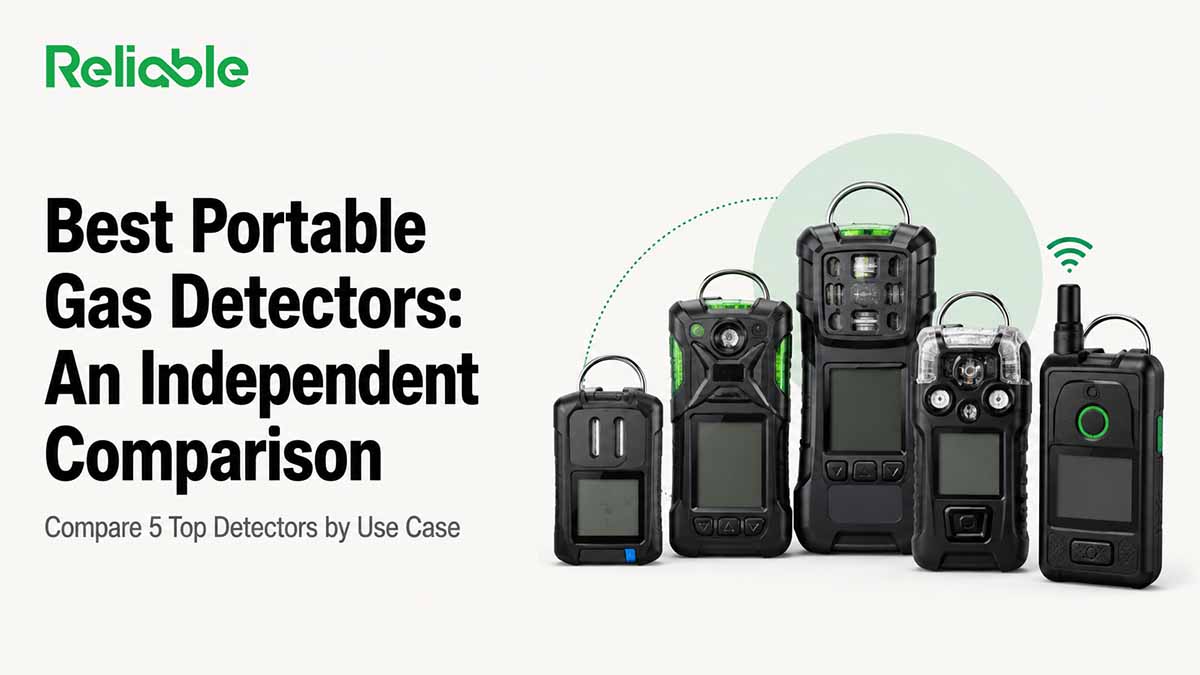
The Short Version: For an everyday personal 1 to 4 gas detector that does not require a cellular subscription, the Dräger X-am 2800 is the pick. For a connected 1 to 4 gas wearable that ships with cellular and requires MSA Grid, the MSA ALTAIR io 4 fits. For a wearable multi-gas detector managed through IntelliDoX and Safety Suite, the Honeywell BW Flex is the match. For a personal 5-gas detector that adds optional pumped pre-entry sampling, the Industrial Scientific Ventis Pro5 is built for it. And for a connected portable multi-gas detector with published per-device pricing, the Blackline Safety G8 Portable Multi-Gas Detector is the option that puts a number on the page. Before choosing, confirm the exact sensor set, connectivity path, and hazardous-area approvals against each vendor's own product page, because the ranked SKU is not always the family's headline spec. These are portable gas detectors, not a CMMS, EAM, EHS platform, or permit-to-work tool: for the software layer that manages incidents and compliance, see Best EHS / Safety Management Software and Best Permit-to-Work and LOTO Software.
How We Evaluated
This guide is independent editorial analysis based on publicly available product documentation. Reliable Magazine does not sell portable gas detectors and has no commercial interest in routing buyers toward any particular platform. Reliable does not accept payment for rankings. Vendors may sponsor enhanced listings with additional detail, but editorial rankings are independent. Read our editorial policy.
We evaluated each platform across six criteria that matter for a portable gas-detector buy:
Safety job - personal single-gas, personal multi-gas, pumped sampling, connected detector, or a combination
Hardware named - the specific portable detector named on the cited hub
Connectivity - cellular, BLE, Wi-Fi, docking, satellite, or not stated
Approvals / standards named - ATEX, IECEx, CSA, UL, or none named on the cited hub
Who it is for - plant EHS, confined-space teams, field crews, industrial sites
Price - a published list price, or not
These five products overlap more than their names suggest. Several vendors list a diffusion wearable for confined-space work. A pump is for remote or pre-entry sampling, not a requirement to wear a diffusion monitor in a confined space. Several also offer connected live monitoring, though the path ranges from a Bluetooth gateway to a built-in cellular modem to an optional battery pack. Where a ranked page names one job and the wider family names another, this guide holds to the ranked page.
5 Best Portable Gas Detectors for 2026, Ranked by Use Case
1. Dräger X-am 2800: Best for an Everyday Personal 1–4 Gas Detector without a Required Cellular Subscription
The X-am 2800 is Dräger's personal air-monitoring instrument for 1 to 4 gases, with four sensor ports covering flammable gases and vapours plus O2, CO, and a toxic channel of H2S, NO2, or SO2.
It runs as a diffusion wearable with Bluetooth, and live monitoring is possible through Dräger Gas Detection Connect, either the smartphone app or a ConHub gateway, rather than a cellular modem inside the detector. There is no internal pump; sampling and clearance work run through the optional external X-am Pump. For hazardous areas, the product page names ATEX, IECEx, and c CSA us Class I Division 1, including approval for use in Ex zone 0. IP 68 is an enclosure-protection rating. It docks through the X-dock station and a bump test station.
For a plant that wants a rugged clip-on 4-gas without committing every worker to a monthly cellular plan, this is the straightforward personal monitor.
Best for: an everyday personal 1 to 4 gas detector without a required cellular subscription.
Starting price: not published. Dräger does not list a public price for the X-am 2800.
2. MSA ALTAIR io 4: Best for a Connected 1–4 Gas Wearable that Requires MSA Grid
The ALTAIR io 4 is MSA's connected personal wearable, configurable for 1 to 4 gases on the XCell sensor platform. U.S. part numbers ship with LTE-M USA cellular out of the box. LTE-M/2G Global (Excluding USA) is a separate SKU.
Every io 4 includes and requires an MSA Grid account, the cloud platform the device reports to, and MSA+ is the optional subscription that wraps hardware and software together as an alternative to an outright purchase. Approvals named on the hub include Class I Zone 0 AEx da ia IIC Ga T4 and Class I Division 1 Groups A, B, C, and D at T4, with an IP68 rating and MIL-STD-810G and NFPA 1982-2018 durability testing, and the ALTAIR io Dock automates bump and calibration over the device's own cellular link.
It is a diffusion wearable with no built-in pump. MSA lists the pump-less io 4 for Confined Space; pumped sampling belongs to the separate io 6. For a site that wants real-time visibility on every worker and is ready to run a cloud platform, the io 4 is the connected 4-gas built around that model.
Best for: a connected 1 to 4 gas wearable that requires MSA Grid.
Starting price: not published. MSA lists part numbers and commercial models, including outright purchase and MSA+ subscription, without a public dollar figure.
3. Honeywell BW Flex: Best for a Wearable Multi-Gas Detector Managed through IntelliDoX and Safety Suite
The BW Flex is Honeywell's wearable personal multi-gas monitor, sold as the BW Flex 4/5 Series. The English data sheet linked from that hub says four sensors can protect against up to five gases.
It is a one-button diffusion monitor with live readings, paired over Bluetooth Low Energy to the Safety Suite Device Configurator app and managed through the IntelliDoX docking system for bump, calibration, and configuration. The Flex Series user manual lists IECEx SIR 20.0020X and ATEX Sira 20ATEX2012X certifications for hazardous areas. Honeywell frames it for workers and first responders across industries the hub names, including steel, wastewater, and paper and pulp. Honeywell lists BW Flex for confined spaces. Cellular is not stated on the Flex hub. Live monitoring runs through Bluetooth mobile remote measurement and Safety Communicator. The IntelliDoX dock handles bump, calibration, and records, not live monitoring.
For a fleet already standardized on IntelliDoX and Safety Suite, the Flex is the multi-gas that fits that management stack.
Best for: a wearable multi-gas detector managed through IntelliDoX and Safety Suite.
Starting price: not published. Honeywell does not list a public price for the BW Flex.
4. Industrial Scientific Ventis Pro5: Best for a Personal 5-Gas Detector with Optional Pumped Pre-Entry Sampling
The Ventis Pro5 is Industrial Scientific's personal monitor for up to five gases. Its sensor menu is wide, spanning LEL, O2, CO, CO2, H2S, NO2, NH3, SO2, Cl2, HCN, PH3, and a PID channel for volatile organic compounds.
Adding the optional pump switches it between personal diffusion monitoring and pumped pre-entry sampling on the same instrument. Connectivity starts with LENS Wireless, an on-device peer-to-peer mesh rated to 100 m line of sight across up to 25 peers, with optional cellular (LTE CAT M1) or Wi-Fi battery packs feeding iNet Now live monitoring. Approvals on the spec sheet include ATEX, IECEx, CSA Class I Division 1, UL, and MSHA under 30 CFR Part 22, with an IP68 rating.
For a crew that wants one personal 5-gas that also handles pre-entry sampling, the Pro5 covers both jobs.
Best for: a personal 5-gas detector with optional pumped pre-entry sampling.
Starting price: not published. Industrial Scientific builds and quotes the Pro5 through its online Instrument Builder rather than a public list price.
5. Blackline Safety G8 Portable Multi-Gas Detector: Best for a Connected Portable Multi-Gas Detector with Published Per-Device Pricing
The G8 Portable Multi-Gas Detector is Blackline's connected gas SKU, detecting up to 5 gases simultaneously from a menu of more than 20 sensors, with an optional pump cartridge to switch between pre-entry and continuous monitoring.
Connectivity is its defining trait: 4G LTE with automatic switching between major carriers, direct-to-cloud reporting into Blackline Live, over-the-air firmware, plus Bluetooth 4.2, NFC, and dual-band GNSS. Satellite is not built into the G8; that path runs through a mixed fleet with the older G7x and G7 Bridge. Hazardous-area approvals include Class I Division 1 Groups A, B, C, and D at T4, Class I Zone 0 AEx ia IIC T4, IECEx and ATEX Ex ia IIC T4 Ga, and an IP67 rating. LEL Performance is tested to CSA C22.2 No. 152, ISA 12.13.01, and 60079-29-1.
The service plan matters as much as the hardware: the Standard plan sends only SOS and high-gas email or text alerts, with no live monitoring or alert management in the platform, while fall, no-motion, and missed-check-in platform alerts begin at the Pro tier, and Emergency Voice, 24/7 Live Monitoring, and up-to-10-second gas updates are Pro or Enterprise add-ons. Push-to-Talk can be added to any plan, including Standard. For a team that wants a portable multi-gas with a published per-device price and a cloud platform behind it, the G8 is the one with a number attached.
Best for: a connected portable multi-gas detector with published per-device pricing.
Starting price: USD $43 per device per month for the Standard plan and USD $58 per device per month for the Pro plan, based on a four-year term paid upfront with a four-year warranty, for a LEL-MPS, H2S, CO, O2 cartridge configuration. Enterprise pricing is quoted by contacting Blackline. These are USD figures; Blackline's page also shows CAD $46 and $61, which are not the same as the USD prices.
Comparison Table
| Platform | Best For | Starting Price | Core job | Connectivity / approvals | Deployment |
|---|---|---|---|---|---|
| Dräger X-am 2800 | Everyday personal 1–4 gas, no required cellular subscription | Not published | Personal diffusion 1–4 gas monitoring | Bluetooth, optional Gas Detection Connect; ATEX, IECEx, c CSA us; IP 68 enclosure rating | Hardware buy; optional GDC, ConHub, X-dock |
| MSA ALTAIR io 4 | Connected 1–4 gas wearable requiring MSA Grid | Not published | Personal connected 1–4 gas wearable | LTE-M USA on U.S. part numbers, BLE, GNSS; Class I Zone 0 / Div 1 T4, IP68 | Requires Grid account; optional io Dock; MSA+ subscription option |
| Honeywell BW Flex | Wearable multi-gas managed via IntelliDoX and Safety Suite | Not published | Personal wearable multi-gas (four sensors, up to five gases) | Bluetooth LE, Safety Suite app, IntelliDoX; IECEx SIR 20.0020X, ATEX Sira 20ATEX2012X | Hardware plus Safety Suite app and IntelliDoX system |
| Industrial Scientific Ventis Pro5 | Personal 5-gas with optional pumped pre-entry sampling | Not published | Personal up-to-5-gas, optional pump | LENS mesh, optional cellular or Wi-Fi battery, iNet Now; ATEX, IECEx, CSA, UL, MSHA, IP68 | Hardware plus optional pump; iNet services; DSX / DSXi dock |
| Blackline Safety G8 Portable Multi-Gas Detector | Connected portable multi-gas with published per-device pricing | USD $43 / device / mo (Standard), four-year prepaid | Connected portable multi-gas, optional pump cartridge | 4G LTE auto-switching, BLE 4.2, GNSS; Class I Div 1 / Zone 0 T4, IECEx / ATEX Ex ia IIC T4 Ga, IP67 | Blackline Live cloud, plan-tiered; optional G8 Dock |
How to Choose Portable Gas Detectors
Do you need a cellular subscription, or a clip-on that works without one? The MSA ALTAIR io 4 ships with cellular and requires an MSA Grid account, and the Blackline G8 runs on a service plan. The Dräger X-am 2800 and Honeywell BW Flex connect over Bluetooth and do not require a monthly cellular plan on each device. Decide whether real-time visibility is worth a per-device subscription before standardizing a fleet.
Do you need pumped pre-entry sampling, or is a diffusion wearable enough? A pump is for remote or pre-entry sampling, not a requirement to wear a diffusion monitor in a confined space. MSA lists the pump-less io 4 for Confined Space, and Honeywell lists BW Flex for confined spaces. The Ventis Pro5 and the G8 add pumped sampling through an optional pump or pump cartridge. The Dräger X-am 2800 samples only through the external X-am Pump accessory. MSA's pumped sampling lives in the separate io 6.
How many gases, and which exotic sensors, does the job actually require? The Dräger X-am 2800 and MSA ALTAIR io 4 are 1 to 4 gas instruments. The Honeywell BW Flex data sheet says four sensors can protect against up to five gases. The Ventis Pro5 and the G8 also reach up to five gases with wide sensor menus that include PID and other channels. Confirm the exact sensor is supported on the ranked SKU, not just somewhere in the family.
Which hazardous-area approvals does your site enforce? Approvals differ by detector and by the page that names them. The MSA U.S. hub gives Class I Zone 0 and Class I Division 1 markings and warns that approvals vary by configuration, part number, and country; it does not list IECEx there. IP ratings range from IP67 to IP68. Read the approval that matches your area classification off each vendor's own page rather than assuming parity across the five.
Do you want a published per-device price, or a quoted configuration? Only Blackline publishes a per-device figure for the ranked G8 gas SKU; Dräger, MSA, Honeywell, and Industrial Scientific quote through sales channels or an online builder. If budgeting needs a firm number up front, that difference will shape the shortlist.
Frequently Asked Questions
What is the best portable gas detector in 2026?
The best portable gas detector depends on the job. For an everyday personal 1 to 4 gas detector without a required cellular subscription, the Dräger X-am 2800 is the pick. For a connected 1 to 4 gas wearable that requires MSA Grid, the MSA ALTAIR io 4 fits. For a wearable multi-gas detector managed through IntelliDoX and Safety Suite, the Honeywell BW Flex is the match. For a personal 5-gas detector with optional pumped pre-entry sampling, the Industrial Scientific Ventis Pro5 is built for it. And for a connected portable multi-gas detector with published per-device pricing, the Blackline Safety G8 Portable Multi-Gas Detector is the option that lists a number.
Which portable gas detectors ship with cellular connectivity?
The MSA ALTAIR io 4 ships with LTE-M cellular connectivity out of the box and requires an MSA Grid account. The Blackline Safety G8 Portable Multi-Gas Detector uses 4G LTE with automatic carrier switching and reports directly to Blackline Live. The Industrial Scientific Ventis Pro5 can add cellular through an optional battery pack. The Dräger X-am 2800 and Honeywell BW Flex connect over Bluetooth rather than a built-in cellular modem. Dräger live monitoring runs through Gas Detection Connect on a smartphone app or a ConHub gateway. Honeywell live monitoring runs through Bluetooth mobile remote measurement and Safety Communicator, not through the IntelliDoX dock.
Which of these detectors support confined-space sampling with a pump?
The Industrial Scientific Ventis Pro5 adds an optional pump to switch between personal diffusion monitoring and pumped pre-entry sampling. The Blackline Safety G8 Portable Multi-Gas Detector offers an optional pump cartridge to move between pre-entry and continuous monitoring. The Dräger X-am 2800 has no internal pump and uses the optional external X-am Pump for sampling. The MSA ALTAIR io 4 and Honeywell BW Flex are diffusion wearables without a built-in pump. MSA lists the pump-less io 4 for Confined Space, Honeywell lists BW Flex for confined spaces, and MSA's pumped sampling belongs to the separate io 6.
Do any of these portable gas detectors publish a price?
Blackline publishes per-device pricing for the G8 Portable Multi-Gas Detector, listing USD $43 per device per month for the Standard plan and USD $58 per device per month for the Pro plan, based on a four-year term paid upfront for a LEL-MPS, H2S, CO, O2 cartridge configuration. Dräger, MSA, Honeywell, and Industrial Scientific do not publish list prices for their ranked detectors; MSA and Industrial Scientific direct buyers to purchase options or an online builder, and the others quote through sales channels.
What hazardous-area approvals do these detectors carry?
All five detectors name hazardous-area approvals on their first-party documentation. The Dräger X-am 2800 lists ATEX, IECEx, and c CSA us Class I Division 1. IP 68 is an enclosure-protection rating, not a hazardous-area approval. The MSA ALTAIR io 4 names Class I Zone 0 and Class I Division 1 markings at T4, with IP68 as an enclosure-protection rating. The Honeywell BW Flex user manual lists IECEx SIR 20.0020X and ATEX Sira 20ATEX2012X. The Industrial Scientific Ventis Pro5 spec sheet names ATEX, IECEx, CSA, UL, and MSHA, with IP68 as an enclosure-protection rating. The Blackline Safety G8 lists Class I Division 1 and Class I Zone 0 markings, IECEx and ATEX Ex ia IIC T4 Ga, with IP67 as an enclosure-protection rating. Confirm the exact approval that matches your site's classification against each vendor's page.
Are these portable gas detectors the same as EHS or permit-to-work software?
No. These are portable personal gas detectors, hardware that measures gas hazards on or near a worker. They are not a CMMS, EAM, EHS platform, or permit-to-work tool. For the software that manages safety incidents and compliance, see our guide to the best EHS and safety management software, and for controlling hazardous work, see our guide to the best permit-to-work and LOTO software.
Related Guides
Sources
Dräger – Dräger X-am 2800 (US product page for the ranked detector)
MSA Safety – ALTAIR io 4 Gas Detection Wearable (product hub for the ranked wearable)
Honeywell – Honeywell BW Flex (US multi-gas product hub)
Industrial Scientific – Ventis Pro5 (product hub for the ranked 5-gas monitor)
Blackline Safety – G8 Portable Multi-Gas Detector (product hub; service-plan pricing is on the same site)