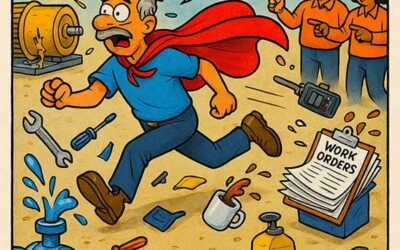


In the cartoon, a maintenance worker stands in front of an empty shelf where the thermal camera should be. The sign warns that the estimated return date is “never,” and the technician suspects HR may be using it to check coffee temperatures. It’s humorous, but the underlying message is profound: if thermal inspections depend on a wandering tool, the earliest signs of deteriorating equipment go undetected.
A structured thermal imaging maintenance schedule improves uptime by ensuring inspections occur under predictable conditions, with correct technique, and at intervals aligned with equipment risk. Many failure modes – such as abnormal electrical resistance, friction, unbalanced phases, or conductor deterioration – produce excess heat under load.
Thermal imaging identifies these patterns early. But some issues, such as early bearing defects, lubrication starvation, micro-cracks, or subtle insulation breakdown, may show minimal thermal change until later stages. This reinforces thermography’s role as a screening method best used alongside vibration, lubrication analysis, and electrical testing.
You can’t trend what you don’t inspect on schedule.
This article breaks down the engineering principles, scheduling logic, and best practices that make a thermal imaging maintenance schedule a cornerstone of downtime reduction.
Why a Thermal Imaging Maintenance Schedule Matters for Uptime
Thermal imaging is powerful because it detects temperature deviations caused by abnormal electrical resistance (P = I²R), mechanical losses, or unequal loading. However, not all deterioration produces a strong thermal signature early, which makes consistent inspections vital for catching what thermography can see.
Trending Gives the Most Actionable Insights
Trending is where thermal imaging provides the highest diagnostic value. Single images can reveal major issues—like a severely overheated busbar—but trend lines expose deterioration months before failure.
Effective trending compares:
- historical baselines
- similar components at similar loads
- past delta-T patterns
- ambient and seasonal differences
- acceptable limits for that asset type
A slight temperature rise over time is often more meaningful than a single measurement.
Example:
A 5°C increase over six months on a termination may indicate progressive loosening or oxidation, whereas a single 5°C measurement may fall within normal variance.
A structured schedule creates the conditions needed to reliably detect these changes.
Structuring a Thermal Imaging Maintenance Schedule That Works
A strong schedule reflects industry guidance, equipment criticality, load conditions, and the realities of plant operation.
Core Components of a Strong Schedule
Criticality-Based Inspection Frequency
- Critical electrical equipment: monthly to quarterly
- Critical motors and rotating systems: quarterly to semiannual
- Moderate-risk equipment: semiannual to annual
- Low-risk components: annual
Load Requirements
NFPA 70B recommends inspections at normal operating load whenever possible.
- ≥40% load is a practical minimum for good thermal contrast.
- 60–80% load often improves detection of resistive heating.
Some failure modes may still be visible even below the 40% figure.
Thermal Stability Before Imaging
Thermal equilibrium varies widely:
- Motors: typically 30–120 minutes, depending on size, load, cooling method, duty cycle, and enclosure
- Electrical components: often 15–60 minutes
Observers should confirm equilibrium by checking that temperature slopes flatten, not by relying strictly on time ranges.
Camera Specification Requirements
Recommended:
- NETD ≤ 0.05°C for excellent sensitivity
- Industrial inspections often remain effective up to 0.08–0.10°C
- ±2°C or ±2% accuracy
- Adequate spatial resolution at working distance
Temperature Severity Criteria
Commonly used guidelines for components at equal load:
- 1–3°C above similar components: monitor
- 4–15°C above: investigate
- >15°C above: immediate action
These apply only when emissivity and reflected energy are correctly accounted for.
Correct Emissivity Values
- Painted or coated surfaces: 0.90–0.95
- Oxidized metal: typically 0.85–0.95, but varies with oxide thickness and roughness
- Bare copper/aluminum: 0.05–0.15 (use reference tape when possible)
Consistency is helpful, but accuracy matters more.
Environmental Conditions
Inspectors should avoid or compensate for:
- direct sunlight
- reflective metal surfaces
- strong convective airflow
- unstable loads
- objects not at thermal equilibrium
Data Management & Naming Conventions
Good records require:
- asset ID
- emissivity settings
- load condition
- ambient temperature
- date/time
- operator name
Use standardized file naming, such as: MTR-101_2026-01-14_75PCT-LOAD
This improves trend accuracy and retrieval speed.
What a Good Schedule Actually Prevents
Thermal imaging excels at identifying temperature anomalies, though confirming the underlying cause often requires complementary technologies.
Early Detection of High-Impact Failure Modes
- Electrical Hotspots
Excessive I²R losses from loose or corroded connections create detectable temperature rises under load. - Bearing Temperature Elevation
Lubrication issues, loading problems, or progressing wear can increase bearing temperature. Thermal imaging indicates the presence of stress, but root-cause discrimination requires vibration or lubrication analysis. - Phase Imbalance & Load Issues
Uneven heating between phases often signals load imbalance, harmonic distortion, or conductor degradation. - Mechanical Misalignment Effects
Misalignment can elevate bearing temperatures or create asymmetric heating patterns. Severity depends on coupling flexibility, misalignment type, stiffness, and damping. Vibration analysis remains the primary detection method. - Cable & Conductor Issues
Thermal anomalies at terminations often indicate looseness or deterioration.
Along-cable gradients may reflect loading differences, routing geometry, or conductor imbalance – not necessarily insulation failure.
A schedule ensures these anomalies are found early enough for structured investigation.
The Hidden Reason Schedules Fail: Tool Availability & Safety
As the cartoon suggests, the availability of tools often undermines thermography programs. Safety and qualification are equally important.
A Numbered List of Practical Requirements
Access Control
The thermal camera should be controlled by maintenance, not borrowed casually.
Check-Out / Check-In Logging
Log user, job, timestamp, and return condition.
Locked Storage + Charging Dock
Ensures the camera is always ready and findable.
Qualified Personnel Only
Electrical thermography on energized equipment requires:
- NFPA 70E hazard assessment
- appropriate arc-rated PPE
- adherence to safe approach boundaries
- trained and qualified operators
Camera Redundancy (as justified by workload)
Plants with frequent inspections may require two units.
CMMS Integration
Work orders that require thermal images enforce documentation consistency and timely tool return.
When these controls are in place, the thermal imaging maintenance schedule becomes reliable, repeatable, and safe.
Closing Insights
Thermal imaging is a powerful diagnostic tool, but its value depends entirely on structured application. A disciplined thermal imaging maintenance schedule—supported by correct load conditions, proper camera setup, sound data management, and qualified personnel—enables early detection of anomalies that contribute to downtime. The schedule amplifies thermography’s strengths, complements other condition-monitoring technologies, and ensures insights are captured while they still matter.