Seeing Heat Before It Becomes a Problem
Thermal imaging for predictive maintenance enables maintenance professionals to detect what the naked eye can’t: friction, resistance, and heat buildup that signal pending equipment failure. Every motor, breaker, and bearing emits a thermal signature. When that signature changes, reliability shifts with it.
When heat patterns change, so does reliability. For instance, an electrical terminal that usually runs at 98°F but suddenly jumps to 140°F isn’t “just running warm.” It’s a near-certain indicator of:
- Resistance buildup
- Corrosion or oxidation
- Improper torque or loosened connections
Left unchecked, that rise can lead to component failure, unplanned shutdowns, or even fire. The precision and immediacy of thermal imaging for predictive maintenance let technicians act before heat translates into damage.
Heat doesn’t lie; thermal imaging turns invisible warning signs into visible proof before failure strikes.
Unlike vibration or oil analysis, thermal imaging is contactless and fast. It scans large areas instantly, ideal for inspecting energized systems without disrupting operations. Comparing images over time reveals progressive wear and degradation, an early warning system that helps plants anticipate and prevent failure with confidence.
Turning Infrared Insights into Action
Every image tells a story. A symmetrical heat pattern might confirm that a pump is operating efficiently, while a hotspot at one coupling end could expose:
- Misalignment
- Bearing drag
- Excessive load or lubrication failure
In electrical systems, a single overheating fuse terminal could indicate a poor contact or a loose lug. Skilled technicians interpret these signals within context—understanding load, emissivity, and environmental factors.
When heat, sound, and motion tell the same story, the diagnosis is no longer a guess; it’s a certainty.
Integrating Data for Better Decisions
Modern predictive programs amplify this capability by merging infrared data with:
- Vibration analysis
- Ultrasonic testing
- Motor current and performance readings
When multiple sensors agree on a temperature spike matched with elevated vibration amplitude, the diagnosis becomes conclusive.
Advanced plants now automate this process using fixed infrared cameras feeding continuous data into analytics systems. Algorithms detect anomalies, rank risks, and issue alerts in real time. What used to take hours of manual inspection can now be done continuously, with improved precision and reliability.
Building a Case for Predictive Investment
Some organizations still hesitate to invest in thermal imaging for predictive maintenance, viewing it as a luxury instead of a necessity. That thinking is short-sighted.
Consider this example:
A high-voltage switchgear terminal begins to heat up due to a loose lug. A thermal image detects the anomaly the moment resistance builds, well before insulation melts or arcing occurs. Without it, the result could be a plant-wide outage. That single image could save hundreds of thousands in repair costs.
One thermal image can expose a fault invisible to the naked eye, and prevent a failure that could cost millions.
The Financial and Operational Benefits
Thermal imaging doesn’t just prevent failures—it drives efficiency and sustainability. It helps identify:
- Steam and air leaks
- Insulation weaknesses
- Overheating components
- Energy losses in electrical systems
Over time, these incremental savings create measurable ROI. The process also builds a powerful visual audit trail—side-by-side infrared snapshots that clearly show degradation trends. Those images are robust evidence when presenting capital requests to management, turning maintenance data into a persuasive investment story.
Integrating Thermal Imaging into Maintenance Strategy
The key to success is standardization. Treating thermal imaging as an occasional project undervalues its potential; integrating it into the reliability framework turns it into a continuous improvement tool.
Implementation Checklist
- Define inspection routes – Focus on high-load and heat-intensive assets.
- Establish baselines – Capture thermal profiles of healthy equipment for comparison.
- Integrate with CMMS – Attach images, temperature data, and notes to each asset record.
- Automate alerts – Set thresholds for automatic work order creation when temperatures deviate.
- Correlate with other data – Combine thermal readings with vibration, ultrasound, and oil data.
AI and Automation in Infrared Monitoring
Next-generation systems use machine learning to analyze hundreds of images simultaneously, detecting subtle shifts that humans might overlook. Over time, the software learns what “normal” looks like for each asset, improving accuracy and reducing false positives.
This convergence of human expertise and machine intelligence means earlier warnings, faster responses, and better prioritization of maintenance activities.
From Curiosity to Competence
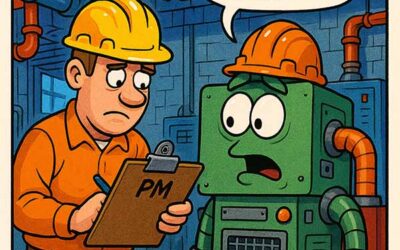
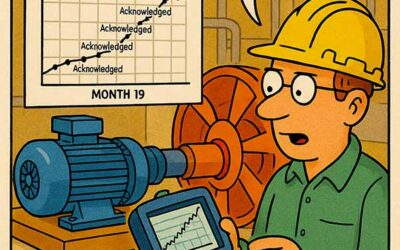
The cartoon perfectly captures the early fascination with new technology, with technicians scanning everything in sight – from motors to coffee mugs. But curiosity without structure leads to confusion.
To unlock the full potential of thermal imaging for predictive maintenance:
- Train users on emissivity, reflection, and environmental effects.
- Calibrate cameras regularly for accuracy.
- Standardize reports using consistent temperature scales and annotation formats.
- Categorize anomalies by severity and link them to corrective actions.
Proper discipline transforms infrared from novelty to necessity. Without it, teams risk chasing false alarms or ignoring real hazards. With it, they gain a tool that continuously strengthens safety, reliability, and operational excellence.
Beyond the Glow: The Future of Maintenance
Thermal imaging for predictive maintenance is evolving fast. The next generation of technology will include:
- AI-assisted image interpretation
- Augmented reality overlays
- Cloud-based analytics
- Integration with digital twins
Technicians may soon wear smart glasses that display live temperature gradients across assets, instantly highlighting problem zones. Digital twins will simulate how heat distribution affects long-term performance and help optimize maintenance intervals.
As this technology matures, thermal imaging won’t just detect problems; it will predict them. The plants that invest now will lead in uptime, energy efficiency, and asset longevity.
Key Takeaways
- Thermal imaging sees problems early, long before failure symptoms appear.
- Data integration multiplies insight – when infrared combines with vibration and ultrasound, diagnostics become undeniable.
- ROI is immediate and visual – each scan reduces downtime, waste, and energy loss.
- Standardization and training turn technology into a strategic advantage.
- AI and automation are pushing predictive maintenance toward complete digital integration.